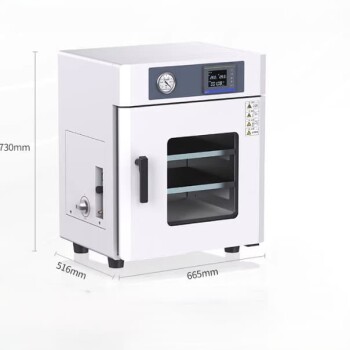
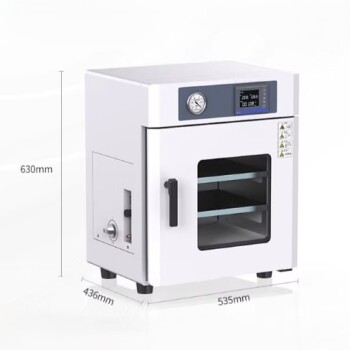
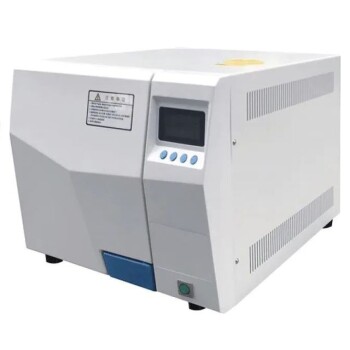
The role of a laboratory oven in this process is to execute a precise, controlled drying phase for acid-treated mesoporous carbon supports. Specifically, the material is heated at a constant temperature of 333 K (60°C) for 6 hours to ensure the complete removal of physically adsorbed water and residual solvents following filtration and washing.
Core Takeaway: This drying step is not merely about removing moisture; it is an architectural preservation strategy. By maintaining a moderate temperature of 333 K, the process clears the internal pore volume without collapsing the carbon framework, ensuring the material is chemically accessible for subsequent catalyst loading.
The Critical Function of Controlled Drying
The laboratory oven serves as the bridge between the initial modification of the carbon support and the final catalyst synthesis. Its function goes beyond simple evaporation.
Removing Physical Contaminants
After the carbon supports are treated with nitric acid, filtered, and washed, they retain significant moisture.
The oven eliminates physically adsorbed water and any remaining solvents trapped within the material.
Complete removal is essential because these fluids occupy the physical space within the mesopores.
Standardizing the Process
The protocol specifies a duration of 6 hours at a constant temperature.
This standardization ensures that every batch of support material reaches the same level of dryness.
Consistency here eliminates variables that could cause fluctuations in the performance of the final catalyst.
Preserving Material Architecture
The true value of using a laboratory oven lies in its ability to protect the delicate structure of mesoporous carbon.
Protecting Pore Structure
Mesoporous carbon is defined by its specific surface area and pore network.
Rapid, high-heat drying methods can sometimes cause thermal stress or structural collapse.
By adhering to 333 K, the oven provides a gentle thermal environment that preserves the integrity of the pore channels.
Enabling Precursor Penetration
The ultimate goal of this process is to prepare the carbon for incipient wetness impregnation.
This technique requires the platinum precursors to flow deep into the mesoporous channels.
If the drying step is ineffective, residual water will block these channels, preventing the platinum from fully penetrating and reducing the catalyst's effectiveness.
Understanding the Trade-offs
While the laboratory oven is essential, strict adherence to the parameters is required to avoid common processing failures.
The Risk of Incomplete Drying
If the drying time is cut short (less than 6 hours), moisture remains deep within the pores.
This residual moisture acts as a barrier, resulting in poor dispersion of the platinum precursor later in the process.
The Danger of Overheating
Exceeding the recommended 333 K temperature can lead to detrimental structural changes.
Overheating risks altering the surface chemistry or damaging the pore walls, which defeats the purpose of the initial acid modification.
Making the Right Choice for Your Goal
To ensure your mesoporous carbon supports are optimized for catalytic activity, you must treat the drying phase as a critical quality control step.
- If your primary focus is structural integrity: Strictly maintain the temperature at 333 K to prevent thermal shock or pore collapse, ensuring the specific surface area remains high.
- If your primary focus is catalyst performance: Ensure the full 6-hour duration is met so that the pores are completely void of solvents, maximizing the uptake of platinum precursors.
The laboratory oven transforms a wet, washed solid into a high-performance scaffold ready for chemical functionalization.
Summary Table:
| Process Parameter | Specification | Purpose |
|---|---|---|
| Temperature | 333 K (60°C) | Prevents thermal stress and pore collapse |
| Duration | 6 Hours | Ensures complete removal of adsorbed water |
| Material Focus | Mesoporous Carbon | Preserves architectural integrity for impregnation |
| Final Goal | Catalyst Loading | Enables deep penetration of platinum precursors |
Elevate Your Material Research with KINTEK Precision
Achieving the perfect mesoporous structure requires more than just heat; it requires absolute thermal stability. KINTEK specializes in high-performance laboratory equipment designed for the most demanding research applications.
Whether you are processing carbon supports in our precision drying ovens, performing advanced synthesis in our high-temperature furnaces (tube, vacuum, or CVD), or preparing samples with our crushing and milling systems, we provide the consistency your data depends on. From high-pressure reactors to specialized PTFE and ceramic consumables, KINTEK is your partner in laboratory excellence.
Ready to optimize your catalyst synthesis? Contact our technical experts today to find the perfect equipment solution for your lab.
References
- Cheng‐Di Dong, Chang‐Mao Hung. Platinum particles supported on mesoporous carbons: fabrication and electrocatalytic performance in methanol-tolerant oxygen-reduction reactions. DOI: 10.1038/srep05790
This article is also based on technical information from Kintek Solution Knowledge Base .
Related Products
- Laboratory Scientific Electric Heating Blast Drying Oven
- 56L Vertical Laboratory Vacuum Drying Oven
- 23L Laboratory Vacuum Drying Oven
- 1200℃ Muffle Furnace Oven for Laboratory
- 1700℃ Muffle Oven Furnace for Laboratory
People Also Ask
- How does a laboratory electric drying oven contribute to the formation of the initial coating? Expert Insights
- What role does a precision laboratory drying oven play in the synthesis of GO-PANI nanocomposites? Protect Material Integrity
- What role does a laboratory drying oven play in the preparation of zinc oxide nanoparticle precursors?
- What is the necessity of using a laboratory drying oven when processing MoO3/GO composite nanopowders? Find out here.
- What is the role of a laboratory drying oven in cellulose citrate production? Ensure Material Stability & Purity