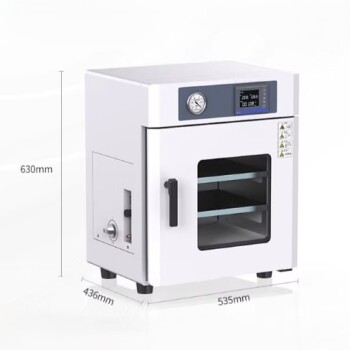
The primary role of these ovens is to provide a strictly controlled thermal environment for the gradual phase transition of your material. In the specific context of preparing PMMA/PEG nanocomposites via solvent casting, the oven is responsible for the uniform and slow evaporation of solvents from the polymer solution. This precise regulation is the defining factor in preventing surface defects, ensuring the final film achieves the structural density required for high-performance applications.
Core Takeaway Success in solvent casting is defined not just by how well you mix the solution, but by how carefully you remove the solvent. A precision oven transforms a liquid polymer mixture into a solid, high-performance film by enforcing a slow, controlled evaporation rate, which is the only way to guarantee the optical transparency and mechanical integrity necessary for biomedical use.
The Mechanics of Solvent Removal
Regulating Volatile Release
The fundamental function of the drying oven is to manage the rate at which volatile components leave the polymer matrix.
If solvents evaporate too quickly, they disrupt the alignment of the PMMA and PEG chains. By maintaining a constant, precise temperature, the oven ensures that solvent molecules exit the material at a steady, manageable pace.
Achieving Uniformity
In solvent casting, uneven drying leads to warping. A precision oven ensures that the thermal energy is distributed evenly across the entire sample.
This prevents thermal gradients, ensuring that the solvent evaporates from the center of the film at the same rate as the edges. This uniformity is essential for producing films with consistent thickness throughout.
Impact on Microstructure and Film Quality
Preventing Surface Defects
The most critical role of the oven is to prevent the formation of physical defects.
Rapid evaporation often causes "skinning," where the surface dries before the interior, trapping solvent bubbles inside. This leads to surface pores and cracks. A controlled vacuum or constant temperature environment prevents this, allowing the material to dry without rupturing.
Densification of the Composite
For a nanocomposite to function correctly, the polymer network must form a dense, cohesive structure.
Slow drying allows the PMMA and PEG chains to settle and interlock properly as the solvent recedes. This results in a dense structure rather than a porous, sponge-like material, which is vital for the material's durability.
Critical Performance Outcomes
Optical Transparency
PMMA/PEG nanocomposites are frequently used in biomedical applications where visibility is key.
Surface pores and internal cracks scatter light, rendering a film opaque or cloudy. By eliminating these defects through controlled drying, the oven directly preserves the optical transparency of the composite.
Mechanical Properties
The mechanical strength of a composite is defined by its weakest point.
Pores and cracks act as stress concentrators, causing the material to fail under lower loads. By ensuring a uniform and dense structure, the drying process maximizes the mechanical resilience of the final film.
Common Pitfalls to Avoid
The Risk of Rushing
It is tempting to increase the temperature to speed up the manufacturing process.
However, structurally, this leads to structural collapse or severe agglomeration. Much like in sol-gel processes, rapid removal of the liquid medium prevents the network from stabilizing, resulting in a brittle, inferior product.
Vacuum vs. Standard Drying
While a standard oven relies on heat, a vacuum drying oven lowers the boiling point of the solvent.
This allows for evaporation at lower temperatures, which is particularly beneficial if you are concerned about thermal degradation of the polymer or oxidation of sensitive additives. It provides a gentler drying environment while still ensuring complete solvent removal.
Making the Right Choice for Your Goal
To maximize the quality of your PMMA/PEG nanocomposites, tailor your drying strategy to your specific performance metrics:
- If your primary focus is Optical Clarity: Prioritize a slower, lower-temperature drying cycle (potentially under vacuum) to completely eliminate pore formation and light-scattering defects.
- If your primary focus is Mechanical Uniformity: Ensure the drying time is sufficient to remove all residual solvent, as trapped solvent can plasticize the polymer and weaken the material structure.
Ultimately, the drying oven is not just a heating element; it is a stabilization tool that dictates whether your mixture becomes a usable composite or a flawed sample.
Summary Table:
| Feature | Precision Drying Oven Role | Benefit for PMMA/PEG Nanocomposites |
|---|---|---|
| Evaporation Rate | Regulated volatile release | Prevents 'skinning', surface pores, and micro-cracks |
| Thermal Control | Uniform heat distribution | Eliminates warping and ensures consistent film thickness |
| Microstructure | Controlled densification | Facilitates chain interlocking for high mechanical strength |
| Environment | Vacuum or constant temperature | Lowers boiling point to prevent thermal degradation/oxidation |
| Final Quality | Defect elimination | Guarantees optical transparency for biomedical applications |
Elevate Your Material Research with KINTEK Precision Solutions
Don't let improper drying compromise your nanocomposite research. KINTEK specializes in high-performance laboratory equipment designed for the most demanding material science applications. Whether you require precision constant temperature drying ovens for uniform film casting or vacuum drying ovens to protect heat-sensitive additives, our technology ensures your PMMA/PEG composites achieve maximum optical clarity and mechanical density.
Our extensive portfolio also includes:
- High-temperature furnaces (Muffle, Vacuum, CVD) for advanced material synthesis.
- Hydraulic presses (Pellet, Isostatic) and crushing systems for sample preparation.
- High-pressure reactors and specialized PTFE/Ceramic consumables.
Ready to achieve repeatable, defect-free results? Contact KINTEK today to consult with our experts on the perfect drying solution for your lab!
References
- Ghaith Ahmed, Ahmed Hashim. Development of nanometal nitride doped PMMA blend for biomedicine and industrial fields: Recent review. DOI: 10.30574/wjarr.2023.17.3.0405
This article is also based on technical information from Kintek Solution Knowledge Base .
Related Products
- 56L Vertical Laboratory Vacuum Drying Oven
- 23L Laboratory Vacuum Drying Oven
- Laboratory Scientific Electric Heating Blast Drying Oven
- Benchtop Laboratory Vacuum Freeze Dryer
- Vacuum Heat Treat Sintering Brazing Furnace
People Also Ask
- Why is a laboratory vacuum drying oven recommended for rice straw residues? Protect Your Biomass Integrity
- What role does a laboratory vacuum drying oven play in the preparation of modified multi-walled carbon nanotubes?
- What is the importance of using a laboratory vacuum drying oven? Preserving Slow-Release Microcapsule Integrity
- Why is a Laboratory Vacuum Drying Oven recommended for PBAT microspheres? Protect Sensitive Polymer Integrity
- What role does a laboratory vacuum drying oven play in processing nanoparticle powder samples? Protect Sample Integrity