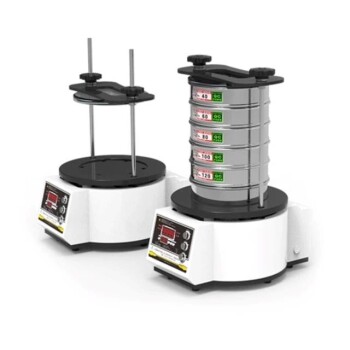
The standard vibrating sieve is the primary tool for achieving particle size uniformity during the pretreatment of crushed rice husks. It ensures that raw materials are categorized into a specific, consistent range—typically between 1.40 mm and 2.36 mm—to prevent uneven carbonization during high-temperature furnace reactions. This mechanical classification is the foundation for producing high-quality Si-C composites with repeatable structural and chemical properties.
Core Takeaway: By standardizing particle dimensions, the vibrating sieve eliminates physical variables that lead to uneven heat distribution and poor chemical penetration. This ensures that the subsequent carbonization and impregnation processes occur uniformly across all material samples.
Achieving Structural Uniformity
Eliminating Variable Particle Dimensions
The primary role of the sieve is to screen crushed rice husk to ensure high consistency in particle size. Without this step, a mixture of fine dust and large chunks would react at different rates, leading to a compromised final composite.
Mechanical Classification via Precision Mesh
Standard vibrating sieves use precise mesh screens to physically separate materials into specific ranges. This process removes oversized impurities and undersized "fines" that could otherwise clog equipment or cause unpredictable reaction kinetics.
Optimizing the Reaction Environment
Ensuring Uniform Heat Conduction
In a high-temperature tube furnace, variations in particle size create differences in heat conduction. Uniform particles ensure that the thermal energy reaches the core of every grain at the same rate, effectively preventing the "core-shell" effect where the outside is charred while the inside remains raw.
Improving Chemical Impregnation
For Si-C composites, rice husks often undergo alkaline solution impregnation. A uniform particle size ensures that the solution penetrates the fibers at a consistent depth, leading to a more homogenous distribution of silicon and carbon precursors throughout the material.
Reducing Diffusion Limitations
Standardizing the material to a smaller, uniform size provides a larger effective contact area and shorter internal diffusion paths. This eliminates experimental errors in kinetic data, as the chemical reactions are no longer bottlenecked by the time it takes for reagents to travel through varying thicknesses of raw material.
Understanding the Trade-offs and Pitfalls
The Risk of Mesh Clogging
Vibrating sieves can suffer from "blinding," where particles become wedged in the mesh openings. If the sieve is not properly maintained or if the material is too moist, the accuracy of the particle size distribution will degrade, leading to inconsistent batches.
Loss of Raw Material Yield
Rigidly adhering to a very narrow particle size range (e.g., exactly 1.5 mm) can lead to significant material waste. Engineers must balance the need for extreme uniformity with the economic reality of raw material yields to ensure the process remains cost-effective.
How to Apply This to Your Process
Implementation Based on Project Goals
- If your primary focus is high-precision kinetic research: Utilize a narrow mesh range (e.g., 40–60 mesh) to minimize diffusion variables and ensure that your data is repeatable across multiple experiments.
- If your primary focus is industrial-scale production: Aim for a broader but still controlled range, such as 1.40 mm to 2.36 mm, to maximize material throughput while still preventing major carbonization failures.
- If your primary focus is maximizing composite strength: Use multiple sieve layers to create a specific gradation of particles, which can increase the final compaction density of the Si-C material.
Uniformity at the pretreatment stage is the single most important factor in ensuring the stability and quality of the final Si-C composite product.
Summary Table:
| Feature | Role in Pretreatment | Impact on Final Si-C Composite |
|---|---|---|
| Particle Size Control | Eliminates dust and oversized chunks (1.40–2.36 mm). | Prevents uneven carbonization and "core-shell" effects. |
| Mechanical Classification | Precision mesh removes physical impurities and fines. | Ensures repeatable structural and chemical properties. |
| Thermal Optimization | Provides uniform grain size for heat conduction. | Guarantees consistent thermal energy reaches each grain core. |
| Chemical Penetration | Increases effective contact area for alkaline solutions. | Leads to homogenous distribution of silicon/carbon precursors. |
| Kinetic Stability | Shortens and standardizes internal diffusion paths. | Minimizes experimental error and reaction bottlenecks. |
Optimize Your Material Pretreatment with KINTEK
Achieving precision in Si-C composite synthesis starts with the right equipment. KINTEK specializes in high-performance laboratory solutions, providing the sieving equipment and vibrating sieves necessary for perfect particle uniformity. Whether you are conducting high-precision kinetic research or scaling up production, our tools eliminate variables to ensure repeatable, high-quality outcomes.
Our comprehensive range also includes:
- High-temperature furnaces (tube, muffle, vacuum, and CVD) for uniform carbonization.
- Crushing and milling systems for efficient raw material reduction.
- High-pressure reactors and autoclaves for advanced material synthesis.
Ready to enhance your lab's efficiency and material stability? Contact KINTEK today to consult with our experts on the best equipment for your specific research goals!
References
- Changwei Li, Honglei Chen. Effectively Controlled Structures of Si-C Composites from Rice Husk for Oxygen Evolution Catalyst. DOI: 10.3390/molecules28166117
This article is also based on technical information from Kintek Solution Knowledge Base .
Related Products
- Vibratory Sieve Shaker Machine Dry Three-Dimensional Vibrating Sieve
- Laboratory Vibratory Sieve Shaker Machine Slap Vibrating Sieve
- Laboratory Wet Three-Dimensional Vibratory Sieve Shaker Machine
- Laboratory Test Sieves and Vibratory Sieve Shaker Machine
- Laboratory Vibratory Sieve Shaker Machine for Dry and Wet Three-Dimensional Sieving
People Also Ask
- How is a vibratory sieve shaker used in the particle size analysis of mechanically alloyed powders? Expert Guide
- Why use a vibratory sieve shaker for PET powder? Achieve Precise Particle Size Control for Chemical Research
- What is the principle of vibratory sieve shaker? Achieve Accurate Particle Size Analysis
- What is the function of a vibratory sieve shaker? Achieve Precise Particle Size Analysis
- What is the use of vibratory sieve shaker? Achieve Precise Particle Size Analysis for Your Lab