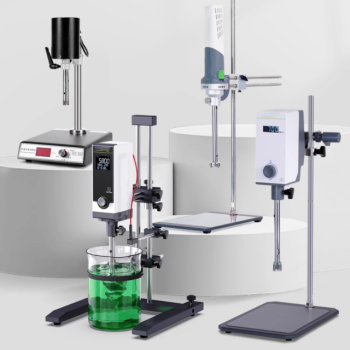
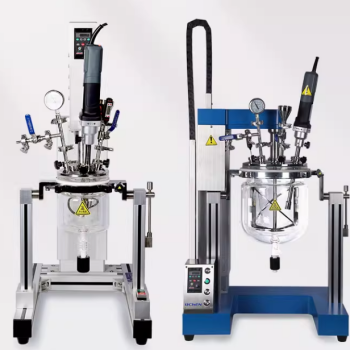
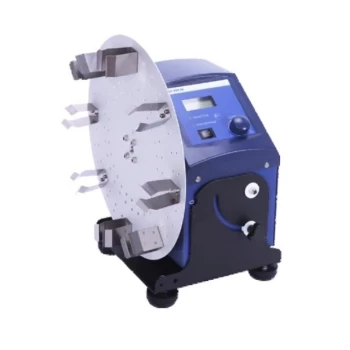
An ultrasonic homogenizer acts as the critical mechanical force needed to prepare stable catalyst inks for electrode modification. Its primary role is to generate acoustic cavitation, which physically breaks the strong Van der Waals forces that cause nanomaterials—such as carbon nanotubes, graphene, or metal nanoparticles—to clump together in a solvent.
Nanomaterials naturally aggregate, hiding their active surfaces and creating uneven coatings. Ultrasonic homogenization disrupts these aggregates at a microscopic level, ensuring the sensing material is fully dispersed and capable of forming a high-quality, reproducible interface.
The Mechanics of De-Agglomeration
Overcoming Van der Waals Forces
Nanomaterials possess high surface energy, leading them to attract one another strongly via Van der Waals forces.
Standard mixing methods, such as magnetic stirring, are often insufficient to overcome these atomic-level attractions.
The ultrasonic homogenizer provides the necessary energy input to disrupt these forces and separate the particles.
The Power of Cavitation
The device functions by inducing cavitation within the solvent.
This involves the rapid formation and violent collapse of microscopic bubbles.
The shockwaves generated by these collapsing bubbles physically force the nanomaterial clusters apart, creating a homogenous suspension.
Impact on Sensor Architecture
Achieving Uniform Film Thickness
To fabricate a reliable sensor, the catalyst ink must be applied to the working electrode as a smooth, even layer.
A homogenized solution ensures that the resulting sensing film has a consistent thickness across the entire electrode surface.
This prevents structural irregularities that could skew the sensor's baseline readings.
Maximizing Active Sites
The sensitivity of a formaldehyde sensor depends on how much of the catalyst interacts with the analyte.
Agglomerated particles hide their internal surface area, effectively "wasting" the sensing material.
By fully dispersing the material, you ensure that the active sites are fully exposed, maximizing the electrochemical response.
The Risks of Inadequate Dispersion
Understanding the Reproducibility Trap
The most significant trade-off in sensor fabrication is often between speed and reproducibility.
Skipping or rushing the homogenization stage leads to batch-to-batch inconsistency.
If the material is not uniformly dispersed, two sensors made from the same ink may yield vastly different results, destroying the reliability of your fabrication process.
Making the Right Choice for Your Goal
To optimize your electrochemical formaldehyde sensor, apply the dispersion process with the following objectives in mind:
- If your primary focus is Reproducibility: Ensure the dispersion cycle is sufficient to create a stable suspension, as this guarantees consistent film thickness across every sensor batch.
- If your primary focus is Sensitivity: Prioritize complete de-agglomeration to maximize the exposed surface area of your active sites, allowing for higher signal response.
The quality of your dispersion step is the invisible foundation that dictates the final accuracy of your sensor.
Summary Table:
| Feature | Role in Sensor Fabrication | Impact on Performance |
|---|---|---|
| Acoustic Cavitation | Breaks Van der Waals forces in nanomaterials | Ensures complete de-agglomeration |
| Uniform Dispersion | Creates stable, homogenous catalyst inks | Guarantees consistent film thickness |
| Surface Area Maximization | Exposes internal active sites of particles | Enhances electrochemical sensitivity |
| Process Control | Eliminates batch-to-batch inconsistency | Improves sensor reproducibility |
Elevate Your Sensor Precision with KINTEK Solutions
Don't let material clumping compromise your research results. KINTEK specializes in advanced laboratory equipment designed to meet the rigorous demands of electrochemical sensor fabrication. Whether you are developing high-performance formaldehyde sensors or experimenting with novel nanomaterials, our high-power ultrasonic homogenizers and shakers provide the mechanical force necessary for perfect dispersion.
From battery research tools to high-temperature reactors and centrifuges, KINTEK provides the comprehensive toolkit needed to ensure reproducibility and maximum sensitivity in your lab.
Ready to achieve superior material homogeneity? Contact our experts today to find the perfect dispersion solution for your lab!
References
- Yufei Yang, Wansong Chen. Recent Advances in Electrochemical Sensors for Formaldehyde. DOI: 10.3390/molecules29020327
This article is also based on technical information from Kintek Solution Knowledge Base .
Related Products
- High Shear Homogenizer for Pharmaceutical and Cosmetic Applications
- High Performance Lab Homogenizer for Pharma Cosmetics and Food R&D
- Lab Sterile Slapping Type Homogenizer for Tissue Mashing and Dispersing
- Laboratory High Throughput Tissue Grinding Mill Grinder
- Laboratory Disc Rotary Mixer for Efficient Sample Mixing and Homogenization
People Also Ask
- Why Use a High Shear Homogenizer for Cathode Slurries? Optimize Double-Layer Solid-State Battery Production
- What is the function of high-shear dispersion equipment in corona-resistant nanocomposites? Elevate Your Insulation
- What is the necessity of using an industrial-grade high-shear homogenizer for biomass washing? Ensure Process Efficiency
- What are the advantages of using a high-shear homogenizer for BED/GMA coatings? Achieve Superior Nano-Dispersion
- What role does a high-shear homogenizer play in ODC catalyst suspensions? Unlock Superior Electrochemical Efficiency