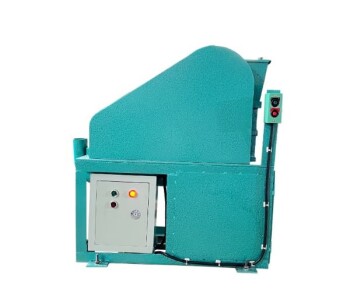
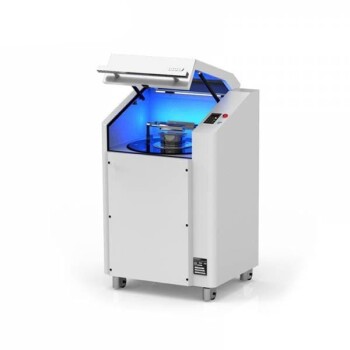
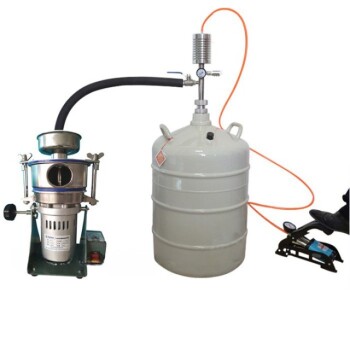
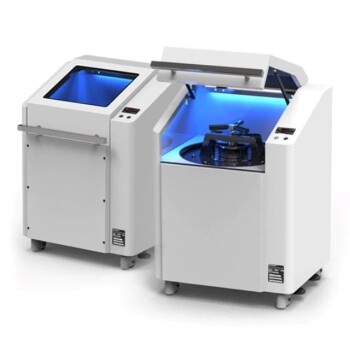
Laboratory crushing and milling equipment provides the essential physical foundation for the synthesis of lignin-based sulfur-doped nanoporous carbon. By mechanically refining hard lignin precursors and blending them with sulfurizing and activating agents, these tools ensure microscopic uniformity and maximize the contact area required for effective chemical transformation.
Core Takeaway: Milling acts as a critical "mechanical activation" step that ensures sulfurizing and pore-forming agents are intimately integrated with the lignin matrix, enabling simultaneous pore development and uniform in-situ sulfur doping during high-temperature carbonization.
Facilitating Microscopic Homogeneity
Integration of Precursors and Additives
Lignin is a naturally hard and complex polymer that requires significant mechanical force to break down. Milling equipment refines this precursor alongside sulfurizing agents (such as sodium thiosulfate) and activating agents (such as potassium hydroxide).
Enabling Uniform In-Situ Doping
For sulfur atoms to bond effectively within the carbon framework, the sulfur source must be in direct contact with the lignin at a molecular or microscopic level. The intensive mixing provided by laboratory mills ensures that sulfur doping is consistent throughout the material rather than localized.
Establishing the Reaction Foundation
This mechanical processing creates a physical prerequisite for subsequent stages. Without this high degree of contact, the chemical reactions occurring during carbonization would be inefficient, leading to a poorly developed pore structure.
Optimizing Physical and Thermal Kinetics
Increasing Geometric Specific Surface Area
Reducing the particle size of the raw biomass significantly increases the available surface area for chemical interaction. This allows activating agents like KOH to penetrate deeper into the carbon matrix, leading to higher porosity in the final product.
Improving Heat Transfer Uniformity
Fine, uniform powders facilitate more consistent heat transfer when processed in a tube furnace. Eliminating large chunks prevents internal temperature gradients, ensuring that the entire sample undergoes carbonization and activation at the same rate.
Enhancing Ion Accessibility and Diffusion
In applications like supercapacitors, ultrafine milling shortens ion diffusion paths by creating smaller particles. This physical modification enhances the penetration depth of activators and improves the electrochemical performance of the resulting carbon.
Understanding the Trade-offs
Potential for Material Contamination
High-energy milling can introduce impurities from the milling media, such as zirconia or stainless steel wear particles. For high-purity laboratory applications, selecting the appropriate jar and ball material is critical to avoid compromising the chemical analysis.
Energy Density vs. Material Damage
While finer particles generally improve reactivity, over-milling can lead to excessive heat generation or the unwanted mechanical deformation of the lignin structure. Finding the balance between particle size reduction and energy consumption is a key process optimization challenge.
Particle Agglomeration Risks
Extremely fine powders may undergo agglomeration due to van der Waals forces, which can paradoxically decrease the effective surface area. Proper storage and handling of the milled powder are necessary to maintain the benefits of the grinding process.
How to Apply This to Your Research
Making the Right Choice for Your Goal
- If your primary focus is maximizing porosity: Use high-energy milling to achieve the finest possible powder, ensuring that KOH activators have the maximum possible interface with the lignin.
- If your primary focus is uniform sulfur doping: Prioritize the duration and intensity of the mixing phase to ensure the sodium thiosulfate is distributed evenly at the microscopic scale.
- If your primary focus is electrochemical performance: Focus on achieving a standardized particle size (e.g., using a 100-mesh sieve) to ensure consistent ion diffusion and slurry rheology for electrode coating.
By mastering the mechanical refinement of precursors, researchers can precisely control the chemical environment necessary to produce high-performance nanoporous carbons.
Summary Table:
| Key Role | Impact on Material | Research Benefit |
|---|---|---|
| Microscopic Mixing | Uniform integration of sulfur/activators | Consistent in-situ doping & pore structure |
| Size Reduction | Increased geometric surface area | Enhanced chemical reactivity & KOH penetration |
| Thermal Optimization | Improved heat transfer uniformity | Homogeneous carbonization in tube furnaces |
| Kinetics Improvement | Shortened ion diffusion paths | Superior electrochemical performance in capacitors |
Elevate Your Material Synthesis with KINTEK
At KINTEK, we provide the precision tools necessary to transform raw lignin into high-performance nanoporous carbon. From high-energy crushing and milling systems that ensure microscopic homogeneity to sieving equipment for standardized particle sizes, our solutions provide the essential physical foundation for your research.
Once your precursors are refined, achieve perfect carbonization with our comprehensive range of high-temperature furnaces (tube, vacuum, and atmosphere). Our portfolio also supports your entire workflow with hydraulic presses, electrolytic cells, and battery research tools for advanced electrochemical testing.
Ready to optimize your lab's efficiency and material quality? Contact our experts today to find the perfect equipment for your specific application!
References
- Dipendu Saha, Dean Bates. One-Step Synthesis of Sulfur-Doped Nanoporous Carbons from Lignin with Ultra-High Surface Area, Sulfur Content and CO2 Adsorption Capacity. DOI: 10.3390/ma16010455
This article is also based on technical information from Kintek Solution Knowledge Base .
Related Products
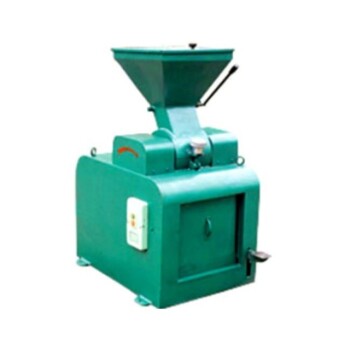
- Laboratory Sealed Hammer Crusher for Efficient Sample Preparation
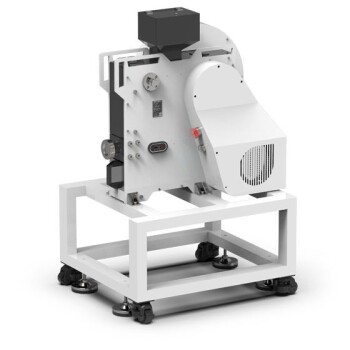
- Mini Planetary Ball Mill Machine for Laboratory Milling
- Laboratory Jar Mill with Agate Grinding Jar and Balls
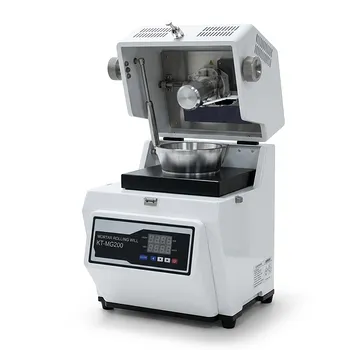
- Laboratory Grinding Mill Mortar Grinder for Sample Preparation
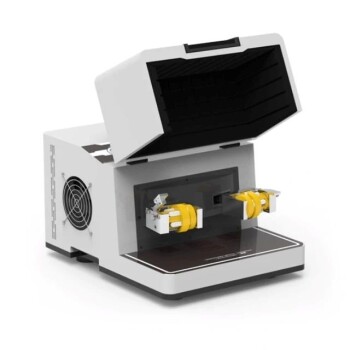
- Vibrating Disc Mill Small Laboratory Grinding Machine
People Also Ask
- What role do laboratory crushers and standard sieves play in Datura stramonium pretreatment? Optimize Your HTL Yield
- What is the primary function of a laboratory crusher? Optimize Biomass & Coal Co-Gasification Efficiency
- What lab equipment would be use to crush or grind a substance? A Guide to Choosing the Right Tool
- What is the purpose of sample preparation? Ensure Accurate & Reliable Analytical Results
- What kind of material is a hammer mill used for? Process Brittle, Dry, and Crystalline Materials Efficiently