Knowledge laboratory mill What is the role of the grinding step in the solid-state synthesis of Bismuth Vanadate (BiVO4)? Optimize Phase Purity
Author avatar

Tech Team · Kintek Solution

Updated 1 week ago

What is the role of the grinding step in the solid-state synthesis of Bismuth Vanadate (BiVO4)? Optimize Phase Purity


The grinding step in the solid-state synthesis of Bismuth Vanadate ($BiVO_4$) is the critical mechanism for ensuring molecular-level mixing and maximizing the physical contact area between precursors. By drastically reducing particle size and diffusion distances, grinding facilitates a complete chemical reaction during subsequent heat treatment, which is essential for achieving a high-purity crystalline phase.

Grinding serves as the "activation" phase of solid-state synthesis, transforming bulk precursors into a high-surface-area mixture that overcomes the inherent kinetic limitations of solid-phase atomic diffusion.

Maximizing Reaction Kinetics through Physical Interaction

Achieving Molecular-Level Homogeneity

Manual or mechanical grinding forces the precursor materials—such as bismuth nitrate pentahydrate and ammonium metavanadate—into an intimate blend.

This uniformity ensures that the chemical reaction occurs evenly throughout the entire bulk of the material, preventing localized imbalances in stoichiometry.

Reducing Diffusion Distances

Solid-state reactions rely on atoms migrating through crystalline lattices, a process that is naturally slow and energy-intensive.

Grinding minimizes the diffusion distance these atoms must travel, which significantly increases the efficiency and speed of the reaction during the calcination process.

Optimizing Material Properties for Synthesis

Increasing Surface Area and Reactivity

The mechanical action of milling reduces the particle size of raw materials like Bismuth Oxide ($Bi_2O_3$) and Vanadium Pentoxide ($V_2O_5$).

Smaller particles provide a much larger active surface area, which increases the overall reaction activity of the powder mixture.

Ensuring Phase Purity

Without sufficient grinding, incomplete reactions are common, often leaving behind unreacted precursors or creating unwanted secondary phases.

Thorough grinding is a technical prerequisite for obtaining the specific monoclinic scheelite structure required for high-performance Bismuth Vanadate applications.

Understanding the Trade-offs and Limitations

The Risk of Media Contamination

Extended mechanical milling can introduce impurities from the grinding media (such as alumina or zirconia balls) into the precursor mixture.

These microscopic contaminants can act as dopants, unintentionally altering the electronic properties or catalytic performance of the final $BiVO_4$ product.

Energy Balance and Amorphization

Excessive grinding energy can lead to the formation of amorphous phases or structural defects within the raw materials rather than simple size reduction.

While increased reactivity is generally beneficial, significant structural damage may require higher calcination temperatures to "heal" the crystal lattice.

How to Apply This to Your Synthesis Project

When designing your synthesis protocol, the grinding method should align with your specific material requirements:

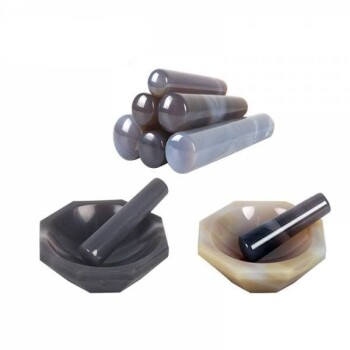
  • If your primary focus is high phase purity: Prioritize manual grinding in an agate mortar or controlled low-speed milling to ensure homogeneity without introducing media contaminants.
  • If your primary focus is rapid production or small particle size: Utilize high-energy planetary ball milling to maximize surface area and reaction activity, though you must monitor for media wear.
  • If your primary focus is stoichiometric precision: Ensure that all precursors are ground together in a dry environment to prevent clumping and maintain the exact molar ratios required for the reaction.

Precise control over the grinding stage is the most effective way to ensure the structural integrity and performance of Bismuth Vanadate.

Summary Table:

Grinding Function Mechanism Impact on BiVO4 Synthesis
Homogenization Molecular-level mixing of precursors Prevents stoichiometric imbalances and secondary phases
Size Reduction Increasing active surface area Enhances reaction kinetics and material reactivity
Diffusion Control Minimizing atomic travel distance Enables complete chemical reaction during calcination
Phase Control Mechanical activation of precursors Essential for forming the monoclinic scheelite structure

Elevate Your Material Synthesis with KINTEK Precision

Achieving high-purity Bismuth Vanadate (BiVO4) requires both meticulous precursor preparation and precise thermal processing. KINTEK specializes in the high-performance laboratory equipment essential for every stage of your solid-state synthesis workflow.

Whether you need advanced crushing and milling systems to ensure molecular homogeneity without contamination, or high-stability muffle and tube furnaces for the critical calcination phase, we provide the tools to guarantee consistent crystalline results. Our portfolio also includes premium agate mortars, crucibles, and ceramics to maintain the highest purity standards for your research.

Ready to optimize your synthesis results? Contact KINTEK today to find the perfect equipment for your laboratory.

References

  1. Ana C. Estrada, Tito Trindade. BiVO4-Based Magnetic Heterostructures as Photocatalysts for Degradation of Antibiotics in Water. DOI: 10.3390/iocn2023-14532

This article is also based on technical information from Kintek Solution Knowledge Base .

Related Products

People Also Ask

Related Products

Three-dimensional electromagnetic sieving instrument

Three-dimensional electromagnetic sieving instrument

KT-VT150 is a desktop sample processing instrument for both sieving and grinding. Grinding and sieving can be used both dry and wet. The vibration amplitude is 5mm and the vibration frequency is 3000-3600 times/min.

Vibrating Disc Mill Small Laboratory Grinding Machine

Vibrating Disc Mill Small Laboratory Grinding Machine

Discover the versatile Vibrating Disc Mill for efficient laboratory grinding. Ideal for geology, metallurgy, biology, and more. Explore now!

Laboratory Grinding Mill Mortar Grinder for Sample Preparation

Laboratory Grinding Mill Mortar Grinder for Sample Preparation

KT-MG200 mortar grinder can be used for mixing and homogenizing powder, suspension, paste and even viscous samples. It can help users realize the ideal operation of sample preparation with more regularization and higher repeatability.

Laboratory Hybrid Tissue Grinding Mill

Laboratory Hybrid Tissue Grinding Mill

KT-MT20 is a versatile laboratory device used for rapid grinding or mixing of small samples, whether dry, wet, or frozen. It comes with two 50ml ball mill jars and various cell wall breaking adapters for biological applications such as DNA/RNA and protein extraction.

Laboratory High Throughput Tissue Grinding Mill Grinder

Laboratory High Throughput Tissue Grinding Mill Grinder

KT-MT is a high-quality, small, and versatile tissue grinder used for crushing, grinding, mixing, and cell wall breaking in various fields, including food, medical, and environmental protection. It is equipped with 24 or 48 2ml adapters and ball grinding tanks and is widely employed for DNA, RNA, and protein extraction.

Liquid Nitrogen Cryogenic Grinder Mill Cryomill with Screw Feeder

Liquid Nitrogen Cryogenic Grinder Mill Cryomill with Screw Feeder

Discover the Liquid Nitrogen Cryogenic Pulverizer with Screw Feeder, perfect for fine material processing. Ideal for plastics, rubber, and more. Boost your lab efficiency now!

Laboratory Disc Cup Vibratory Mill for Sample Grinding

Laboratory Disc Cup Vibratory Mill for Sample Grinding

The vibrating disc mill is suitable for non-destructive crushing and fine grinding of samples with large particle sizes, and can quickly prepare samples with analytical fineness and purity.

Laboratory Ball Mill Jar Mill with Metal Alloy Grinding Jar and Balls

Laboratory Ball Mill Jar Mill with Metal Alloy Grinding Jar and Balls

Grind and mill with ease using metal alloy grinding jars with balls. Choose from 304/316L stainless steel or tungsten carbide and optional liner materials. Compatible with various mills and features optional functions.

Laboratory Jar Mill with Agate Grinding Jar and Balls

Laboratory Jar Mill with Agate Grinding Jar and Balls

Grind your materials with ease using Agate Grinding Jars with Balls. Sizes from 50ml to 3000ml, perfect for planetary and vibration mills.

High Energy Planetary Ball Mill Milling Machine for Laboratory

High Energy Planetary Ball Mill Milling Machine for Laboratory

The biggest feature is that the high energy planetary ball mill can not only perform fast and effective grinding, but also has good crushing ability

Powerful Plastic Crusher Machine

Powerful Plastic Crusher Machine

KINTEK's powerful plastic crusher machines process 60-1350 KG/H of diverse plastics, ideal for labs and recycling. Durable, efficient, and customizable.

High Energy Vibratory Laboratory Ball Mill Grinding Mill Single Tank Type

High Energy Vibratory Laboratory Ball Mill Grinding Mill Single Tank Type

High-energy vibration ball mill is a small desktop laboratory grinding instrument.It can be ball-milled or mixed with different particle sizes and materials by dry and wet methods.

Lab Vibration Mill

Lab Vibration Mill

Vibration Mill for Efficient Sample Preparation, Suitable for Crushing and Grinding a Variety of Materials with Analytical Precision. Supports Dry / Wet / Cryogenic Grinding and Vacuum/Inert Gas Protection.

Nature Agate Mortar and Pestle for Grinding and Mixing

Nature Agate Mortar and Pestle for Grinding and Mixing

Get high-quality grinding results with Nature Agate Mortar and Pestle. Available in various sizes with shining polished grinding surfaces.

High Energy Planetary Ball Mill Milling Machine for Laboratory

High Energy Planetary Ball Mill Milling Machine for Laboratory

Experience fast and effective sample processing with the F-P2000 high-energy planetary ball mill. This versatile equipment offers precise control and excellent grinding capabilities. Perfect for laboratories, it features multiple grinding bowls for simultaneous testing and high output. Achieve optimal results with its ergonomic design, compact structure, and advanced features. Ideal for a wide range of materials, it ensures consistent particle size reduction and low maintenance.

High-Energy Omnidirectional Planetary Ball Mill Milling Machine for Laboratory

High-Energy Omnidirectional Planetary Ball Mill Milling Machine for Laboratory

The KT-P4000E is a new product derived from the vertical high-energy planetary ball mill with a 360° swivel function. Experience faster, uniform, and smaller sample output results with 4 ≤1000ml ball mill jars.

Mini Planetary Ball Mill Machine for Laboratory Milling

Mini Planetary Ball Mill Machine for Laboratory Milling

Discover the KT-P400 desktop planetary ball mill, ideal for grinding and mixing small samples in the lab. Enjoy stable performance, long service life, and practicality. Functions include timing and overload protection.

Low-Temperature Water-Cooled Touchscreen Vibratory Ultrafine Pulverizer

Low-Temperature Water-Cooled Touchscreen Vibratory Ultrafine Pulverizer

Low-temperature water-cooled vibratory pulverizer for ultrafine grinding. Preserves material integrity. Ideal for labs and production. Learn more.

Laboratory Planetary Ball Mill Rotating Ball Milling Machine

Laboratory Planetary Ball Mill Rotating Ball Milling Machine

KT-P400E is a desktop multi-directional planetary ball mill with unique grinding and mixing capabilities. It offers continuous and intermittent operation, timing, and overload protection, making it ideal for various applications.

Laboratory Horizontal Planetary Ball Mill Milling Machine

Laboratory Horizontal Planetary Ball Mill Milling Machine

Improve sample uniformity with our Horizontal Planetary Ball Mills. KT-P400H reduces sample deposition and KT-P400E has multi-directional capabilities. Safe, convenient and efficient with overload protection.


Leave Your Message