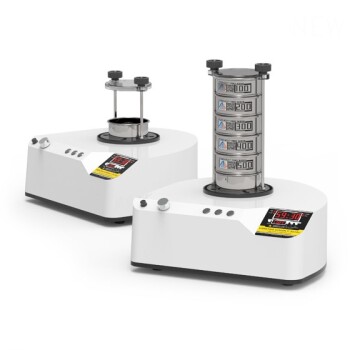
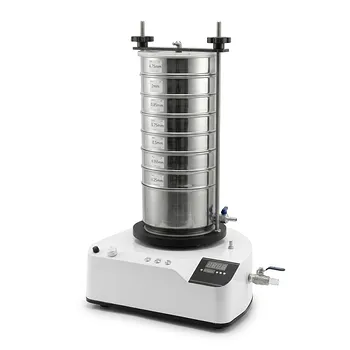
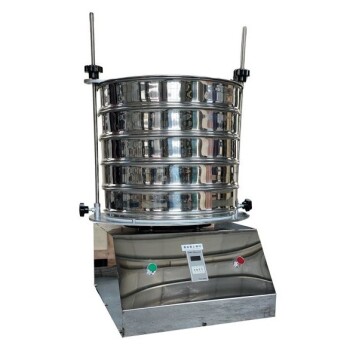
Precision sieving is the foundation of experimental integrity in coal char research.
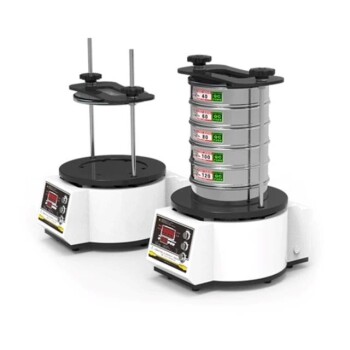
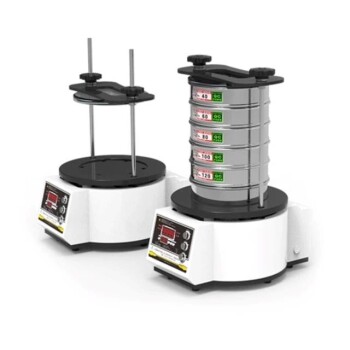
High-precision sieving equipment is used to isolate narrow, specific particle size ranges—such as 36–72 µm or 80–120 µm—to ensure absolute sample uniformity. By eliminating particle size as a variable, researchers can accurately measure heating rates, devolatilization kinetics, and combustion behavior without interference from inconsistent heat and mass transfer.
The primary significance of high-precision sieving lies in its ability to eliminate particle-size-induced variability, ensuring that observed reaction data reflects true material kinetics rather than physical inconsistencies. This uniformity is the prerequisite for building reliable mathematical models and achieving repeatable results across diverse experimental platforms.
Eliminating Kinetic and Thermal Interference
Standardizing Heat and Mass Transfer
Variations in particle size create different internal temperature gradients and heat diffusion resistance. High-precision sieving ensures that every particle in a sample experiences the same thermal environment, which is critical for accurate kinetic measurements in thermogravimetric analysis (TGA).
Ensuring Reliable Devolatilization Data
Consistent particle size ensures that volatile release occurs uniformly during heating. This prevents the "smearing" of data that occurs when larger particles lag behind smaller ones, allowing for the establishment of precise devolatilization kinetics.
Impact on Combustion Behavior
The particle size directly determines the residence time and heating conditions within a reaction furnace. By strictly limiting the distribution range, researchers ensure that final combustion behavior is a result of the material properties rather than size-related anomalies.
Enhancing Analytical and Modeling Accuracy
Consistency in Specific Surface Area
In spectroscopic testing or wetting agent immersion, the specific surface area must remain constant to ensure comparable data. Precise sieving ensures that functional group intensity and wetting kinetics are not distorted by variations in particle geometry.
Validation of Mathematical Models
Reliable mathematical models require standardized inputs to produce predictive results. High-precision sieving provides the uniform sample base necessary to verify these models against empirical combustion characteristics.
Multi-Stage Classification for Complex Mixtures
When comparing coal waste to other materials like river sand, high-precision equipment allows for multi-stage classification. This ensures that key indicators like D50 and D90 remain consistent, maintaining the density and workability of the resulting mixtures.
Practical Applications in Industrial Simulation
Simulating Pulverized Coal Boilers
Researchers use precision sieving to meet specific mesh requirements for different fuel components, such as under 200 mesh for coal. This accuracy is essential for simulating the actual combustion environment of industrial-scale boilers in a laboratory setting.
Stability in Feeding Systems
Uniform particle sizes prevent clogging and ensure a steady flow within drop tube furnace feeding systems. This stability is vital for maintaining a constant reaction environment and obtaining repeatable emission results during co-firing experiments.
Understanding the Trade-offs
Precision vs. Sample Yield
High-precision sieving often results in a significantly lower sample yield. Because the target windows are so narrow (e.g., 40–63 μm), a large portion of the crushed raw material may be discarded, increasing the initial material requirement.
Risk of Mechanical Degradation
Extended sieving times or high-intensity vibration can cause particle attrition. This process can break down fragile coal or char structures, potentially creating "fines" that alter the very distribution the researcher is trying to standardize.
Equipment Maintenance and Calibration
Maintaining high precision requires regular screen inspection and calibration. Even minor wear or "blinding" (plugging) of the mesh can lead to inaccurate size distributions, compromising the entire experimental data set.
How to Apply This to Your Project
Accurate particle preparation is the first step toward high-impact combustion research. Your choice of sieving parameters should be dictated by the specific goals of your study.
- If your primary focus is Kinetic Modeling: Use the narrowest possible range (e.g., 40–63 μm) to eliminate internal heat diffusion resistance and ensure data repeatability.
- If your primary focus is Industrial Simulation: Align your sieving targets with industrial standards, such as ensuring pulverized coal is sieved to under 200 mesh to mimic commercial boiler conditions.
- If your primary focus is Material Characterization: Prioritize maintaining a consistent specific surface area to ensure that spectroscopic and wetting kinetics data are comparable across different samples.
Mastering particle size uniformity through high-precision sieving transforms raw data into a reliable foundation for technical innovation.
Summary Table:
| Key Benefit | Description | Impact on Research |
|---|---|---|
| Thermal Uniformity | Eliminates internal temperature gradients | Accurate TGA and kinetic measurements |
| Kinetic Integrity | Standardizes volatile release timing | Reliable devolatilization modeling |
| Surface Consistency | Maintains constant specific surface area | Comparable spectroscopic and wetting data |
| Industrial Realism | Mimics pulverized coal boiler conditions | Validated industrial-scale simulations |
| Feeding Stability | Prevents clogging in drop tube furnaces | Repeatable emission and reaction results |
Precision Starts with the Right Preparation
In coal char research, experimental integrity depends on particle uniformity. KINTEK specializes in high-performance laboratory equipment designed to meet the rigorous demands of material science. Whether you need high-precision sieving equipment, crushing and milling systems, or high-temperature furnaces (muffle, tube, and vacuum) for your combustion studies, we provide the tools necessary to eliminate variables and ensure repeatable data.
From sample preparation to thermal analysis, KINTEK offers a comprehensive range of solutions, including high-temperature reactors, pellet presses, and essential ceramic crucibles. Ensure your research reflects true material kinetics—contact our experts today to find the ideal equipment for your laboratory.
References
- Alain Brillard, Valérie Tschamber. Numerical Simulation of the Combustion of a Coal Char Particle Spherically Shrinking in a Drop Tube Furnace. DOI: 10.3390/app13084729
This article is also based on technical information from Kintek Solution Knowledge Base .
Related Products
- Three-dimensional electromagnetic sieving instrument
- Laboratory Vibratory Sieve Shaker Machine for Dry and Wet Three-Dimensional Sieving
- Laboratory Test Sieves and Sieving Machines
- Laboratory Test Sieves and Vibratory Sieve Shaker Machine
- High Precision Diamond Wire Cutting Machine Laboratory Saw Precision Wire EDM Cutting Machine
People Also Ask
- Why is sieving equipment essential for the classification of processed bio-activated carbon? Optimize Performance
- What are the limitations of sieving? Understanding the Constraints of Particle Size Analysis
- What are advantages and disadvantages of sieving method? A Guide to Reliable & Cost-Effective Particle Sizing
- How is sieving important? The Critical Role of Particle Size Analysis in Quality Control
- What is sieving and how does it work? A Guide to Accurate Particle Size Analysis