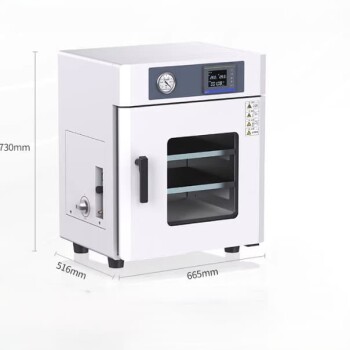
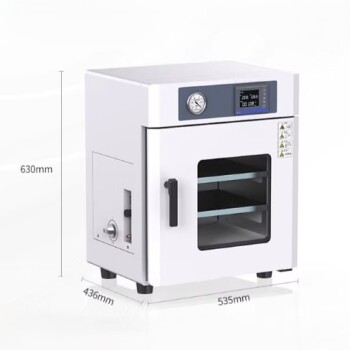
The specific function of a vacuum oven in this context is the deep dehydration of highly hygroscopic precursor reagents, such as sodium hydroxide (NaOH). By combining heat with negative pressure, the oven effectively removes adsorbed moisture to ensure a completely water-free environment, which is critical for preventing side reactions during subsequent high-temperature synthesis steps.
The core objective is to stabilize the reaction environment before melting occurs. By lowering the boiling point of water, a vacuum oven removes moisture from deep within particle pores without requiring excessive heat, thereby preventing the formation of bubbles or oxides that would compromise the final cathode material.
The Mechanism of Dehydration
Eliminating Adsorbed Moisture
Sodium-based precursors are often highly hygroscopic, meaning they readily attract water from the surrounding air. The vacuum oven performs "deep dehydration" to strip this adsorbed moisture away from reagents like NaOH.
Creating a Water-Free Molten System
Removing this water is a prerequisite for the subsequent melting process. If moisture remains, it disrupts the formation of a pure molten salt system.
Preventing Physical Defects
The presence of water during high-temperature melting leads to the formation of bubbles. These bubbles can disrupt the homogeneity of the mixture, leading to structural inconsistencies in the final material.
Preserving Material Integrity
Lowering the Boiling Point
The vacuum environment significantly lowers the boiling point of water. This allows for the thorough removal of residual moisture from particle gaps and pores at relatively low temperatures (e.g., 80 °C), rather than requiring extreme heat that could damage the precursors.
Preventing Oxidation
Standard drying methods expose materials to air, which increases the risk of oxidation. Vacuum drying removes air and oxygen from the chamber, protecting the chemical state of the precursors and preventing oxidative side reactions.
Maintaining Particle Morphology
By avoiding high heat and oxidation, the vacuum oven helps maintain the morphological integrity of the precursor particles. This prevents the agglomeration (clumping) of particles that often occurs when precursors are exposed to air for extended periods.
Common Pitfalls to Avoid
Incomplete Solvent Volatilization
While effective for water, the process must also account for weak polar solvents if wet mixing was used. Failure to fully volatilize these solvents can lead to side reactions later in the battery cycling process.
Rapid Evaporation Risks
If the temperature is ramped up too quickly even under vacuum, moisture can turn to steam violently. This rapid expansion can cause structural collapse or cracking in the precursor material before it even reaches the carbonization or firing stage.
Making the Right Choice for Your Goal
To optimize your pre-treatment process, align your vacuum oven parameters with your specific synthesis objectives:
- If your primary focus is Chemical Purity: Prioritize the removal of adsorbed moisture from hygroscopic reagents (like NaOH) to prevent bubble formation and side reactions during melting.
- If your primary focus is Particle Morphology: Utilize the lowered boiling point effect to dry at lower temperatures (around 80 °C), preventing agglomeration and oxidation.
Deep dehydration under vacuum is the single most effective method to ensure a stable, defect-free foundation for sodium-based cathode synthesis.
Summary Table:
| Function | Benefit to Synthesis | Impact on Material |
|---|---|---|
| Deep Dehydration | Removes moisture from hygroscopic NaOH | Prevents bubbles & structural defects |
| Lowered Boiling Point | Low-temp moisture removal (80°C) | Preserves particle morphology |
| Oxygen-Free Drying | Eliminates air from the chamber | Prevents oxidative side reactions |
| Negative Pressure | Clears moisture from particle pores | Ensures a pure molten salt system |
Elevate Your Battery Research with KINTEK Precision
Don't let moisture compromise your sodium-ion cathode synthesis. KINTEK specializes in advanced laboratory solutions, including high-performance vacuum ovens and high-temperature furnaces designed to ensure the chemical purity and morphological integrity of your precursors.
Whether you require precise thermal processing, battery research tools, or specialized vacuum and atmosphere systems, our engineering team provides the reliability your lab demands. From PTFE products to high-pressure reactors, we empower researchers to achieve defect-free material foundations.
Ready to optimize your synthesis workflow? Contact KINTEK today to discuss our range of laboratory equipment and find the perfect fit for your research goals.
Related Products
- 56L Vertical Laboratory Vacuum Drying Oven
- 23L Laboratory Vacuum Drying Oven
- Vacuum Heat Treat Sintering Brazing Furnace
- 2200 ℃ Graphite Vacuum Heat Treat Furnace
- Dental Porcelain Zirconia Sintering Ceramic Vacuum Press Furnace
People Also Ask
- Why is a laboratory vacuum drying oven recommended for rice straw residues? Protect Your Biomass Integrity
- What role does a laboratory vacuum drying oven play in the preparation of modified multi-walled carbon nanotubes?
- What is the importance of using a laboratory vacuum drying oven? Preserving Slow-Release Microcapsule Integrity
- Why is a Laboratory Vacuum Drying Oven recommended for PBAT microspheres? Protect Sensitive Polymer Integrity
- What role does a laboratory vacuum drying oven play in processing nanoparticle powder samples? Protect Sample Integrity