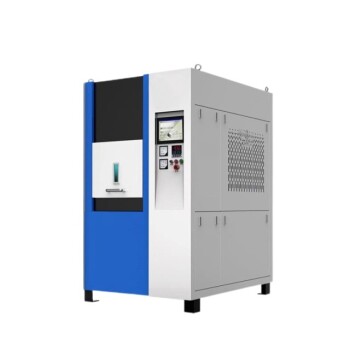
The high-temperature annealing furnace serves as the critical phase-transformation engine in the synthesis of Li6PS5Cl solid-state electrolytes. Its specific function is to heat-treat ball-milled powders at temperatures between 500°C and 600°C, providing the thermal energy required to convert the material from a disordered, amorphous state into a highly conductive, fully crystalline phase.
Core Takeaway: The annealing furnace is not merely for drying or setting the material; it is responsible for the fundamental atomic reorganization of the electrolyte. Without this thermal treatment, the material remains structurally defective with poor ionic conductivity.
The Mechanics of Structural Transformation
From Amorphous to Crystalline
The primary role of the furnace is to facilitate a transition in the material's state.
After the initial ball-milling process, the precursor powders exist in an amorphous or mixed state. The furnace provides the necessary thermal environment to drive the solid-state reaction, converting these precursors into the specific Li-argyrodite crystal structure.
Repairing Lattice Defects
Ball milling is a high-energy mechanical process that introduces significant defects into the material's atomic lattice.
The annealing process acts as a "healing" step. The heat allows atoms to diffuse and settle into their energetically favorable positions, effectively repairing these lattice defects. This structural repair is essential for unobstructed ion movement.
Enhancing Connectivity
Beyond the atomic structure, the furnace improves the macroscopic connection between particles.
The treatment helps eliminate grain boundary impedance. By sintering the particles, the furnace ensures better contact between grains, creating a continuous pathway for lithium ions to flow.
Operational Parameters and Environment
Precise Temperature Control
The effectiveness of this process relies on maintaining a specific temperature window.
The furnace must sustain a temperature range of 500°C to 600°C (often targeting 550°C). This specific range is energetic enough to induce crystallization but controlled enough to maintain the stability of the desired phase.
Controlled Atmosphere
To prevent contamination or unwanted side reactions, this process is often conducted in a controlled environment.
Tube furnaces or sintering furnaces are typically employed to heat sealed reaction tubes containing the precursor mixture. This isolation ensures the chemical integrity of the Li6PS5Cl during the phase transition.
Understanding the Trade-offs
The Balance of Crystallinity
While high heat is necessary for crystallization, the process requires strict adherence to the 500°C–600°C window.
Insufficient heating will leave the material in an amorphous, low-conductivity state. However, the process is strictly bound to this window to optimize the formation of the conductive Argyrodite structure without inducing decomposition or unwanted phases.
Process Dependency
The furnace step is dependent on the quality of the preceding step.
Annealing is effective only if the precursors have been properly ball-milled first. The furnace consolidates and organizes the material, but it relies on the mechanical mixing of the ball mill to establish the initial chemical distribution.
Making the Right Choice for Your Goal
To maximize the performance of your solid-state electrolyte, consider the following regarding your thermal treatment strategy:
- If your primary focus is maximizing Ionic Conductivity: Ensure your furnace can hold a stable temperature strictly between 500°C and 600°C to achieve the full transition to the Li-argyrodite structure.
- If your primary focus is Material Purity: Utilize a tube furnace with sealed reaction tubes to prevent atmospheric contamination during the sintering phase.
- If your primary focus is Structural Integrity: Prioritize the annealing step to repair lattice defects caused by mechanical milling, as this is the primary method for reducing internal resistance.
The annealing furnace is the decisive tool that transforms a raw powder mixture into a functional, high-performance solid-state electrolyte.
Summary Table:
| Process Phase | Temperature Range | Primary Function | Structural Outcome |
|---|---|---|---|
| Phase Transformation | 500°C - 600°C | Converts amorphous powder to crystalline | Formation of Li-argyrodite structure |
| Lattice Repair | 550°C (Typical) | Atomic diffusion & settling | Elimination of ball-milling defects |
| Sintering/Connectivity | High Thermal Input | Reducing grain boundary impedance | Improved contact and ion pathways |
| Atmosphere Control | Environment Dependent | Prevents chemical contamination | High-purity Li6PS5Cl electrolyte |
Elevate Your Battery Research with KINTEK Precision
Unlock the full potential of your Li6PS5Cl solid-state electrolytes with KINTEK’s industry-leading thermal solutions. Our specialized high-temperature tube furnaces and vacuum sintering systems provide the precise temperature control (500°C–600°C) and controlled atmospheres essential for achieving the perfect Li-argyrodite crystal structure.
From high-performance ball milling systems for precursor preparation to advanced high-temperature furnaces and hydraulic pellet presses, KINTEK offers a comprehensive ecosystem for battery research.
Ready to minimize grain boundary impedance and maximize ionic conductivity? Contact our laboratory specialists today to find the ideal equipment for your material synthesis needs.
Related Products
- 1700℃ Controlled Atmosphere Furnace Nitrogen Inert Atmosphere Furnace
- Vacuum Heat Treat and Pressure Sintering Furnace for High Temperature Applications
- 1700℃ Laboratory High Temperature Tube Furnace with Alumina Tube
- Ultra-High Temperature Graphite Vacuum Graphitization Furnace
- Horizontal High Temperature Graphite Vacuum Graphitization Furnace
People Also Ask
- What is a controlled atmosphere furnace for heat treatment? Master Surface Chemistry and Metallurgy
- What are the two primary purposes of using a controlled atmosphere? Master Protection vs. Material Modification
- What is the necessity of a controlled atmosphere furnace for corrosion research? Replicating Realistic Industrial Risks
- What is the necessity of controlled atmosphere furnaces for gas corrosion? Ensure Precise Material Failure Modeling
- How is oxygen (O2) used in controlled furnace atmospheres? Mastering Surface Engineering for Metals