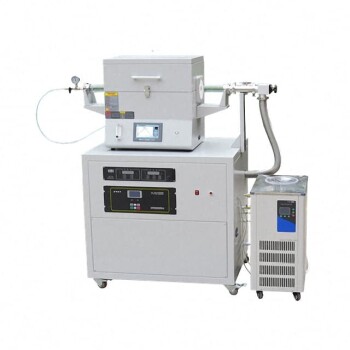
Precise environmental control is non-negotiable during the final reduction stage of Hyper-cross-linked Polystyrene (HPS) supported catalysts. A controlled atmosphere tube furnace provides the necessary thermal stability and continuous hydrogen flow required to convert adsorbed metal precursors into active catalytic nanoclusters. Without this specific equipment, you cannot achieve the chemical reduction necessary for catalyst activation while simultaneously preserving the delicate dispersion of metal particles.
Core Insight: The tube furnace functions as a specialized chemical reactor, maintaining a hydrogen-rich atmosphere at approximately 300°C. This specific environment is critical for transforming precursors like ruthenium hydroxychloride into active metal sites without allowing them to oxidize or grow too large, which would diminish catalytic performance.
The Mechanics of Activation
Facilitating Chemical Reduction
The primary function of the tube furnace is to drive the chemical reduction of metal precursors. Catalysts often start with precursors, such as ruthenium hydroxychloride, adsorbed onto the HPS support.
The Role of Hydrogen Flow
To activate these precursors, the furnace introduces a stable flow of hydrogen gas. This reductive atmosphere strips away the chloride or oxide components, leaving behind the pure, active metal required for catalysis.
In-Situ Transformation
This transformation happens directly within the pores of the Hyper-cross-linked Polystyrene. By reducing the precursor "in situ" (in place), the furnace ensures that the active metal remains anchored within the polymer's internal structure.
Controlling Nanostructure and Dispersion
Preventing Metal Oxidation
Standard heating methods expose materials to ambient oxygen, which is detrimental at this stage. The controlled atmosphere of the tube furnace rigorously excludes oxygen, preventing the newly formed metal nanoclusters from re-oxidizing and losing activity.
Inhibiting Particle Agglomeration
One of the greatest risks during reduction is "sintering," where small metal particles merge into larger, less effective clumps. The precise temperature control (~300°C) provided by the furnace inhibits this excessive growth.
Ensuring Uniform Distribution
By balancing temperature and gas flow, the furnace ensures the metal active sites are distributed evenly. This results in highly dispersed, extremely fine particles that maximize the surface area available for future chemical reactions.
Common Pitfalls and Trade-offs
Temperature Sensitivity
While heat is necessary for reduction, excessive temperatures can be dangerous for polymer supports like HPS. You must maintain the temperature near 300°C; going significantly higher risks degrading the polystyrene structure itself.
Atmosphere Stability
The quality of the final catalyst is directly tied to the stability of the gas flow. Fluctuations in hydrogen concentration during the reduction phase can lead to heterogeneous particle sizes and inconsistent catalytic performance.
Making the Right Choice for Your Goal
To ensure you are utilizing the tube furnace effectively for HPS catalysts, consider your specific objectives:
- If your primary focus is Maximizing Activity: Prioritize the precision of your hydrogen flow rate to ensure complete reduction of all adsorbed precursors.
- If your primary focus is Catalyst Longevity: strictly monitor the 300°C temperature limit to prevent thermal damage to the HPS support structure while inhibiting nanoparticle sintering.
The controlled atmosphere tube furnace is not just a heating element; it is a precision tool that defines the final geometry and efficiency of your catalyst's active sites.
Summary Table:
| Parameter | Role in Catalyst Reduction | Impact on Final Product |
|---|---|---|
| Atmosphere Control | Continuous hydrogen flow | Strips precursors to form active metal sites |
| Temperature (~300°C) | Precision thermal stability | Prevents HPS degradation & metal sintering |
| Oxygen Exclusion | In-situ vacuum/inert seal | Prevents re-oxidation of nanoclusters |
| Gas Flow Dynamics | Uniform distribution | Ensures consistent particle size & high surface area |
Elevate Your Material Research with KINTEK Precision
Achieving the perfect nanostructure in Hyper-cross-linked Polystyrene (HPS) catalysts requires more than just heat—it requires total environmental control. KINTEK specializes in advanced controlled atmosphere tube furnaces, CVD systems, and vacuum solutions designed to meet the rigorous demands of catalyst activation and polymer-supported material research.
From our precision crushing and milling systems for precursor preparation to our high-temperature furnaces and high-pressure reactors for final synthesis, KINTEK provides the high-performance tools your laboratory needs to ensure repeatable, high-activity results.
Ready to optimize your reduction process? Contact our technical specialists today to find the ideal furnace configuration for your specific research goals.
References
- Oleg V. Manaenkov, Lioubov Kiwi‐Minsker. An Overview of Heterogeneous Catalysts Based on Hypercrosslinked Polystyrene for the Synthesis and Transformation of Platform Chemicals Derived from Biomass. DOI: 10.3390/molecules28248126
This article is also based on technical information from Kintek Solution Knowledge Base .
Related Products
- 1200℃ Controlled Atmosphere Furnace Nitrogen Inert Atmosphere Furnace
- 1700℃ Controlled Atmosphere Furnace Nitrogen Inert Atmosphere Furnace
- 1400℃ Controlled Atmosphere Furnace with Nitrogen and Inert Atmosphere
- Controlled Nitrogen Inert Hydrogen Atmosphere Furnace
- Mesh belt controlled atmosphere furnace
People Also Ask
- What is controlled atmosphere furnace? Precision Heating Without Oxidation for Superior Materials
- Why is a high-temperature furnace with a controlled atmosphere required for S@MMPC? Master Precision Synthesis
- What is the function of a high-precision controlled atmosphere furnace for Alloy 617? Simulate Extreme VHTR Conditions
- What is the role of the furnace atmosphere? Master Precise Metallurgical Control for Your Heat Treatment
- What is the necessity of a controlled atmosphere furnace for corrosion research? Replicating Realistic Industrial Risks