Knowledge laboratory mill What kind of material is a hammer mill used for? Process Brittle, Dry, and Crystalline Materials Efficiently
Author avatar

Tech Team · Kintek Solution

Updated 2 months ago

What kind of material is a hammer mill used for? Process Brittle, Dry, and Crystalline Materials Efficiently


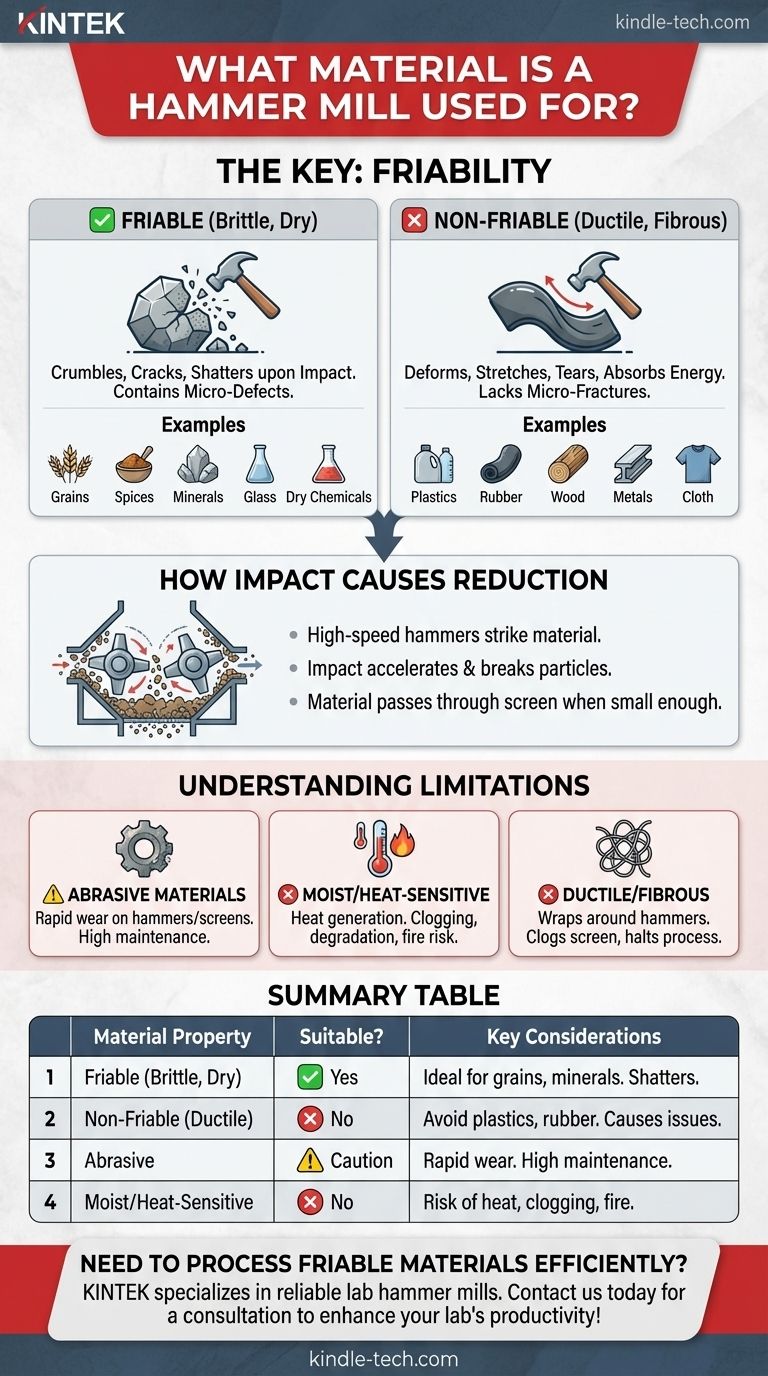
In short, a hammer mill is designed to process friable materials. These are materials that are brittle, dry, or crystalline and will easily crumble, crack, or shatter into a granular or powder consistency when struck with force.

The effectiveness of a hammer mill depends less on the specific material and more on a single physical property: friability. If a material shatters under impact, a hammer mill will likely work; if it deforms, stretches, or tears, it will not.
What kind of material is a hammer mill used for? Process Brittle, Dry, and Crystalline Materials Efficiently

What Defines a Suitable Material?

A hammer mill is fundamentally a high-impact device. Its entire operation is based on the principle of striking material with hardened steel hammers at very high speeds, causing it to break apart upon impact.

The Critical Role of Friability

A friable material is one that has a tendency to be reduced to smaller particles when subjected to pressure or impact.

These materials contain microscopic defects, fractures, or gaps. When the hammer strikes, energy is transferred into the material, and these defects become points of failure, allowing cracks to propagate rapidly and cause the material to shatter.

How Impact Causes Size Reduction

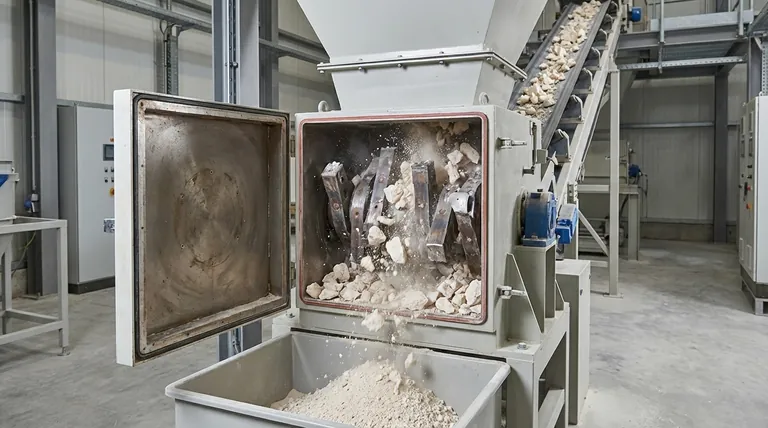
The process is straightforward. Material is fed into the mill's chamber, where rotating hammers strike it repeatedly. This impact accelerates the material, causing it to collide with the chamber walls or other particles, breaking it down further until it is small enough to pass through a screen.

Why Non-Friable Materials Fail

Conversely, non-friable or ductile materials are unsuitable. These materials lack the internal micro-fractures needed for shattering.

When struck by a hammer, they tend to absorb the energy and deform, smear, or melt rather than break. Trying to process materials like tough plastics, rubber, or metal hard drives will be ineffective and can damage the mill.

Understanding the Limitations

While versatile for the right materials, a hammer mill has clear operational boundaries. Forcing an unsuitable material can lead to inefficiency, equipment damage, and safety hazards.

The Problem with Abrasive Materials

Highly abrasive materials, even if friable, will cause extremely rapid wear on the hammers, screens, and internal chamber liners. This leads to high maintenance costs and significant downtime.

The Risk of Heat Generation

Fibrous or moist materials can generate significant heat from friction. This can degrade the material itself, create a sticky buildup that clogs the screen, or, in the worst case, pose a fire or explosion risk with combustible dusts.

Inefficiency with Ductile or Fibrous Content

Materials that stretch or tear, like cloth or soft plastics, will not shatter. They will often wrap around the hammers, clog the screen, and bring the entire process to a halt without achieving any meaningful size reduction.

Matching the Mill to Your Material

Selecting the right equipment begins with a clear understanding of your input material's physical properties.

  • If your primary focus is reducing dry, brittle materials (e.g., grains, spices, minerals, glass, dry chemicals): A hammer mill is an efficient and cost-effective solution for creating a consistent powder or granular product.
  • If your primary focus is processing tough, elastic, or fibrous materials (e.g., plastics, rubber, wood, metal): You must consider alternative equipment like a shredder, granulator, or knife mill designed for shearing and cutting.
  • If you are unsure of your material's properties: Always test a small sample before committing to a full production run to confirm its friability and avoid costly equipment damage.

Ultimately, aligning the material's characteristics with the machine's mechanism is the key to successful size reduction.

Summary Table:

Material Property Suitable for Hammer Mill? Key Considerations
Friable (Brittle, Dry) ✅ Yes Ideal for grains, spices, minerals, glass, dry chemicals. Shatters upon impact.
Non-Friable (Ductile, Fibrous) ❌ No Avoid plastics, rubber, cloth. Causes clogging, wear, and inefficiency.
Abrasive ⚠️ Use with Caution Causes rapid wear on hammers and screens; high maintenance required.
Moist or Heat-Sensitive ❌ No Risk of heat buildup, degradation, or fire hazard.

Need to process friable materials efficiently? KINTEK specializes in lab equipment and consumables, providing reliable hammer mills designed for your specific laboratory needs. Our experts can help you select the right mill to achieve consistent particle size reduction, improve your workflow, and avoid costly equipment damage. Contact us today for a consultation and see how we can enhance your lab's productivity!

Visual Guide
What kind of material is a hammer mill used for? Process Brittle, Dry, and Crystalline Materials Efficiently Visual Guide

Related Products

People Also Ask

Related Products

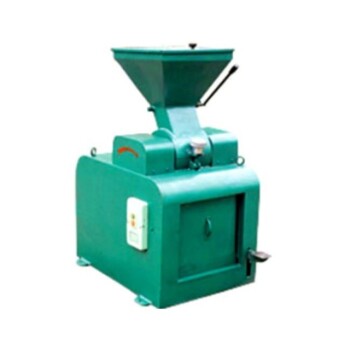
Laboratory Sealed Hammer Crusher for Efficient Sample Preparation

Laboratory Sealed Hammer Crusher for Efficient Sample Preparation

Discover the Laboratory Sealed Hammer Crusher for efficient sample preparation. Ideal for coal, metallurgy, and research, this crusher ensures high production efficiency and environmental friendliness.

Laboratory Ball Mill Jar Mill with Metal Alloy Grinding Jar and Balls

Laboratory Ball Mill Jar Mill with Metal Alloy Grinding Jar and Balls

Grind and mill with ease using metal alloy grinding jars with balls. Choose from 304/316L stainless steel or tungsten carbide and optional liner materials. Compatible with various mills and features optional functions.

Laboratory Disc Cup Vibratory Mill for Sample Grinding

Laboratory Disc Cup Vibratory Mill for Sample Grinding

The vibrating disc mill is suitable for non-destructive crushing and fine grinding of samples with large particle sizes, and can quickly prepare samples with analytical fineness and purity.

Open Type Two Roll Mixing Mill Machine for Rubber Crusher

Open Type Two Roll Mixing Mill Machine for Rubber Crusher

Rubber crusher open mixing mill/Open two roller rubber mixing mill machine is suitable for mixing and dispersing rubber, plastic raw materials, pigments, masterbatches and other high molecular polymers.

Laboratory Single Horizontal Jar Mill

Laboratory Single Horizontal Jar Mill

KT-JM3000 is a mixing and grinding instrument for placing a ball milling tank with a volume of 3000ml or less. It adopts frequency conversion control to realize timing, constant speed, direction change, overload protection and other functions.

Laboratory Horizontal Planetary Ball Mill Milling Machine

Laboratory Horizontal Planetary Ball Mill Milling Machine

Improve sample uniformity with our Horizontal Planetary Ball Mills. KT-P400H reduces sample deposition and KT-P400E has multi-directional capabilities. Safe, convenient and efficient with overload protection.

Vibrating Disc Mill Small Laboratory Grinding Machine

Vibrating Disc Mill Small Laboratory Grinding Machine

Discover the versatile Vibrating Disc Mill for efficient laboratory grinding. Ideal for geology, metallurgy, biology, and more. Explore now!

Laboratory Jar Mill with Agate Grinding Jar and Balls

Laboratory Jar Mill with Agate Grinding Jar and Balls

Grind your materials with ease using Agate Grinding Jars with Balls. Sizes from 50ml to 3000ml, perfect for planetary and vibration mills.

Laboratory Four-Body Horizontal Jar Mill

Laboratory Four-Body Horizontal Jar Mill

The four-body horizontal tank mill ball mill can be used with four horizontal ball mill tanks with a volume of 3000ml. It is mostly used for mixing and grinding laboratory samples.

Laboratory Ten-Body Horizontal Jar Mill for Lab Use

Laboratory Ten-Body Horizontal Jar Mill for Lab Use

The Ten-body horizontal jar mill is for 10 ball mill pots (3000ml or less). It has frequency conversion control, rubber roller movement, and PE protective cover.

High Energy Planetary Ball Mill Milling Machine for Laboratory

High Energy Planetary Ball Mill Milling Machine for Laboratory

Experience fast and effective sample processing with the F-P2000 high-energy planetary ball mill. This versatile equipment offers precise control and excellent grinding capabilities. Perfect for laboratories, it features multiple grinding bowls for simultaneous testing and high output. Achieve optimal results with its ergonomic design, compact structure, and advanced features. Ideal for a wide range of materials, it ensures consistent particle size reduction and low maintenance.

High-Energy Omnidirectional Planetary Ball Mill Milling Machine for Laboratory

High-Energy Omnidirectional Planetary Ball Mill Milling Machine for Laboratory

The KT-P4000E is a new product derived from the vertical high-energy planetary ball mill with a 360° swivel function. Experience faster, uniform, and smaller sample output results with 4 ≤1000ml ball mill jars.

Laboratory Planetary Ball Mill Rotating Ball Milling Machine

Laboratory Planetary Ball Mill Rotating Ball Milling Machine

KT-P400E is a desktop multi-directional planetary ball mill with unique grinding and mixing capabilities. It offers continuous and intermittent operation, timing, and overload protection, making it ideal for various applications.

High Energy Planetary Ball Mill Milling Machine for Laboratory

High Energy Planetary Ball Mill Milling Machine for Laboratory

The biggest feature is that the high energy planetary ball mill can not only perform fast and effective grinding, but also has good crushing ability

High-Energy Omnidirectional Planetary Ball Mill Machine for Laboratory

High-Energy Omnidirectional Planetary Ball Mill Machine for Laboratory

The KT-P2000E is a new product derived from the vertical high-energy planetary ball mill with a 360°rotation function. The product not only has the characteristics of the vertical high-energy ball mill, but also has a unique 360°rotation function for the planetary body.

High Energy Vibratory Ball Mill for Lab Use

High Energy Vibratory Ball Mill for Lab Use

The high-energy vibrating ball mill is a high-energy oscillating and impacting multifunctional laboratory ball mill. The table-top type is easy to operate, small in size, comfortable and safe.

Hybrid High Energy Vibratory Ball Mill for Lab Use

Hybrid High Energy Vibratory Ball Mill for Lab Use

KT-BM400 is used for rapid grinding or mixing of dry, wet and frozen small amount of samples in the laboratory. It can be configured with two 50ml ball mill jars

Mini Planetary Ball Mill Machine for Laboratory Milling

Mini Planetary Ball Mill Machine for Laboratory Milling

Discover the KT-P400 desktop planetary ball mill, ideal for grinding and mixing small samples in the lab. Enjoy stable performance, long service life, and practicality. Functions include timing and overload protection.

Laboratory High Throughput Tissue Grinding Mill Grinder

Laboratory High Throughput Tissue Grinding Mill Grinder

KT-MT is a high-quality, small, and versatile tissue grinder used for crushing, grinding, mixing, and cell wall breaking in various fields, including food, medical, and environmental protection. It is equipped with 24 or 48 2ml adapters and ball grinding tanks and is widely employed for DNA, RNA, and protein extraction.

High Energy Vibratory Laboratory Ball Mill Grinding Mill Single Tank Type

High Energy Vibratory Laboratory Ball Mill Grinding Mill Single Tank Type

High-energy vibration ball mill is a small desktop laboratory grinding instrument.It can be ball-milled or mixed with different particle sizes and materials by dry and wet methods.


Leave Your Message