Selecting the right crucible for high-potassium biomass analysis requires prioritizing high chemical inertness and exceptional thermal shock resistance. Because potassium chloride (KCl) melts at approximately 770°C and becomes highly corrosive in its liquid state, the crucible must be made of materials like alumina or specialized ceramics. These properties ensure the container does not react with the sample or fail under the intense thermal stresses of a thermogravimetric (TGA) cycle.
To maintain experimental integrity and protect equipment when heating potassium chloride above 770°C, you must use crucibles that offer extreme chemical stability. Alumina and ceramic options are the industry standard because they prevent corrosive reactions and withstand the rapid temperature changes inherent in biomass TGA.
The Impact of Molten Salts on Material Selection
Managing the 770°C Phase Transition
Potassium chloride undergoes a phase change to a molten state at roughly 770°C, significantly increasing its reactivity. At this temperature, the salt can aggressively attack common crucible materials, leading to structural failure or sample leakage.
Preventing Sample Contamination
Chemical stability is the most critical physical property for preventing unwanted reactions between the KCl and the crucible walls. Ceramic and alumina crucibles provide a non-reactive surface that ensures the weight loss measured by the TGA is due solely to the biomass mixture, not the crucible degrading.
Structural Integrity Under Thermal Stress
The Importance of Thermal Shock Resistance
Thermogravimetric analysis often involves rapid heating or cooling phases that create significant internal tension in materials. High-temperature shock resistance allows the crucible to expand and contract without cracking or shattering.
Ensuring Laboratory and Equipment Safety
A crucible failure inside a TGA furnace can lead to molten salts leaking onto sensitive sensors and heating elements. Using resilient materials like alumina mitigates the risk of catastrophic equipment damage and ensures a safe working environment.
Understanding the Trade-offs
Porosity and Cleaning Challenges
While ceramic crucibles offer excellent stability, some grades can be slightly porous, potentially trapping trace amounts of salts or ash. This can make thorough cleaning difficult, sometimes requiring the crucible to be treated as a consumable or "single-use" item for high-precision work.
Cost Versus Durability
High-purity alumina crucibles are generally more expensive than standard porcelain or clay alternatives. However, the investment is necessary because cheaper materials often lack the specific chemical resistance required to survive repeated exposure to molten KCl.
Best Practices for High-Chloride Biomass Analysis
Effective crucible selection is the foundation of repeatable TGA data when working with aggressive salts.
- If your primary focus is experimental precision: Use high-purity alumina crucibles to ensure zero reactivity with the molten potassium chloride.
- If your primary focus is equipment longevity: Prioritize materials with the highest rated thermal shock resistance to prevent cracks that could leak corrosive salts into the furnace.
- If your primary focus is cost-efficiency: Evaluate high-grade ceramic crucibles, but monitor them closely for signs of pitting or degradation after each run.
By matching the crucible material to the specific corrosive profile of potassium chloride, you ensure both the accuracy of your biomass research and the safety of your analytical hardware.
Summary Table:
| Physical Property | Importance for KCl-Rich Biomass Analysis | Recommended Material |
|---|---|---|
| Chemical Inertness | Prevents reaction with molten salts at >770°C; ensures data integrity. | High-purity Alumina |
| Thermal Shock Resistance | Withstands rapid TGA heating/cooling cycles without cracking or leaking. | Specialized Ceramics |
| Low Porosity | Reduces sample absorption and simplifies cleaning for repeated use. | Dense Alumina |
| High Melting Point | Maintains structural integrity well above the 770°C KCl phase transition. | Refractory Ceramics |
Optimize Your Biomass Research with KINTEK Precision
Protect your analytical equipment and ensure uncompromising data accuracy with KINTEK’s specialized laboratory consumables. Whether you are conducting TGA on corrosive biomass mixtures or high-temperature material characterization, our high-purity alumina crucibles, ceramic components, and refractory solutions are engineered to withstand the most demanding thermal and chemical environments.
From high-temperature furnaces (muffle, vacuum, CVD) to essential crucibles and ceramics, KINTEK provides researchers and labs with the reliability needed for high-pressure and high-temperature applications.
Need help selecting the right material for your corrosive samples? Contact our technical team today for expert guidance and a comprehensive quote on our full range of laboratory equipment.
References
- Linen Xie, Huanhuan Ma. Co-Pyrolysis for Pine Sawdust with Potassium Chloride: Insight into Interactions and Assisting Biochar Graphitization. DOI: 10.3390/ma16103667
This article is also based on technical information from Kintek Solution Knowledge Base .
Related Products
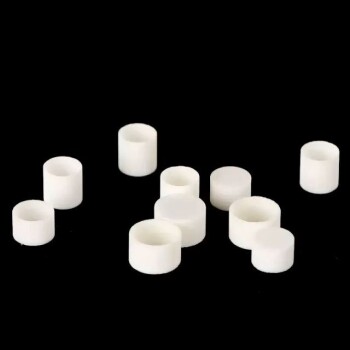
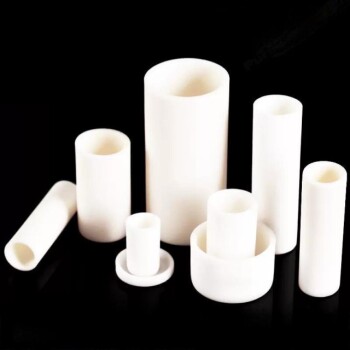
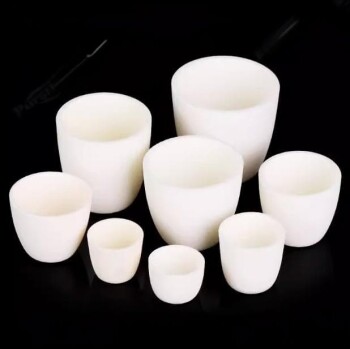
- Engineering Advanced Fine Ceramics Alumina Crucibles (Al2O3) for Thermal Analysis TGA DTA
- Evaporation Crucible for Organic Matter
- Evaporation Boat for Organic Matter
- High Purity Pure Graphite Crucible for Evaporation
- High Purity Pure Graphite Crucible for Electron Beam Evaporation
People Also Ask
- Why Use Alumina Crucibles for TGA of Bicyclic Carbonates? Ensure Data Purity & Chemical Inertness
- Why are alumina crucibles and mother powder essential for LATP sintering? Optimize Your Solid Electrolyte Performance
- Why are high-purity alumina crucibles used for liquid lead corrosion experiments? Ensure Data Accuracy at 550°C
- What is the primary purpose of using alumina crucibles for LLTO ceramics? Optimize Your High-Temperature Sintering
- Why Use Alumina Crucibles & Powder Burial for NaSICON? Ensure Phase Purity and Prevent Elemental Volatilization