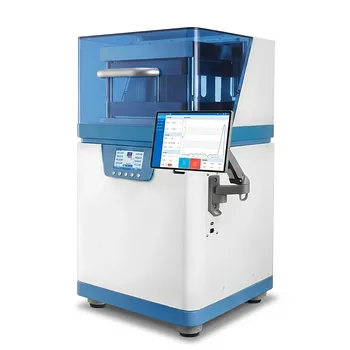
High-pressure reactors serve as the fundamental vessel for the hydrothermal synthesis of $\text{NiMoO}_4$ nanowires. They create a sealed, high-temperature environment—typically maintained at 150°C—which generates the autogenous pressure necessary to drive the chemical reaction. This pressure facilitates the directional arrangement and crystallization of metal ions, enabling the growth of single-crystal nanowire structures with high specific surface areas onto flexible substrates like activated carbon cloth (ACC).
The high-pressure reactor acts as a thermodynamic catalyst, providing the superheated liquid environment required to transform dissolved nickel and molybdenum salts into highly ordered, vertically aligned nanowire arrays. This structural foundation is essential for the subsequent efficiency of the $\text{Ru/a–Ni–MoO}_3$ catalyst.
The Role of Autogenous Pressure in Synthesis
Overcoming Solvent Boiling Points
High-pressure reactors allow aqueous precursor solutions to reach temperatures far exceeding their natural boiling point without evaporating. This superheated state is critical for the complete dissolution of nickel and molybdenum salts, ensuring all reactants are available for crystal formation.
Facilitating Oriented Nucleation
The internal pressure generated within the sealed reactor increases the kinetic energy and diffusion rates of metal ions. This environment forces the ions to undergo uniform nucleation, where they begin to form solid crystals at a consistent rate across the entire surface of the substrate.
Morphological Control and Crystallinity
Driving Directional Nanowire Growth
The specific thermodynamic conditions inside the reactor promote growth along preferred crystal planes. By maintaining a constant temperature and pressure, the reactor ensures that the $\text{NiMoO}_4$ develops into elongated single-crystal nanowires rather than irregular particles.
Maximizing Specific Surface Area
A primary goal of using high-pressure hydrothermal methods is to create a morphology with a high specific surface area. The reactor’s ability to produce thin, dense nanowire arrays ensures that the final catalyst has maximum exposure of active sites for the subsequent Ruthenium (Ru) loading.
Substrate Integration and Structural Stability
Achieving In-Situ Growth
High-pressure reactors facilitate the in-situ growth of $\text{NiMoO}_4$ directly onto substrates such as activated carbon cloth (ACC) or nickel foam. The pressure ensures that the precursor solution penetrates the porous structure of the substrate, leading to a robust mechanical bond between the nanowires and the surface.
Eliminating the Need for Binders
Because the nanowires grow directly from the substrate under pressure, the resulting electrode is free-standing. This eliminates the need for polymer binders, which can often block active sites and reduce the overall electrical conductivity of the catalyst.
Understanding the Trade-offs
Safety and Equipment Requirements
Operating at 150°C under autogenous pressure requires specialized Teflon-lined stainless steel autoclaves. These systems must be meticulously maintained to prevent seal failure or explosive decompression, adding a layer of operational complexity and cost to the synthesis process.
Sensitivity to Processing Time
The morphology of the $\text{NiMoO}_4$ is highly sensitive to the duration of the hydrothermal treatment. While 6 hours may produce ideal nanowires, excessive time in the high-pressure environment can lead to Ostwald ripening, where smaller nanowires dissolve to feed the growth of larger, less efficient structures, reducing the surface area.
Optimizing the Reaction for Your Catalyst Goals
To achieve the best results when preparing $\text{NiMoO}_4$ precursors for $\text{Ru/a–Ni–MoO}_3$ catalysts, consider the following strategic approaches:
- If your primary focus is maximizing catalytic active sites: Prioritize a reactor temperature of exactly 150°C to ensure the growth of the thinnest possible nanowires with the highest specific surface area.
- If your primary focus is mechanical durability for industrial use: Extend the hydrothermal reaction time slightly to promote deeper penetration and stronger adhesion of the nanowires into the substrate matrix.
- If your primary focus is phase purity: Ensure the reactor is filled to approximately 60-80% of its total volume to maintain optimal autogenous pressure levels throughout the heating cycle.
By mastering the high-pressure environment, you can precisely engineer the structural framework necessary for high-performance ruthenium-based catalysts.
Summary Table:
| Synthesis Aspect | Role of High-Pressure Reactor | Key Benefit |
|---|---|---|
| Temperature Control | Maintains superheated liquid state at 150°C | Complete dissolution of Ni/Mo precursor salts |
| Autogenous Pressure | Facilitates ion diffusion and uniform nucleation | Growth of single-crystal nanowire structures |
| Morphology Control | Promotes growth along preferred crystal planes | High specific surface area for active sites |
| Substrate Bonding | Drives in-situ growth into porous substrates | Binder-free electrode with high conductivity |
Elevate Your Catalyst Synthesis with KINTEK Precision
Achieving the perfect morphology for NiMoO4 nanowires requires uncompromising control over temperature and pressure. KINTEK specializes in providing high-performance laboratory equipment designed for advanced material research. Our robust high-temperature high-pressure reactors and autoclaves are engineered to deliver the precise hydrothermal conditions necessary for superior catalyst preparation.
Beyond reactors, KINTEK offers a comprehensive suite of tools for your lab, including:
- High-Temperature Furnaces: Muffle, tube, and vacuum systems for precise heat treatment.
- Processing Equipment: Hydraulic pellet presses, crushing systems, and cooling solutions.
- Specialized Consumables: High-purity ceramics, crucibles, and PTFE products.
Whether you are a researcher aiming for high-purity phases or an industrial developer seeking scalable results, KINTEK provides the reliability and expertise you need to succeed.
Contact KINTEK Today to Optimize Your Lab Results
References
- Lingyi Peng, Zhaojun Han. Enhanced pH‐Universal Hydrogen Evolution Reactions on the Ru/<i>a</i>–Ni–MoO<sub>3</sub> Electrocatalysts. DOI: 10.1002/sstr.202300194
This article is also based on technical information from Kintek Solution Knowledge Base .
Related Products
- Customizable Laboratory High Temperature High Pressure Reactors for Diverse Scientific Applications
- Customizable High Pressure Reactors for Advanced Scientific and Industrial Applications
- Stainless High Pressure Autoclave Reactor Laboratory Pressure Reactor
- Visual High-Pressure Reactor for In-Situ Observation
- Mini SS High Pressure Autoclave Reactor for Laboratory Use
People Also Ask
- How do high-pressure and high-temperature reactors ensure the effective treatment of lignocellulosic wastewater in WAO?
- What equipment is required for high-pressure high-temperature reactions? Master Extreme Chemistry Safely
- How do you control high pressure in a reactor? A Guide to Safe & Stable Operation
- How does initial oxygen pressure affect the wet oxidation of pharmaceutical sludge? Master Your Oxidation Depth
- Why is argon better than nitrogen for inert atmosphere? Ensure Absolute Reactivity & Stability