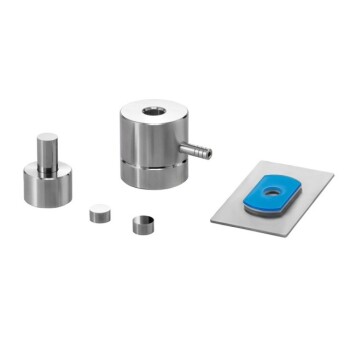
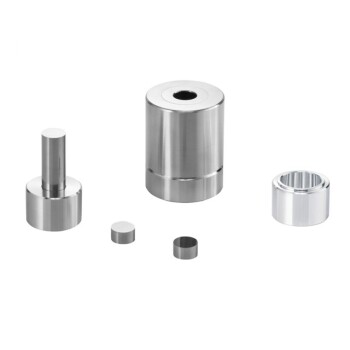
High-strength graphite molds function as the critical interface for structural containment and pressure transmission. During the hot pressing of C-SiC-B4C composites, these molds serve as the vessel for the mixed powders, defining the component's geometric shape. Crucially, they enable the material to undergo effective densification by withstanding specific extreme conditions—simultaneous exposure to 1900°C heat and 25 MPa of uniaxial mechanical pressure.
Core Takeaway The mold is not merely a container; it is an active mechanical component that must maintain total structural and chemical stability under extreme thermal load. Its ability to resist deformation at 1900°C ensures that the applied pressure is effectively converted into material density rather than mold distortion.
The Mechanics of Densification
Acting as a Pressure Vessel
The primary function of the mold is to facilitate uniaxial mechanical pressure. In the specific context of C-SiC-B4C composites, the mold must transmit a pressure of 25 MPa to the powder mixture.
This pressure is necessary to force the powder particles into close contact. By transmitting this force uniformly, the mold drives the plastic deformation and consolidation required to transform loose powder into a solid, dense composite.
Defining Geometric Shape
At the most fundamental level, the mold serves as the container that defines the final dimensions of the billet. It holds the mixed powders in a precise configuration prior to sintering.
Because the process involves a transition from loose powder to a solid state, the mold must maintain its internal dimensions rigidly. Any fluctuation in the mold's shape would result in geometric inaccuracies in the final composite.
Surviving Extreme Environments
Thermal Stability at 1900°C
Processing C-SiC-B4C composites requires temperatures reaching 1900°C. Most metal alloys would melt or lose all structural integrity at this threshold.
High-strength graphite is selected because it maintains—and often increases—its strength at these elevated temperatures. It must remain structurally stable to prevent the containment vessel from collapsing or warping during the heating cycle.
Chemical Inertness
Beyond physical strength, the mold must possess chemical stability. At high temperatures, materials become highly reactive.
The graphite mold must resist reacting adversely with the composite powders or the surrounding atmosphere. This ensures that the final product is not contaminated and that the mold can be successfully separated (demolded) from the sintered billet.
Critical Process Factors (Synthesis)
Uniform Heat Transfer
While the primary focus is containment and pressure, the graphite mold also acts as a thermal conductor. Graphite's high thermal conductivity helps transfer heat from the furnace elements to the powder core.
This ensures a uniform temperature field throughout the composite. Without this uniformity, the material could suffer from uneven sintering, leading to internal stresses or heterogeneous properties.
Understanding the Trade-offs
Mechanical Limitations
While graphite is robust, it is brittle. The mold must be designed carefully to withstand the 25 MPa pressure without cracking.
If the pressure exceeds the mold's compressive strength, or if the mold has internal flaws, catastrophic failure can occur. The balance between wall thickness and pressure application is critical.
Chemical Erosion and Interaction
Although generally inert, graphite is not immune to all interactions. Over repeated cycles or at extreme temperatures, there is a risk of carbon diffusion or reaction with certain alloy elements.
This can degrade the mold surface over time, affecting the surface finish of the composite and necessitating frequent mold replacement or re-machining.
Making the Right Choice for Your Goal
To optimize the hot pressing of C-SiC-B4C composites, consider these specific priorities:
- If your primary focus is Dimensional Accuracy: Ensure the graphite grade selected has high density and low porosity to minimize deformation under the 25 MPa load.
- If your primary focus is Process Efficiency: Prioritize high-purity graphite with excellent thermal conductivity to reduce cycle times and ensure rapid, uniform heating.
Success in hot pressing relies on viewing the mold not as a consumable accessory, but as a vital structural component of the synthesis machinery.
Summary Table:
| Feature | Function in Hot Pressing | Impact on C-SiC-B4C Composite |
|---|---|---|
| Pressure Transmission | Delivers 25 MPa uniaxial force | Drives powder densification and consolidation |
| Thermal Stability | Maintains integrity at 1900°C | Prevents mold warping and ensures geometric accuracy |
| Thermal Conductivity | Rapid heat transfer from furnace | Ensures a uniform temperature field and even sintering |
| Chemical Inertness | Resists reaction with powders | Prevents contamination and allows for easy demolding |
| Structural Rigidity | High compressive strength | Maintains precise dimensions under extreme mechanical load |
Elevate Your Material Synthesis with KINTEK Precision
Achieving perfect densification in C-SiC-B4C composites requires more than just heat—it requires high-performance hardware designed for extreme environments. KINTEK specializes in advanced laboratory equipment and consumables, providing the high-strength graphite molds and hydraulic hot presses essential for your most demanding research.
From high-temperature furnaces and vacuum systems to specialized crushing, milling, and pellet pressing solutions, our portfolio is engineered to support the entire lifecycle of advanced ceramics and battery research.
Ready to optimize your hot pressing process? Contact our technical experts today to find the perfect equipment and consumables for your laboratory. Let KINTEK help you achieve superior material properties and dimensional accuracy.
Related Products
- High Purity Pure Graphite Crucible for Evaporation
- High Purity Pure Graphite Crucible for Electron Beam Evaporation
- Vertical High Temperature Graphite Vacuum Graphitization Furnace
- Horizontal High Temperature Graphite Vacuum Graphitization Furnace
- Special Shape Press Mold for Lab
People Also Ask
- Why are high-purity graphite crucibles preferred for sulfide solid electrolytes? Achieve Superior Material Purity
- Why is a high-purity graphite crucible required for Chromel-TaC composites? Ensure Peak Purity at 1400°C
- What role do high-purity graphite crucibles play in molten salt corrosion research? Ensure Reactor-Grade Precision
- Why are high-purity graphite crucibles used for magnesium distillation? Ensure 3N8 Purity & Thermal Stability
- Why is a high-purity graphite crucible ideal for nitrogen-doped graphene at 1500 °C? Maximize Purity and Stability