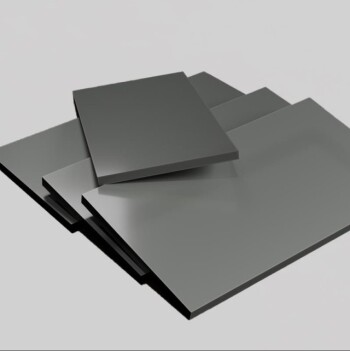
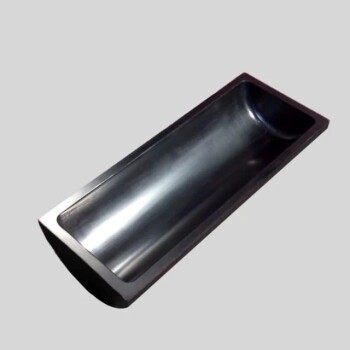
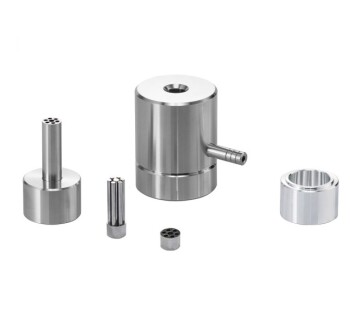
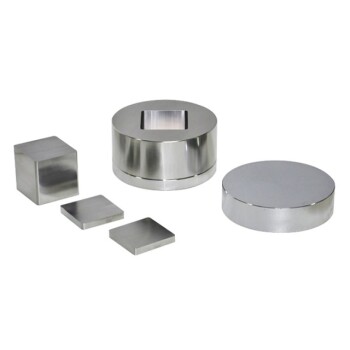
The graphite mold serves a dual purpose as both a robust structural container and an active chemical interface. During the vacuum hot press sintering of Co-50 mass% Cr alloys, it defines the physical dimensions of the green compact while transmitting the substantial mechanical pressure required to densify the material. However, under high-temperature vacuum conditions, the mold is not purely inert; it reacts chemically with the alloy's surface.
Core Insight: While the graphite mold is critical for converting hydraulic force into the uniform pressure needed to eliminate porosity, its interaction with chromium at the interface creates a specific carbide layer (Cr7C3) that alters the surface properties of the final alloy.
The Physical Function: Shaping and Densification
Defining Component Geometry
The most immediate role of the graphite mold is to serve as a precision container. It holds the loose metal powders in the desired shape, defining the final dimensions of the green compact before sintering begins.
Transmitting Mechanical Pressure
The mold acts as the transmission medium for the hydraulic loading system. It transfers external uniaxial pressure (often between 20-50 MPa) directly to the powder compact.
Facilitating Particle Rearrangement
This transmitted pressure is the driving force that eliminates voids. It forces the ductile cobalt particles to undergo plastic deformation, tightly filling the spaces between the harder chromium particles to achieve high densification.
The Thermal Role: Stability and Conductivity
Withstanding Extreme Environments
Graphite is selected for its exceptional thermal stability. It maintains its structural integrity and dimensional accuracy without softening or deforming, even at sintering temperatures that can reach 1700°C.
Ensuring Uniform Heating
The mold functions as an effective thermal conductor. It ensures that heat is distributed evenly throughout the powder compact, preventing thermal gradients that could lead to inconsistent sintering or internal stresses.
Understanding the Trade-offs: Surface Chemistry
The Carbon-Chromium Reaction
While physically stable, graphite is chemically active in this specific context. The high vacuum and high temperature create an environment where carbon from the mold reacts with chromium in the alloy.
Formation of Surface Carbides
This reaction specifically leads to the formation of carbides, such as Cr7C3, at the interface between the mold and the alloy.
Altered Phase Composition
Consequently, the surface of the sintered alloy will possess a different phase composition than the core. This surface modification is an intrinsic side effect of using graphite molds with high-chromium alloys and must be considered during post-processing.
Making the Right Choice for Your Goal
To optimize your sintering process, consider how the mold influences your specific requirements:
- If your primary focus is Maximum Density: Rely on the graphite mold's high compressive strength to sustain pressures (up to 50 MPa) that force plastic deformation of the cobalt matrix.
- If your primary focus is Surface Purity: Be aware that the outer layer will contain chromium carbides (Cr7C3); you may need to plan for a post-sintering machining step to remove this reaction layer.
Graphite molds provide the necessary mechanical leverage to achieve near-zero porosity, but they inevitably introduce a distinct chemical signature on the alloy's surface.
Summary Table:
| Function Category | Role of Graphite Mold | Impact on Co-50Cr Alloy |
|---|---|---|
| Physical | Structural Container & Pressure Medium | Defines geometry and enables high densification (eliminates porosity) |
| Thermal | High-Temperature Conductor | Maintains structural integrity up to 1700°C and ensures uniform heating |
| Chemical | Active Interface | Reacts with Chromium to form a Cr7C3 carbide surface layer |
| Mechanical | Force Transmission | Transfers uniaxial pressure (20-50 MPa) for plastic deformation |
Elevate Your Materials Research with KINTEK Precision Solutions
Achieving near-zero porosity in advanced alloys requires the perfect balance of mechanical pressure and thermal control. KINTEK specializes in high-performance laboratory equipment, including vacuum hot presses, hydraulic pellet presses, and high-temperature furnaces, specifically designed to handle the rigorous demands of sintering and material densification.
Whether you are working with Co-Cr alloys or complex ceramics, our comprehensive range of graphite molds, crucibles, and high-pressure reactors provides the reliability your lab needs to ensure superior phase composition and structural integrity.
Ready to optimize your sintering process? Contact KINTEK today to discover how our expertise in high-temperature systems and laboratory consumables can enhance your research outcomes.
Related Products
- Carbon Graphite Plate Manufactured by Isostatic Pressing Method
- High Purity Pure Graphite Crucible for Evaporation
- Graphite Disc Rod and Sheet Electrode Electrochemical Graphite Electrode
- Carbon Graphite Boat -Laboratory Tube Furnace with Cover
- High Purity Pure Graphite Crucible for Electron Beam Evaporation
People Also Ask
- What is the process of isostatic graphite manufacturing? Achieve Unmatched Material Uniformity and Performance
- What is isostatic graphite? The Ultimate Material for High-Tech and High-Temperature Applications
- What is the density of isostatic graphite? Unlock Superior Performance for Demanding Applications
- How big is the isostatic pressing market? A Deep Dive into the $1.2B+ Advanced Manufacturing Enabler
- Why Use an Isostatic or High-Precision Hydraulic Press for Li/LLZO/Li Batteries? Master Solid-State Interfaces