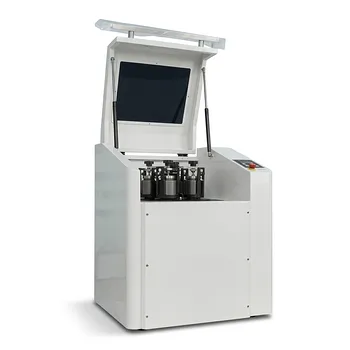
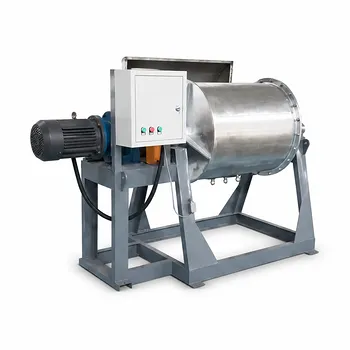
A high-energy planetary ball mill serves as the primary driver for mechanical alloying (MA) in the synthesis of CoCrFeNi(W1-xMox) high entropy alloy powders. Through the generation of intense impact and shear forces, this equipment physically forces elemental powders—including Cobalt, Chromium, Iron, Nickel, Tungsten, and Molybdenum—to merge at the atomic level without melting.
The ball mill does not merely mix ingredients; it utilizes kinetic energy to refine particles from the micron scale down to the nanoscale. This process facilitates solid-state atomic diffusion, enabling the creation of supersaturated Body-Centered Cubic (BCC) and Face-Centered Cubic (FCC) solid solution phases.
The Mechanics of Solid-State Synthesis
Generating Kinetic Energy
The planetary ball mill utilizes high-speed rotation to generate powerful centrifugal forces.
These forces propel the grinding media (balls) to impact the metal powders with high frequency and high energy. This kinetic transfer is the engine that drives the entire alloying process.
Mechanical Alloying (MA)
The central mechanism at play is Mechanical Alloying.
Under the intense friction and impact provided by the mill, the powder particles undergo a repeated cycle of cold welding, fracturing, and re-welding. This physical kneading ensures a uniform mixture of the multi-component elements.
Nanoscale Refinement
Initially, the elemental powders exist at the micron scale.
The continuous high-energy impact fractures these particles, significantly reducing their size. The process refines the grains down to the nanoscale, which dramatically increases the surface area and reactivity of the material.
Driving Structural Transformation
Facilitating Atomic Diffusion
Conventional alloying often relies on heat to melt metals together.
In this process, the ball mill facilitates atomic diffusion in the solid state. The mechanical energy forces atoms of different elements to interdiffuse, bypassing the need for high-temperature melting.
Forming Supersaturated Solid Solutions
The process drives the system away from equilibrium.
By forcing elements like Tungsten (W) and Molybdenum (Mo) into the CoCrFeNi matrix, the mill creates supersaturated solid solutions. This results in a material that is chemically uniform despite comprising elements with varying melting points and densities.
Dual-Phase Evolution
For the specific CoCrFeNi(W1-xMox) system, the milling process induces distinct crystal transformations.
Unlike some simpler alloys that may form a single phase, this high-energy input promotes the formation of both Body-Centered Cubic (BCC) and Face-Centered Cubic (FCC) phases. This dual-phase structure is critical for the final properties of the alloy.
Understanding the Trade-offs
Lattice Distortion
The intense mechanical energy introduces significant lattice distortion.
While this enhances the potential strength of the material, it also creates a high state of internal stress. This distortion is necessary to facilitate the solid solution reaction but requires careful control to manage the final material properties.
Processing Time and Atmosphere
Achieving a true solid solution is time-intensive.
The process often requires extended operation periods (e.g., 20 hours or more) to achieve full alloying. Furthermore, because the powders are highly reactive during this phase, the process typically requires a protective atmosphere (such as Argon) to prevent unwanted oxidation.
Making the Right Choice for Your Goal
The high-energy planetary ball mill is a potent tool for synthesizing complex high entropy alloys. Depending on your specific objectives for the CoCrFeNi(W1-xMox) system, focus on the following parameters:
- If your primary focus is Phase Composition: Monitor the milling time closely; sufficient energy input is required to force the refractory elements (W, Mo) into solution to form the desired BCC/FCC dual-phase structure.
- If your primary focus is Microstructural Refinement: Maximize the impact energy to drive particle size from micron to nano levels, as this refinement is crucial for enhancing the sintering activity of the powder later.
Ultimately, the ball mill acts as a kinetic reactor, transforming elemental blends into advanced nanostructured alloys through pure mechanical force.
Summary Table:
| Mechanism | Impact on CoCrFeNi(W1-xMox) Synthesis |
|---|---|
| Mechanical Alloying | Drives cold welding and fracturing for atomic-level blending without melting. |
| Particle Refinement | Reduces elemental powders from micron scale to nanoscale for higher reactivity. |
| Atomic Diffusion | Facilitates solid-state diffusion to form supersaturated BCC and FCC solid solutions. |
| Phase Evolution | Enables the incorporation of refractory elements like W and Mo into the matrix. |
Revolutionize Your Alloy Synthesis with KINTEK Precision
Unlock the full potential of your material research with KINTEK’s high-energy planetary ball mills and crushing systems. Whether you are developing complex high entropy alloys or advanced nanostructured materials, our equipment provides the high-frequency impact and shear forces required for superior mechanical alloying.
Why choose KINTEK?
- Comprehensive Laboratory Solutions: From vacuum and atmosphere furnaces to high-pressure reactors and hydraulic presses.
- Tailored for Research: Our milling systems and consumables (PTFE, ceramics, and crucibles) are designed for the most demanding chemical and structural transformations.
- Expert Support: We help you manage critical parameters like lattice distortion and processing atmosphere to ensure repeatable, high-quality results.
Ready to achieve precise phase composition and microstructural refinement? Contact us today to explore our full range of laboratory equipment!
Related Products
- High Energy Planetary Ball Mill Milling Machine for Laboratory
- High Energy Planetary Ball Mill for Laboratory Horizontal Tank Type Milling Machine
- High Energy Planetary Ball Mill Milling Machine for Laboratory
- High Energy Planetary Ball Mill Machine for Laboratory Horizontal Tank Type
- High-Energy Omnidirectional Planetary Ball Mill Milling Machine for Laboratory
People Also Ask
- What role do planetary ball mills and zirconia media play in LLZT preparation? Optimize Your Solid Electrolyte Research
- What is the primary function of a planetary ball mill? Mastering SiC/Al Composite Mixing for Homogeneity
- What is the primary purpose of using a planetary ball mill for LAGP? Achieve High-Purity Solid-State Electrolytes
- What role does a planetary ball mill play in the preparation of LGVO powders? Precision Refinement for Aerosol Deposition
- What is the function of a planetary ball mill in the preparation of high-entropy rare earth silicate multi-phase ceramics?