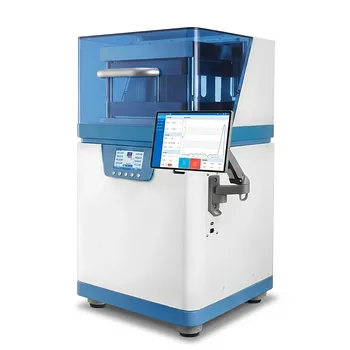
The high-pressure reactor is the foundational environment for hydrothermal carbonization (HTC). In the synthesis of trehalose-derived microspheres, it provides a sealed, pressurized vessel that allows the carbohydrate solution to undergo chemical transformation at temperatures typically around 180 °C. By maintaining the solvent in a liquid phase under autogenous pressure, the reactor enables the specific dehydration and polymerization sequences required to form uniform, micron-sized spherical hydrothermal carbon (pMS).
The high-pressure reactor acts as a controlled "chemical pressure cooker" that prevents solvent evaporation at high temperatures. This environment is essential for driving the liquid-phase reactions that convert trehalose into structured, uniform carbon microspheres.
Facilitating the Hydrothermal Environment
Maintaining the Liquid State
A high-pressure reactor provides a sealed environment that allows solvents to remain in a liquid state even when temperatures exceed their atmospheric boiling points. This physical condition is critical because it ensures the trehalose remains in solution throughout the reaction.
Maintaining the liquid phase significantly accelerates reaction rates compared to atmospheric conditions. It also facilitates the dissolution of precursors that would otherwise be difficult to process at lower temperatures.
Generating Autogenous Pressure
As the temperature inside the sealed reactor rises to levels like 180 °C, the internal pressure increases naturally. This is known as autogenous pressure, which is generated by the vapor-liquid equilibrium of the solvent.
This pressure is a key driver for the hydrothermal carbonization (HTC) process. It forces the trehalose molecules to interact in a confined space, promoting the density required for sphere formation.
Driving Chemical Transformation
Dehydration and Polymerization
Under high pressure and temperature, trehalose undergoes a sequence of dehydration and polymerization. The reactor provides the energy and confinement necessary for these sugar molecules to shed water and link together into long chains.
This process is the first step in moving from a simple carbohydrate solution to a solid carbon structure. The sealed environment prevents the loss of volatile intermediates, ensuring a higher yield of carbon material.
Aromatization and Carbonization
Following polymerization, the reactor environment facilitates aromatization, where the polymer chains arrange into stable carbon rings. This transformation is what gives the resulting microspheres their structural integrity and chemical stability.
The high-pressure liquid-phase environment is essential for converting these carbohydrates into hydrothermal carbon (pMS). Without the pressure to stabilize the liquid, the trehalose would likely char or decompose unevenly rather than forming spheres.
Achieving Morphological Uniformity
Micron-Sized Spherical Structure
The high-pressure reactor is responsible for establishing the physical morphology of the microspheres. The uniform distribution of heat and pressure within the vessel allows for the growth of spheres that are consistent in size.
By controlling the temperature (e.g., 180 °C to 200 °C) and the reaction time, researchers can fine-tune the micron-sized dimensions of the spheres. This level of precision is difficult to achieve in open-air or low-pressure systems.
Surface and Network Formation
The pressurized environment enables controlled hydrolysis and polycondensation, which are the building blocks of the sphere's internal network. This results in a structurally intact framework that can be further modified for specific applications.
In some variations, this environment also allows for the growth of anisotropic structures or high-surface-area nanoneedles on the microsphere surface. These features provide active sites that are highly valued in catalysis and redox reactions.
Understanding the Trade-offs
Complexity of Pressure Management
While high-pressure reactors are powerful, they require rigorous safety protocols and precise monitoring. Sudden pressure releases or sealing failures can ruin a batch and pose significant risks to the operator.
Scalability and Cost
High-pressure synthesis is often more expensive than atmospheric processes due to the cost of specialized alloy vessels and energy consumption. Scaling from a laboratory "autoclave" to industrial-level production requires significant capital investment in pressure-rated infrastructure.
Reaction Kinetics and Over-processing
Extended time in the reactor can lead to over-carbonization, where microspheres begin to fuse together or lose their uniform shape. Finding the "sweet spot" between complete synthesis and morphological degradation requires precise timing, often involving 24-hour reaction cycles.
Making the Right Choice for Your Goal
When utilizing a high-pressure reactor for trehalose-derived synthesis, your approach should vary based on your technical objectives.
- If your primary focus is uniform particle size: Prioritize the precision of the reactor's temperature control and agitation to ensure consistent nucleation across the entire volume.
- If your primary focus is high carbon yield: Maximize the dehydration and aromatization phases by maintaining steady autogenous pressure for the full duration of the HTC process.
- If your primary focus is surface area and porosity: Adjust the pressure and cooling rates post-synthesis to influence the development of the internal pore structure and surface nanostructures.
The high-pressure reactor is not merely a container, but an active participant in the thermodynamic process that defines the quality and structure of the final carbon microspheres.
Summary Table:
| Function | Impact on Synthesis | Key Parameters |
|---|---|---|
| Liquid State Maintenance | Prevents solvent evaporation; ensures trehalose remains in solution. | Temp > Boiling Point |
| Autogenous Pressure | Drives Hydrothermal Carbonization (HTC); promotes sphere density. | Sealed Environment |
| Chemical Transformation | Facilitates dehydration, polymerization, and aromatization. | 180 °C - 200 °C |
| Morphology Control | Ensures uniform micron-sized dimensions and surface structures. | Precise Reaction Time |
Elevate your material synthesis with KINTEK’s industry-leading high-temperature high-pressure reactors and autoclaves. Specifically engineered for hydrothermal carbonization (HTC), our reactors provide the precise autogenous pressure and thermal stability required to produce uniform trehalose-derived microspheres and advanced carbon structures.
As laboratory equipment experts, KINTEK offers a comprehensive range of solutions—from muffle and vacuum furnaces to hydraulic presses and specialized ceramics. Whether you are focused on particle uniformity, carbon yield, or surface porosity, our technical team is ready to provide the reliable equipment and consumables needed to scale your research.
Contact KINTEK today to find the perfect reactor for your laboratory!
References
- Martin Wortmann, Natalie Frese. Hard carbon microspheres with bimodal size distribution and hierarchical porosity <i>via</i> hydrothermal carbonization of trehalose. DOI: 10.1039/d3ra01301d
This article is also based on technical information from Kintek Solution Knowledge Base .
Related Products
- Customizable Laboratory High Temperature High Pressure Reactors for Diverse Scientific Applications
- Customizable High Pressure Reactors for Advanced Scientific and Industrial Applications
- Stainless High Pressure Autoclave Reactor Laboratory Pressure Reactor
- Visual High-Pressure Reactor for In-Situ Observation
- Mini SS High Pressure Autoclave Reactor for Laboratory Use
People Also Ask
- How do high-pressure and high-temperature reactors ensure the effective treatment of lignocellulosic wastewater in WAO?
- What equipment is required for high-pressure high-temperature reactions? Master Extreme Chemistry Safely
- How do you control high pressure in a reactor? A Guide to Safe & Stable Operation
- Why is argon better than nitrogen for inert atmosphere? Ensure Absolute Reactivity & Stability
- How does initial oxygen pressure affect the wet oxidation of pharmaceutical sludge? Master Your Oxidation Depth