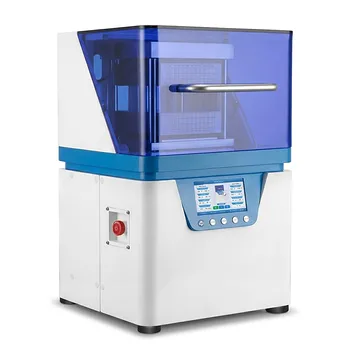
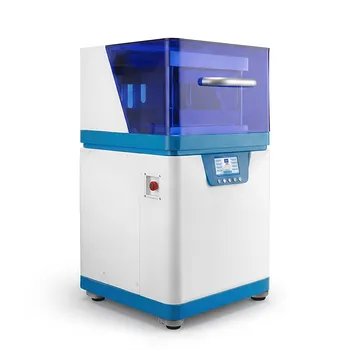
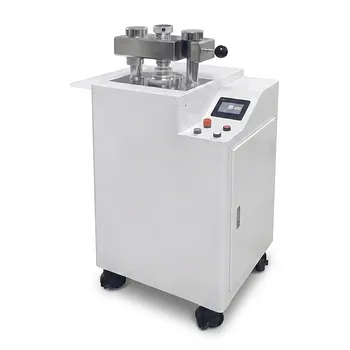
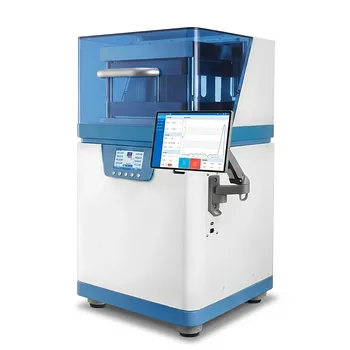
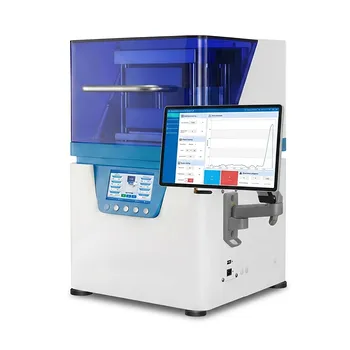
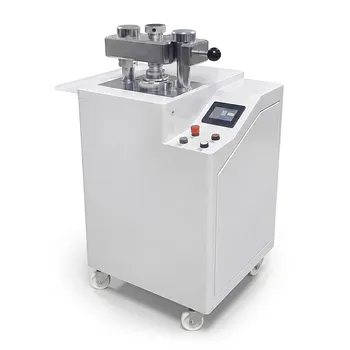
The high-tonnage mechanical hydraulic press is the primary instrument for consolidating loose Fe-Ni-Mo-Cu powders into a solid, cohesive "green compact." By applying precise axial pressure—often reaching 600 MPa—the equipment transforms a loose powder mixture into a structural precursor with a green density of approximately 6.9 g/cm³. This process provides the necessary mechanical strength for handling and establishes the precise geometric constraints required for subsequent thermal processing.
The core role of the hydraulic press is to establish a high-density physical foundation through particle rearrangement and plastic deformation. This creates the critical contact area and internal structure necessary for successful liquid-phase activated sintering.
Achieving Structural Integrity Through Compaction
Overcoming Internal Friction and Rearrangement
A high-tonnage press applies uniform static pressure to overcome the internal friction between individual Fe, Ni, Mo, and Cu particles. This force allows the particles to slide past one another, filling micron-scale pores and significantly increasing the contact area between different elements.
Inducing Plastic Deformation and Interlocking
As pressure reaches levels such as 450 MPa to 600 MPa, the metal particles undergo plastic flow and deformation. This physical change leads to mechanical interlocking, where particles weave together to give the "green body" enough strength to be handled and loaded into a furnace without crumbling.
Defining Geometric Constraints
The press utilizes high-hardness steel molds or dies to ensure the powder takes on a specific, repeatable geometric shape. This "cold press molding" ensures that the final component meets dimensional requirements after the shrinkage that typically occurs during sintering.
Establishing the Foundation for Sintering
Optimizing Green Density for Atomic Diffusion
High green density (approximately 6.9 g/cm³) is essential because it minimizes the distance between atoms. This proximity is the driving force for atomic diffusion during high-temperature treatments, allowing the separate powders to fuse into a single metallic matrix.
Facilitating Liquid-Phase Activated Sintering
Fe-Ni-Mo-Cu alloys often rely on liquid-phase activated sintering, where one component melts to fill remaining gaps. The hydraulic press ensures the initial porosity and particle contact are optimized so that when the liquid phase forms, it can wet the solid particles efficiently and drive final densification.
Eliminating Structural Defects
By providing a stable and controlled molding environment, the hydraulic press reduces internal porosity and structural defects. This ensures that the final specimen's mechanical properties, such as microhardness and modulus, accurately reflect the material's composition rather than manufacturing flaws.
Understanding the Trade-offs and Constraints
The Limits of Cold Compaction
While increasing pressure generally increases density, there is a point of diminishing returns where higher tonnage leads to die wear and increased internal stresses. If pressure is too high or applied unevenly, the green compact may suffer from "springback" or delamination when ejected from the mold.
Balancing Pressure and Porosity
In some specialized applications, such as porous metal structures, the goal is not maximum density but controlled initial porosity. In these cases, the press must be calibrated to a lower, precise axial pressure (sometimes as low as 10 MPa) to maintain a specific pore network while still providing handling strength.
Making the Right Choice for Your Goal
How to Apply This to Your Project
- If your primary focus is maximum mechanical strength: Prioritize higher compaction pressures (up to 600 MPa) to maximize green density and mechanical interlocking before sintering.
- If your primary focus is dimensional precision: Ensure the use of high-hardness steel dies and a controlled ejection speed to prevent "springback" and maintain the geometric constraints of the mold.
- If your primary focus is research and testing: Use a press that provides highly precise, repeatable static pressure to ensure that your microhardness data reflects the material properties rather than structural voids.
The high-tonnage hydraulic press is the indispensable bridge that converts loose powder into a viable engineering material by setting the density and structural foundation for all subsequent thermal processes.
Summary Table:
| Key Compaction Stage | Mechanism Involved | Primary Benefit/Outcome |
|---|---|---|
| Initial Pressing | Overcoming internal friction | High particle rearrangement and contact |
| High Pressure (600 MPa) | Plastic deformation | Mechanical interlocking of metal particles |
| Cold Press Molding | Die/Mold geometric constraints | Precise, repeatable shape and dimensions |
| Densification | Achieving ~6.9 g/cm³ density | Enhanced atomic diffusion for sintering |
| Structural Control | Porosity management | Reduction of internal defects and voids |
Elevate your powder metallurgy research with KINTEK’s precision engineering. Whether you are developing Fe-Ni-Mo-Cu alloys or advanced ceramics, our high-tonnage hydraulic presses—including pellet, hot, and isostatic models—ensure uniform density and structural integrity for every green compact.
Beyond compaction, KINTEK provides a comprehensive laboratory ecosystem, offering everything from crushing and milling systems to high-temperature furnaces (muffle, vacuum, CVD) and high-pressure reactors. Partner with us to optimize your material performance and streamline your manufacturing workflow. Contact our experts today to find the perfect equipment solution for your laboratory!
References
- Małgorzata Perek-Nowak, Mario Rosso. Effect of Particle Size of a Powder upon the Properties and Microstructure of Boron-modified Fe-Ni-Mo-Cu Sinters. DOI: 10.7494/jcme.2023.7.1.1
This article is also based on technical information from Kintek Solution Knowledge Base .
Related Products
- Automatic Laboratory Hot Press Dual Plate Heating Sintering Compaction System 120x120mm
- Automatic Hydraulic Hot Press with 500x500mm Heating Plates and Multi Stage PLC Control for Material Sintering
- kbr pellet press 2t
- Laboratory Hydraulic Press Split Electric Lab Pellet Press
- Manual Lab Heat Press
People Also Ask
- What is the primary function of a laboratory hot press in MEA assembly? Optimize Fuel Cell Bonding & Performance
- What specific conditions does a laboratory hot press provide for the assembly of fuel cell MEA? Expert Bond Tips.
- What are the core advantages of using a laboratory hot press to produce Bi2Se3? Achieve 93% Density & High Conductivity
- How do a laboratory hydraulic hot press and standardized steel molds ensure the quality of WPC test specimens?
- How does a laboratory heating hydraulic press contribute to the preparation of recycled graphite green bodies? - Optimize Density.