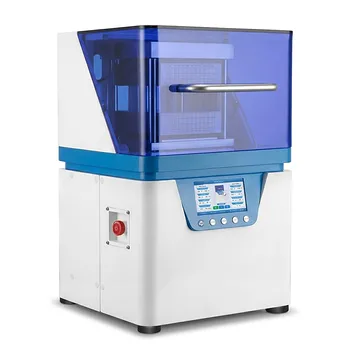
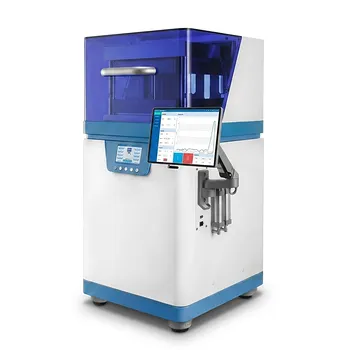
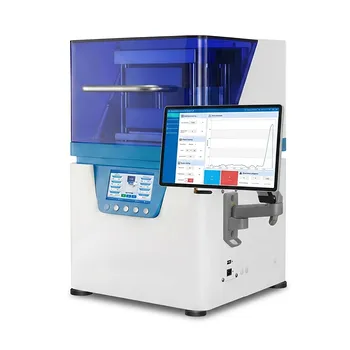
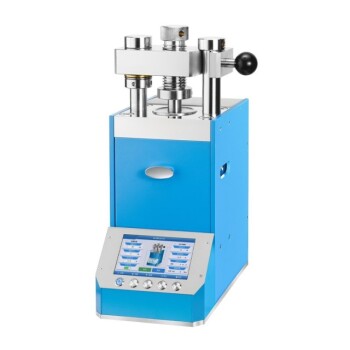
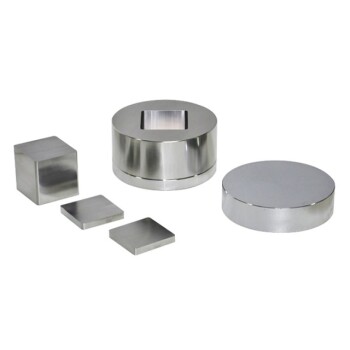
Laboratory pressure forming equipment is used to compress mixed ore and reductant powders into dense "green pellets" to ensure maximum physical contact between reactants. This process is essential for facilitating efficient solid-state reactions, optimizing heat transfer, and preventing the loss of fine materials during high-temperature gas-flow experiments.
The primary purpose of pelletizing ore powder is to transform loose particles into a stable, high-density matrix that mimics industrial conditions while optimizing the chemical and thermal kinetics required for successful reduction.
Enhancing Chemical Reaction Kinetics
Pelletization is not merely a shaping process; it is a critical step in controlling the chemistry of the reduction experiment.
Minimizing Diffusion Distances
By applying high pressure—often reaching 100 MPa—the equipment significantly reduces the voids between powder particles. This compaction shortens the atomic diffusion paths between the iron ore and the reductant, allowing for faster and more complete solid-phase reactions.
Increasing Surface Contact Area
High-density pellets ensure that the contact area between the ore and the carbon source is maximized. This tight physical structure is necessary for promoting carbothermal reduction and ensuring that intermediate components react rapidly before they can volatilize or degrade.
Reducing Reaction Temperatures
Because the particles are in closer proximity, the energy barrier for the reaction is effectively lowered. Pelletized materials can often achieve complete reactions at lower temperatures compared to loose powders, which reduces the presence of unwanted residual intermediate products.
Ensuring Physical and Thermal Stability
Maintaining the structural integrity of the sample is vital for the accuracy and reproducibility of laboratory data.
Preventing Material Loss and Stratification
In high-temperature furnaces, high-velocity gas flows can easily carry away fine powders, leading to inaccurate mass balance data. Pellets provide the necessary mass to resist gas-flow entrainment and prevent the material from stratifying or "drifting" within the furnace.
Optimizing Heat Conduction and Gas Diffusion
A pelletized sample ensures uniform heat transfer throughout the entire volume of the material. This prevents localized "cold spots" and allows for a consistent flow of reaction gases through the interstitial spaces, ensuring the entire sample reacts at a uniform rate.
Managing Volume Shrinkage
Pre-pressing mixed powders expels trapped air and increases the initial packing density of the sample. This step is crucial for reducing volume shrinkage and preventing the deformation of the sample during the subsequent sintering or reduction phases.
Understanding the Trade-offs
While pelletization is generally beneficial, it requires careful calibration to avoid experimental errors.
Pressure Sensitivity
Applying excessive pressure can lead to "over-compaction," where the pellet becomes so dense that reducing gases cannot penetrate the core. Conversely, insufficient pressure results in fragile pellets that may crumble, leading to the very material loss the process was intended to prevent.
Internal Gradient Risks
In very large pellets (exceeding 15 mm), a radial reaction gradient may develop. This means the outer shell of the pellet may reduce completely while the core remains unreacted, potentially skewing the results of kinetic studies.
How to Apply This to Your Project
To achieve the best results with laboratory pressure forming, tailor your approach to your specific experimental goals.
- If your primary focus is kinetic accuracy: Use standardized pellet sizes (10–12 mm) and consistent pressure to ensure that diffusion rates remain the same across all test batches.
- If your primary focus is industrial simulation: Choose a pellet size and density that mirrors the specific agglomeration characteristics of the industrial furnace you are modeling.
- If your primary focus is phase purity: Utilize higher compaction pressures to maximize particle contact, which helps eliminate unreacted intermediates and ensures a more homogenous final product.
By carefully controlling the pelletization process, you transform raw powder into a precision instrument capable of yielding reliable, high-quality metallurgical data.
Summary Table:
| Key Benefit | Primary Mechanism | Impact on Experiment |
|---|---|---|
| Chemical Kinetics | Shortens atomic diffusion paths | Faster reactions at lower temperatures |
| Physical Stability | Prevents gas-flow entrainment | Accurate mass balance and no material loss |
| Thermal Uniformity | Optimizes heat conduction | Prevents cold spots and localized gradients |
| Structural Integrity | Manages volume shrinkage | Prevents sample deformation and cracking |
Elevate Your Metallurgical Research with Precision Equipment
High-quality pelletization is the foundation of reliable reduction data. KINTEK specializes in providing the precision tools necessary for every stage of your material science workflow.
From manual and automatic hydraulic pellet presses designed for high-density compaction to high-temperature muffle, tube, and vacuum furnaces for precise reduction experiments, our equipment ensures maximum repeatability. We also offer a comprehensive range of crushing and milling systems, sieving equipment, and essential consumables like PTFE and ceramic crucibles to support your lab's specific needs.
Ready to optimize your powder preparation and heat treatment processes?
Contact KINTEK today to discuss your project requirements!
References
- Jaroslav Legemza, Kostyantyn Karamanits. Rudomain Iron Ore Treatment by High-Temperature Reduction. DOI: 10.3390/app131910698
This article is also based on technical information from Kintek Solution Knowledge Base .
Related Products
- 30T 40T Split Automatic Heated Hydraulic Press Machine with Heated Plates for Laboratory Hot Press
- Laboratory Hydraulic Press Split Electric Lab Pellet Press
- Laboratory Hydraulic Press Lab Pellet Press Machine for Glove Box
- Automatic Laboratory Hot Press Dual Plate Heating Sintering Compaction System 120x120mm
- Automatic Laboratory Heat Press Machine
People Also Ask
- What are the advantages of using a laboratory hydraulic press for hot pressing? Achieve Peak Nano-Composite Density
- What are the core advantages of using a laboratory hot press to produce Bi2Se3? Achieve 93% Density & High Conductivity
- Why is a laboratory hydraulic hot press essential for high-density, additive-free Silicon Carbide? Unlock Pure SiC.
- How does a laboratory hydraulic hot press ensure the quality of PHBV/natural fiber composites? Expert Guide
- What is the function of a laboratory hydraulic hot press in the assembly of solid-state photoelectrochemical cells?