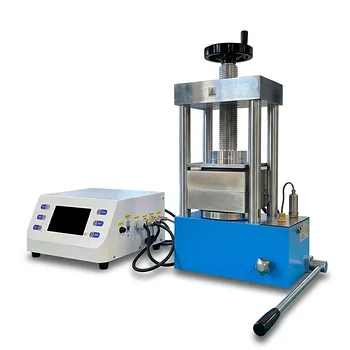
A laboratory hot press acts as the critical bonding agent in the final stages of solar cell assembly. By applying simultaneous, precise pressure and heat—typically around 125°C—it melts thermoplastic gaskets to fuse the photoelectrode and counter electrode together. This process creates a permanent, airtight enclosure essential for the device's operation.
The hot press safeguards the solar cell's lifespan by creating a hermetic seal around the internal electrolyte. By activating a thermoplastic gasket, it prevents the evaporation of vital solvents and blocks the intrusion of air, ensuring long-term stability and consistent performance.
The Mechanics of Encapsulation
Simultaneous Heat and Pressure
The effectiveness of the hot press lies in its dual-action approach. It does not simply heat the components; it applies mechanical force while maintaining a specific temperature. This ensures the sealing material flows evenly and adheres completely to the substrates.
Activation of Thermoplastic Gaskets
The process relies on specialized thermoplastic gaskets, such as Surlyn. At standard operating temperatures of approximately 125°C, these gaskets transition from a solid to a viscous state. This phase change allows the material to bond securely between the photoelectrode and the counter electrode.
Why Hermetic Sealing is Non-Negotiable
Preventing Electrolyte Loss
Many solar cell architectures rely on internal liquid electrolytes to function. Without the robust seal provided by the hot press, these volatile solvents would evaporate rapidly. Solvent loss leads to the device drying out, resulting in immediate performance degradation.
Blocking Environmental Contamination
The encapsulation process is a two-way barrier. While it keeps the electrolyte inside, it also prevents external air and moisture from penetrating the cell. Environmental contaminants can react with internal components, causing irreversible chemical instability.
Operational Precision and Constraints
Temperature Sensitivity
Success depends on strict adherence to the melting point of the gasket material. If the temperature drops below the target (e.g., 125°C), the bond will be incomplete and the seal will fail. Conversely, excessive heat could damage other heat-sensitive layers within the cell structure.
The Pressure Balance
The application of pressure requires a delicate balance. Insufficient pressure will fail to create a hermetic seal, leaving gaps for air infiltration. However, excessive pressure risks fracturing the fragile glass electrodes used in the assembly.
Making the Right Choice for Your Goal
To ensure a successful encapsulation process, you must calibrate your equipment based on your specific assembly requirements.
- If your primary focus is longevity: Ensure your hot press maintains a consistent temperature of 125°C to fully melt the Surlyn and guarantee a hermetic barrier against solvent evaporation.
- If your primary focus is mechanical yield: Prioritize precise pressure control to flatten the gasket uniformly without cracking the electrode substrates.
Precision during the hot press stage is the single most important factor in securing the long-term chemical stability of your solar cell.
Summary Table:
| Feature | Specification/Requirement | Role in Encapsulation |
|---|---|---|
| Temperature | Typically ~125°C | Melts thermoplastic gaskets (e.g., Surlyn) for bonding |
| Pressure | Controlled mechanical force | Ensures uniform gasket flow and substrate adhesion |
| Sealing Type | Hermetic / Airtight | Prevents solvent evaporation and blocks air/moisture |
| Substrates | Photoelectrode & Counter Electrode | Joins the two main components into a single unit |
| Outcome | Chemical Stability | Safeguards solar cell lifespan and device performance |
Enhance Your Solar Research with KINTEK Precision
Achieve uncompromising seal integrity and mechanical yield for your solar cell assembly. KINTEK specializes in advanced laboratory hot presses, isostatic presses, and pellet presses designed to deliver the precise temperature and pressure control required for sensitive encapsulation processes.
Whether you are working with thermoplastic gaskets like Surlyn or developing next-generation photovoltaics, our equipment ensures long-term chemical stability and prevents performance degradation. Beyond pressing solutions, we offer a comprehensive suite of laboratory tools, including high-temperature furnaces, vacuum systems, and specialized consumables.
Ready to optimize your lab's output? Contact KINTEK today to find the perfect equipment for your research goals.
References
- Ressa Muhripah Novianti, Syoni Soepriyanto. The Addition of C, Zn-C and Sn-C on Anatase Titanium Dioxide (TiO2) for Dye-Sensitized Solar Cells Application. DOI: 10.55981/metalurgi.2023.686
This article is also based on technical information from Kintek Solution Knowledge Base .
Related Products
- 30T 40T Split Automatic Heated Hydraulic Press Machine with Heated Plates for Laboratory Hot Press
- Automatic Heated Hydraulic Press Machine with Heated Plates for Laboratory Hot Press
- Heated Hydraulic Press Machine with Heated Plates Split Manual Laboratory Hot Press
- Automatic Laboratory Heat Press Machine
- 24T 30T 60T Heated Hydraulic Press Machine with Heated Plates for Laboratory Hot Press
People Also Ask
- What are the advantages of using a laboratory hydraulic press for hot pressing? Achieve Peak Nano-Composite Density
- What are the core advantages of using a laboratory hot press to produce Bi2Se3? Achieve 93% Density & High Conductivity
- Why is a laboratory hydraulic hot press essential for high-density, additive-free Silicon Carbide? Unlock Pure SiC.
- How does a laboratory hydraulic hot press ensure the quality of PHBV/natural fiber composites? Expert Guide
- What is the function of a laboratory hydraulic hot press in the assembly of solid-state photoelectrochemical cells?