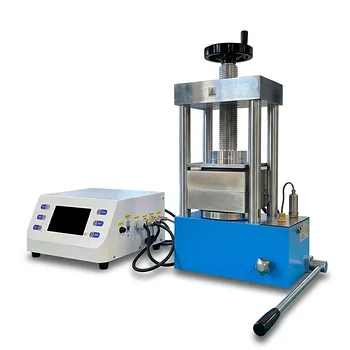
A laboratory hot press is technically indispensable for the production of plastic crystal polymer electrolyte reinforced membranes because it provides the simultaneous heat and mechanical force required to drive molten polymers into non-woven glass fiber scaffolds. Without this precise application of pressure during the melting phase, the polymer cannot overcome physical resistance to thoroughly infiltrate the scaffold, resulting in a porous, defective material rather than a unified composite.
Core Takeaway The hot press acts as a densification mechanism that eliminates structural defects by forcing the electrolyte material to flow into the microscopic voids of a supporting scaffold. This process is the only reliable way to displace trapped air and achieve the high mechanical strength and consistent ionic conductivity required for solid-state batteries.
The Mechanics of Infiltration and Densification
Overcoming Physical Barriers
The primary function of the hot press is to facilitate deep infiltration. Plastic crystal polymer electrolytes, even when molten, possess viscosity that prevents them from passively soaking into dense glass fiber scaffolds.
The Role of Simultaneous Heat and Pressure
By applying heat, the press transitions the polymer into a molten state. Simultaneously, controlled pressure forces this molten material into the intricate web of the non-woven glass fibers.
Displacement of Air
As the polymer is forced into the scaffold, the pressure physically displaces air trapped between the fibers. This is critical because air pockets act as insulators that block ion transport and act as stress points for mechanical failure.
Impact on Performance and Consistency
Maximizing Mechanical Strength
The primary reference highlights that the hot press ensures a dense composite solid-state electrolyte membrane. By eliminating voids and ensuring the polymer fully reinforces the glass fiber scaffold, the resulting membrane possesses significantly higher mechanical strength than a loose or porous alternative.
Enhancing Ionic Conductivity
While the primary goal is structural integrity, densification directly impacts performance. Supplementary data indicates that eliminating internal pores can increase ionic conductivity by nearly an order of magnitude, ensuring that ions have a continuous, uninterrupted path through the membrane.
Achieving Uniform Thickness
For comparative testing and reliable performance, membrane thickness must be exact (often targeting ranges like 25 µm to 50 µm). The hot press molds the material into a continuous film with uniform geometric dimensions, removing the variability found in solvent-cast films that haven't been pressed.
Understanding the Trade-offs
The Necessity of "Controlled" Pressure
The term "controlled pressure" is vital. If pressure is too low, infiltration will be incomplete, leaving voids within the scaffold. If pressure is excessive or uneven, it may crush the glass fiber scaffold or cause the polymer to flow out of the mold entirely, leading to inconsistent thickness.
Precision vs. Throughput
Using a laboratory hot press is a batch process designed for high precision and quality (high fidelity), often at the expense of speed. It is ideal for research and development where the priority is eliminating variables—such as internal defects or uneven surfaces—to isolate the true performance of the electrolyte chemistry.
Making the Right Choice for Your Goal
To optimize your membrane production, align your pressing parameters with your specific performance targets:
- If your primary focus is Mechanical Strength: Prioritize high-pressure settings to ensure maximum penetration of the polymer into the glass fiber scaffold, reinforcing the matrix.
- If your primary focus is Ionic Conductivity: Focus on the elimination of porosity and air voids to create a dense, continuous pathway for ion transport.
- If your primary focus is Comparative Testing: rigorous control of film thickness (e.g., maintaining a strict 50 μm gauge) is essential to ensure that differences in performance are due to chemistry, not geometry.
The laboratory hot press is not just a shaping tool; it is the critical processing step that transforms a mix of raw materials into a functional, high-performance solid-state electrolyte.
Summary Table:
| Process Factor | Role of Laboratory Hot Press | Impact on Final Membrane |
|---|---|---|
| Infiltration | Drives molten polymer into glass fiber scaffolds | Eliminates structural defects and voids |
| Densification | Displaces trapped air via simultaneous heat/pressure | Increases ionic conductivity by nearly 10x |
| Structural Integrity | Bonds polymer matrix to non-woven scaffolds | Maximizes mechanical strength for battery use |
| Precision | Controls geometric dimensions (e.g., 25-50 µm) | Ensures uniform thickness for reliable testing |
Elevate Your Battery Research with KINTEK Precision
Unlock the full potential of your solid-state electrolyte membranes with KINTEK’s advanced laboratory hot presses. Whether you are working on plastic crystal polymers or complex composite scaffolds, our high-precision hydraulic presses (including pellet, hot, and isostatic models) provide the exact heat and pressure control needed to eliminate porosity and maximize ionic conductivity.
From high-temperature furnaces and crushing systems to specialized battery research tools, KINTEK is your partner in material science innovation. Don't let air pockets compromise your results.
Contact Our Experts Today to find the perfect pressing solution for your lab!
Related Products
- 30T 40T Split Automatic Heated Hydraulic Press Machine with Heated Plates for Laboratory Hot Press
- Heated Hydraulic Press Machine with Heated Plates Split Manual Laboratory Hot Press
- Automatic Heated Hydraulic Press Machine with Heated Plates for Laboratory Hot Press
- Automatic Laboratory Heat Press Machine
- 24T 30T 60T Heated Hydraulic Press Machine with Heated Plates for Laboratory Hot Press
People Also Ask
- What are the advantages of using a laboratory hydraulic press for hot pressing? Achieve Peak Nano-Composite Density
- What are the core advantages of using a laboratory hot press to produce Bi2Se3? Achieve 93% Density & High Conductivity
- Why is a laboratory hydraulic hot press essential for high-density, additive-free Silicon Carbide? Unlock Pure SiC.
- How does a laboratory hydraulic hot press ensure the quality of PHBV/natural fiber composites? Expert Guide
- What is the function of a laboratory hydraulic hot press in the assembly of solid-state photoelectrochemical cells?