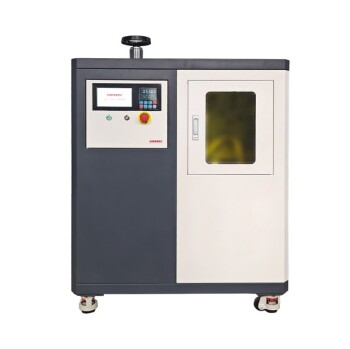
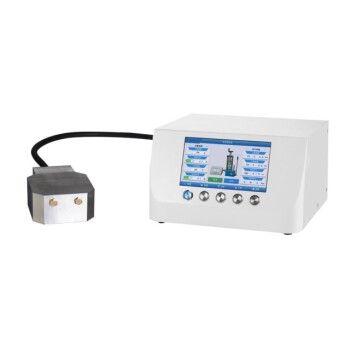
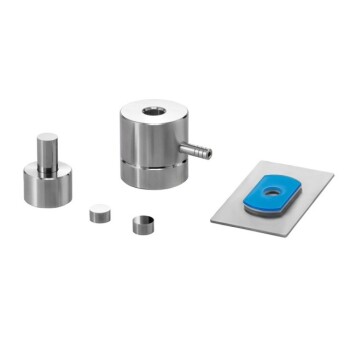
The primary technical advantage of using a hot press over solution casting is the ability to fabricate solvent-free, high-density membranes with superior structural integrity. By utilizing the dual effects of high temperature and pressure, the hot press method eliminates the internal voids and residual impurities common in casting, resulting in an electrolyte with enhanced mechanical strength and electrochemical stability.
The hot press method moves beyond simple mixture drying by physically fusing the polymer matrix and salts. This process creates a dense, pore-free three-dimensional network that is critical for maximizing both ionic conductivity and mechanical durability in solid-state batteries.
The Mechanism of Superior Densification
Eliminating Internal Defects
The solution casting method relies on solvent evaporation, which frequently leaves behind microscopic voids or "air pores" as the liquid escapes.
A hot press circumvents this by applying high pressure directly to the mixture. This force mechanically compresses the material, effectively eliminating internal air pores and creating a highly compact structure.
Achieving Molecular-Level Bonding
The application of heat allows the PEO polymer matrix to melt and flow without the need for a liquid carrier.
In this molten state, the PEO creates a molecular-level bond with lithium salts (such as LiTFSI) and additives. This facilitates the formation of a dense, continuous three-dimensional network that solution casting struggles to replicate consistently.
Electrochemical and Mechanical Benefits
Preventing Solvent-Induced Degradation
One of the most significant drawbacks of solution casting is the presence of residual solvents, which can negatively impact electrochemical performance.
The hot press operates under solvent-free conditions. This ensures the final membrane is chemically pure, preventing the side reactions or degradation often caused by trapped solvent molecules in the electrolyte.
Enhanced Mechanical Robustness
The density achieved through simultaneous heat and pressure directly translates to physical strength.
The resulting membrane possesses significantly higher mechanical strength compared to cast films. This robustness is essential for withstanding the physical stresses within a battery cell and suppressing dendrite growth.
Scalability and Production Considerations
Suitability for Mass Production
Solution casting is often a slow process due to the time required for controlled evaporation and drying.
The hot press method is highly suitable for large-scale production. By removing the drying bottleneck and allowing for direct molding, it streamlines the manufacturing workflow.
Operational Trade-offs
Thermal Stability Requirements
While the hot press offers superior densification, it introduces a thermal constraint not present in room-temperature casting.
Because the process relies on melting the polymer matrix, all components—including lithium salts and plasticizers—must be thermally stable at the processing temperature. You must ensure your specific additives (like flame retardants) do not degrade under the heat required to flow the PEO.
Making the Right Choice for Your Goal
To select the best method for your specific electrolyte development, consider your primary performance metrics:
- If your primary focus is electrochemical stability: Use the hot press to eliminate residual solvents and ensure a pure, non-reactive environment for ion transport.
- If your primary focus is mechanical durability: Use the hot press to maximize density and create a pore-free structure capable of resisting physical deformation.
- If your primary focus is manufacturing efficiency: Use the hot press to bypass lengthy drying times and streamline the transition to large-scale fabrication.
By leveraging the dual power of heat and pressure, you transform a simple mixture into a robust, high-performance solid-state system.
Summary Table:
| Feature | Hot Pressing Method | Solution Casting Method |
|---|---|---|
| Porosity | Pore-free, high-density structure | High (due to solvent evaporation) |
| Solvent Use | Solvent-free (Pure) | Requires solvents (Residual risk) |
| Mechanical Strength | Superior structural integrity | Lower robustness; prone to defects |
| Production Speed | Fast (No drying time required) | Slow (Time-consuming evaporation) |
| Bonding Level | Molecular-level physical fusion | Evaporation-based film formation |
Elevate Your Battery Research with KINTEK Precision
Transitioning from lab-scale casting to high-performance solid-state electrolyte production requires precision and reliability. KINTEK specializes in advanced laboratory equipment designed to meet the rigorous demands of material science. Our high-performance hydraulic presses (pellet, hot, and isostatic) and custom high-temperature furnaces provide the exact thermal and pressure control needed to eliminate defects and maximize the ionic conductivity of your PEO-based membranes.
Whether you are developing next-generation solid-state batteries or exploring advanced ceramics, KINTEK offers a comprehensive range of crushing systems, vacuum solutions, and specialized battery research tools to streamline your workflow.
Ready to achieve superior densification and mechanical robustness? Contact our technical experts today to find the perfect equipment solution for your laboratory’s unique requirements.
Related Products
- Automatic Heated Hydraulic Press Machine with Heated Plates for Laboratory Hot Press 25T 30T 50T
- Manual High Temperature Heated Hydraulic Press Machine with Heated Plates for Lab
- Touchscreen Automatic Vacuum Heat Press
- 30T 40T Split Automatic Heated Hydraulic Press Machine with Heated Plates for Laboratory Hot Press
- Vacuum Hot Press Furnace Machine Heated Vacuum Press
People Also Ask
- Why is the heating function of a laboratory hydraulic press essential for MEA assembly in DEFC? Optimize Cell Bonding
- What technical conditions does a heated hydraulic press provide for PEO batteries? Optimize Solid-State Interfaces
- How is a heated hydraulic press used for Li-LLZO batteries? Optimize Interfacial Bonding with Thermal-Pressure
- What role does a heated hydraulic press play in Cold Sintering (CSP)? Enhancing LATP-Halide Densification
- What are heated hydraulic presses used for? Molding Composites, Vulcanizing Rubber, and More