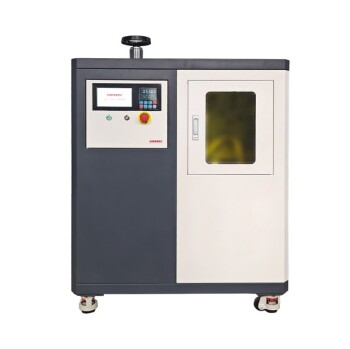
The pressure in a hot press is generated through a specific hydraulic architecture that utilizes two distinct pump types to balance speed and force. This system typically pairs a rotary pump for the initial movement with a piston pump to deliver the final, high-intensity compression.
The operational success of a hot press relies on a two-stage process: a rotary pump handles the rapid closing of the press, while a piston pump takes over to generate and maintain massive tonnage—often reaching 5000 tons—for the actual processing.
The Dual-Pump Generation System
Stage 1: The Rotary Pump
The process begins with the rotary pump. Its primary function is volume rather than intensity.
It drives the initial closing of the press plates, moving the machinery quickly into position. This allows for efficient cycle times by minimizing the time spent on non-productive movement.
Stage 2: The Piston Pump
Once the press is closed, the system switches to the piston pump. This component is responsible for generating the intense pressure required for the application.
It applies and maintains the high pressure necessary for the job, which can reach upwards of 18kg/cm². This pump is the engine behind the machine's capacity, which ranges from 100 to 5000 tons depending on the model.
Controlling and Applying the Force
The Role of Oil and Air
While pumps generate the force, the system is driven by a combination of oil pressure and compressed air.
Because the machinery relies on these fluids, ensuring sufficient air pressure and volume is critical for operation. The interaction between hydraulic oil and pneumatic systems translates the pump's mechanical energy into pressing force.
Precision Monitoring
To ensure the generated pressure matches the material's needs, modern hot presses utilize digital pressure gauges.
These allow operators to preset specific pressure ranges before the cycle begins. This digital oversight ensures consistency and prevents damage to sensitive materials.
Vacuum and Positive Pressure
Advanced application involves applying positive pressure on top of negative pressure.
The system may use a vacuum to create initial low-pressure adsorption. This is followed by high-pressure adsorption to achieve the final bond or shape, ensuring air bubbles are evacuated and the pressure is applied evenly.
Understanding the Operational Trade-offs
Complexity of Maintenance
Using a dual-pump system (rotary and piston) increases the mechanical complexity of the machine.
Operators must maintain two different mechanical systems, along with the hydraulic oil levels and compressed air supply. A failure in the air volume or oil pressure will immediately halt the ability to generate force.
Speed vs. Force
The transition between the rotary pump and the piston pump must be seamless.
If the rotary pump is too slow, cycle times increase; if the piston pump engages too early, energy is wasted. The system is designed for a specific rhythm, and disrupting this can lead to inefficient production.
Making the Right Choice for Your Goal
When evaluating hot press technology for your specific application, consider the following:
- If your primary focus is cycle speed: Prioritize a machine with a high-efficiency rotary pump system to minimize the time spent opening and closing the press.
- If your primary focus is material density and bonding: Ensure the piston pump specification meets or exceeds the 18kg/cm² threshold to guarantee sufficient holding pressure.
Understanding that pressure is a product of both hydraulic force and pneumatic volume allows you to optimize your equipment for peak performance.
Summary Table:
| Component | Pump Type | Primary Function | Key Performance Metric |
|---|---|---|---|
| Initial Movement | Rotary Pump | Rapid closing of press plates | High volume/speed |
| Compression Stage | Piston Pump | Generating & maintaining tonnage | Up to 18kg/cm² pressure |
| Force Transmission | Hydraulic/Pneumatic | Translating mechanical energy | 100 to 5000 tons capacity |
| Monitoring | Digital Gauges | Precision control & preset ranges | Real-time consistency |
Elevate Your Production with KINTEK Precision Hot Presses
Maximize your material density and bonding efficiency with KINTEK’s advanced hydraulic solutions. As experts in high-performance laboratory equipment, we provide a comprehensive range of hydraulic presses (pellet, hot, isostatic) designed to deliver precise pressure control up to 5000 tons.
Whether you are focusing on rapid cycle speeds or extreme material density, our dual-pump systems ensure seamless transitions and unmatched reliability. Beyond pressing, KINTEK supports your entire workflow with high-temperature furnaces, crushing systems, and specialized consumables like PTFE and ceramics.
Ready to optimize your lab’s efficiency? Contact our technical team today to find the perfect hot press configuration for your specific application!
Related Products
- Automatic Heated Hydraulic Press Machine with Heated Plates for Laboratory Hot Press 25T 30T 50T
- Manual High Temperature Heated Hydraulic Press Machine with Heated Plates for Lab
- Touchscreen Automatic Vacuum Heat Press
- 30T 40T Split Automatic Heated Hydraulic Press Machine with Heated Plates for Laboratory Hot Press
- Vacuum Hot Press Furnace Machine Heated Vacuum Press
People Also Ask
- Why is the heating function of a laboratory hydraulic press essential for MEA assembly in DEFC? Optimize Cell Bonding
- What technical conditions does a heated hydraulic press provide for PEO batteries? Optimize Solid-State Interfaces
- How is a heated hydraulic press used for Li-LLZO batteries? Optimize Interfacial Bonding with Thermal-Pressure
- What role does a heated hydraulic press play in Cold Sintering (CSP)? Enhancing LATP-Halide Densification
- What are heated hydraulic presses used for? Molding Composites, Vulcanizing Rubber, and More