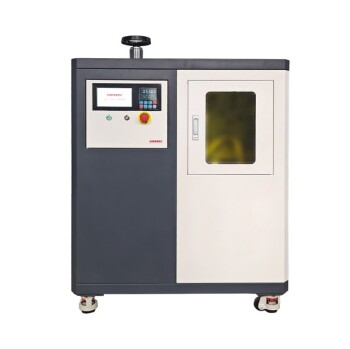
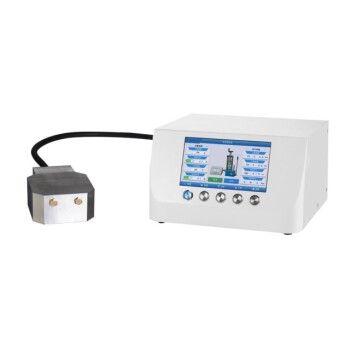
A hot press serves as the definitive bonding mechanism in the fabrication of flexible lithium batteries, applying precise thermal and mechanical energy to fuse the cathode active layer (CAL) and the gel polymer electrolyte (GPE). By subjecting these layers to specific conditions—such as 150 °C and 0.5 bar—the process eliminates the physical voids that naturally occur between distinct materials, ensuring a cohesive and continuous interface.
Core Takeaway The interface between electrodes and electrolytes is often the weakest link in flexible batteries due to poor contact and mechanical stress. Hot pressing solves this by merging the layers into a unified buffer structure, ensuring the battery can withstand bending without losing conductivity or structural integrity.
Enhancing Mechanical Integrity
Eliminating Physical Gaps
When a cathode and a polymer electrolyte are simply placed together, microscopic gaps remain at the contact points.
Applying controlled pressure and heat effectively removes these voids. This ensures maximum surface area contact, which is vital for efficient ion transfer between the CAL and the GPE.
Preventing Delamination
Flexible batteries are subjected to repeated bending and twisting, which generates shear stress between layers.
The hot press treatment significantly enhances interlayer adhesion. This strong bond prevents the layers from separating (delaminating) during mechanical deformation, ensuring the battery remains functional even when flexed.
Creating a Buffer Against Failure
Inhibiting Crack Propagation
Micro-cracks in the electrode material can lead to rapid performance degradation.
The heat-treated interface establishes a specialized "buffer structure" between the layers. This structure helps absorb stress and inhibits the propagation of cracks through the active material, preserving the battery's capacity over time.
Suppressing Lithium Dendrites
Dendrites are needle-like lithium growths that can puncture separators and cause short circuits.
The dense, gap-free interface created by hot pressing acts as a physical barrier. This structure helps inhibit the growth of these dendrites, directly contributing to the safety and reliability of the battery.
Understanding Process Precision
The Importance of Specific Parameters
The success of this treatment relies on applying the appropriate temperature and pressure, not just maximum force.
As noted in standard operating procedures, conditions like 150 °C and 0.5 bar are effective for specific chemistries. Deviating from these optimal parameters can lead to insufficient bonding (too low) or material degradation (too high).
Balancing Adhesion and Integrity
While the goal is aggressive bonding, the materials must remain chemically stable.
Using a warm isostatic press approach ensures that the compression and static heating improve performance without damaging the sensitive polymer chains or the active electrode structure.
Making the Right Choice for Your Goal
To optimize the manufacturing of flexible lithium batteries, you must tune your hot press parameters to your specific performance requirements.
- If your primary focus is Durability (Bending): Prioritize pressure settings that maximize interlayer adhesion to prevent delamination during repetitive flexing.
- If your primary focus is Safety (Cycle Life): Ensure temperature controls are precise to form a uniform buffer structure that inhibits dendrite growth and crack propagation.
By effectively utilizing a hot press, you transform two separate components into a single, robust electrochemical system.
Summary Table:
| Feature | Hot Press Benefit | Impact on Battery Performance |
|---|---|---|
| Interface Voids | Eliminates microscopic gaps | Enhances ion transfer efficiency |
| Adhesion | Strong bonding of CAL and GPE | Prevents delamination during bending |
| Structural Integrity | Creates a unified buffer structure | Inhibits crack propagation in active material |
| Safety | Dense, gap-free interface | Suppresses lithium dendrite growth |
Elevate Your Battery Research with KINTEK Precision
Unlock the full potential of your flexible lithium battery fabrication with KINTEK’s advanced hot pressing and isostatic press solutions. Our equipment is engineered to deliver the precise thermal and mechanical control—such as the critical 150 °C and 0.5 bar parameters—needed to eliminate physical voids and ensure long-term structural integrity.
Beyond our industry-leading hydraulic, hot, and isostatic presses, KINTEK specializes in a comprehensive range of laboratory equipment including high-temperature furnaces, battery research tools, and specialized consumables. Whether you are focused on suppressing dendrite growth or enhancing mechanical durability, our team of experts is ready to provide the high-performance tools your laboratory demands.
Ready to optimize your interface bonding? Contact KINTEK today for a customized solution.
Related Products
- Automatic Heated Hydraulic Press Machine with Heated Plates for Laboratory Hot Press 25T 30T 50T
- Manual High Temperature Heated Hydraulic Press Machine with Heated Plates for Lab
- Touchscreen Automatic Vacuum Heat Press
- 30T 40T Split Automatic Heated Hydraulic Press Machine with Heated Plates for Laboratory Hot Press
- Vacuum Hot Press Furnace Machine Heated Vacuum Press
People Also Ask
- Why is the heating function of a laboratory hydraulic press essential for MEA assembly in DEFC? Optimize Cell Bonding
- What technical conditions does a heated hydraulic press provide for PEO batteries? Optimize Solid-State Interfaces
- How is a heated hydraulic press used for Li-LLZO batteries? Optimize Interfacial Bonding with Thermal-Pressure
- What role does a heated hydraulic press play in Cold Sintering (CSP)? Enhancing LATP-Halide Densification
- What are heated hydraulic presses used for? Molding Composites, Vulcanizing Rubber, and More