A laboratory hot press significantly enhances the microscopic structure of polymer-ceramic composite cathodes by simultaneously applying heat and mechanical pressure. This dual action causes the polymer binder or electrolyte to soften and flow, effectively filling the microscopic voids between active material particles and conductive additives.
Core Takeaway: Hot pressing transforms a disjointed mixture into a cohesive, homogenized composite. By eliminating voids and ensuring the polymer fully coats the active materials, it establishes the continuous pathways necessary for efficient energy storage performance.
The Mechanics of Microstructural Change
Softening the Polymer Matrix
The primary mechanism begins with the application of heat, typically raising the material to temperatures such as 100°C.
At this elevated temperature, the polymer binder or solid electrolyte softens, significantly reducing its viscosity.
Flow and Gap Filling
Once softened, the external pressure forces the polymer to flow into the interstitial spaces of the electrode.
This action allows the polymer to fully fill the gaps that naturally exist between the rigid ceramic particles and conductive additives.
Homogenization of the Composite
Without this process, electrodes often suffer from particle agglomeration and uneven distribution.
Hot pressing physically forces the components together, resulting in a homogenized electrode structure where materials are uniformly distributed throughout the volume.
Optimizing Transport Pathways
Establishing Ionic Continuity
For a battery to function, ions must move freely between the cathode and anode.
By filling voids with the polymer electrolyte, hot pressing creates continuous ionic pathways, ensuring ions do not hit "dead ends" caused by air gaps.
Improving Electronic Contact
Electrons must also travel efficiently from the active material to the current collector.
The pressure ensures intimate contact between the active ceramic particles and the conductive additives, facilitating efficient electronic transport.
Understanding the Trade-offs
Thermal Limits of Polymers
While heat is necessary for flow, excessive temperatures can degrade the polymer chains.
You must ensure the processing temperature softens the material without reaching its thermal decomposition point.
Pressure Distribution
Applying pressure is critical, but uneven pressure can lead to density gradients across the electrode.
A lack of uniformity in the press can result in warping or cracking, particularly in ceramic-rich composites that are naturally brittle.
Making the Right Choice for Your Goal
To optimize your polymer-ceramic cathode fabrication, align your processing parameters with your specific performance targets:
- If your primary focus is Ionic Conductivity: Ensure the temperature is sufficient to maximize polymer flow, eliminating all air voids that act as insulators.
- If your primary focus is Structural Integrity: Calibrate the pressure to achieve high density without crushing the brittle ceramic active materials.
By mastering the balance of heat and pressure, you turn a loose powder mixture into a high-performance, integrated electrochemical system.
Summary Table:
| Mechanism | Impact on Microstructure | Performance Benefit |
|---|---|---|
| Polymer Softening | Reduces viscosity of binder/electrolyte | Enables flow into interstitial spaces |
| Gap Filling | Eliminates microscopic air voids | Creates continuous ionic pathways |
| Pressure Consolidation | Homogenizes particle distribution | Enhances electronic contact & density |
| Thermal Control | Regulates polymer chain flow | Prevents thermal decomposition/degradation |
Elevate Your Battery Research with KINTEK Precision
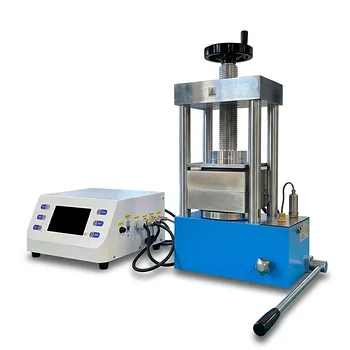
Unlock the full potential of your polymer-ceramic composite cathodes with KINTEK’s advanced laboratory hydraulic presses (pellet, hot, and isostatic). Designed for researchers who demand perfection, our equipment ensures uniform pressure and precise thermal control to eliminate voids and optimize ionic transport pathways.
From high-performance crushing and milling systems to high-temperature furnaces and specialized battery research tools, KINTEK provides the comprehensive infrastructure your lab needs. Whether you are working on solid-state electrolytes or advanced electrode homogenization, our expert solutions help you avoid density gradients and material degradation.
Ready to refine your electrode fabrication? Contact our laboratory specialists today to find the perfect hot press for your specific application.
Related Products
- 30T 40T Split Automatic Heated Hydraulic Press Machine with Heated Plates for Laboratory Hot Press
- Heated Hydraulic Press Machine with Heated Plates Split Manual Laboratory Hot Press
- Automatic Heated Hydraulic Press Machine with Heated Plates for Laboratory Hot Press
- Automatic Laboratory Heat Press Machine
- 24T 30T 60T Heated Hydraulic Press Machine with Heated Plates for Laboratory Hot Press
People Also Ask
- What are the advantages of using a laboratory hydraulic press for hot pressing? Achieve Peak Nano-Composite Density
- What are the core advantages of using a laboratory hot press to produce Bi2Se3? Achieve 93% Density & High Conductivity
- Why is a laboratory hydraulic hot press essential for high-density, additive-free Silicon Carbide? Unlock Pure SiC.
- How does a laboratory hydraulic hot press ensure the quality of PHBV/natural fiber composites? Expert Guide
- What is the function of a laboratory hydraulic hot press in the assembly of solid-state photoelectrochemical cells?