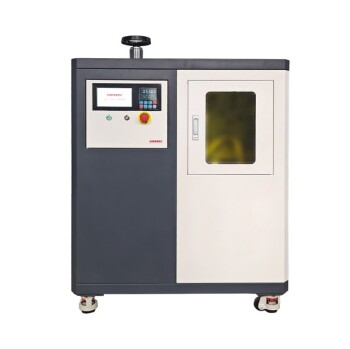
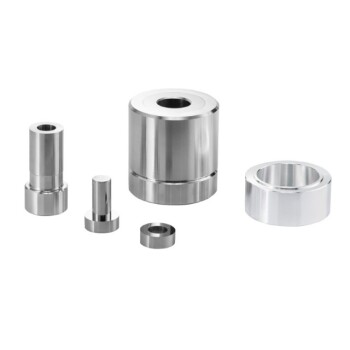
The primary advantage of using a hot press for fabricating Li7P2S8I0.5Cl0.5 electrolyte pellets is a substantial increase in ionic conductivity and physical density. By applying simultaneous heat and pressure, you can more than double the conductivity compared to cold pressing, achieving values such as 6.67 mS/cm versus 3.08 mS/cm.
By triggering plastic deformation and creep, hot pressing resolves the microscopic structural flaws that cold pressing cannot fix, resulting in a near-theoretical density and optimized ion transport.
The Mechanics of Densification
Inducing Plastic Deformation
Hot pressing allows for the application of high pressure (e.g., 350 MPa) alongside elevated temperatures (e.g., 180°C).
This combination causes the sulfide electrolyte particles to undergo plastic deformation and creep, a physical shifting of the material that does not occur under pressure alone.
Eliminating Structural Defects
Standard cold pressing often leaves microscopic gaps between particles.
The hot pressing process effectively eliminates pores and micro-cracks, creating a cohesive, solid pellet that closely matches the material's theoretical density.
Impact on Electrochemical Performance
Reducing Resistance Barriers
The primary inhibitor of performance in solid electrolytes is often grain boundary resistance, where ions struggle to jump from one particle to another.
By fusing the particles through heat and pressure, hot pressing significantly reduces this resistance, creating smoother pathways for lithium ions.
Maximizing Ionic Conductivity
The structural improvements translate directly to measurable performance gains.
For Li7P2S8I0.5Cl0.5, hot pressing can elevate ionic conductivity from 3.08 mS/cm (achieved via cold pressing) to 6.67 mS/cm.
Understanding the Trade-offs
The Risk of Thermal Instability
While hot pressing offers superior density, it is not without risk.
Sulfide electrolytes are chemically sensitive; excessive heat can lead to chemical decomposition or unwanted side reactions that degrade the material.
Complexity vs. Malleability
Cold pressing is often preferred for other sulfides (like Li10SnP2S12) because they are naturally highly malleable and can be densified sufficiently at room temperature.
Hot pressing introduces equipment complexity and thermal variables that must be strictly controlled to prevent the material from breaking down.
Making the Right Choice for Your Goal
To determine the best fabrication method for your specific application, consider your performance requirements against processing constraints:
- If your primary focus is maximizing ionic conductivity: Utilize hot pressing at approximately 180°C and 350 MPa to minimize grain boundary resistance and achieve peak performance.
- If your primary focus is process simplicity or material stability: Evaluate if the baseline conductivity of cold pressing (approx. 3 mS/cm) is sufficient, avoiding the risk of thermal decomposition.
Select hot pressing when the need for high-density, high-conductivity electrolytes outweighs the requirement for simplified room-temperature processing.
Summary Table:
| Feature | Cold Pressing | Hot Pressing (180°C/350 MPa) |
|---|---|---|
| Ionic Conductivity | ~3.08 mS/cm | ~6.67 mS/cm |
| Material Density | Lower (contains pores/cracks) | Near-theoretical (dense) |
| Mechanism | Mechanical compaction | Plastic deformation & creep |
| Grain Boundary Resistance | Higher | Significantly Reduced |
| Process Complexity | Low | Moderate (requires thermal control) |
Elevate Your Battery Research with KINTEK Precision Solutions
Unlock the full potential of your solid-state electrolyte materials with KINTEK’s high-performance hydraulic presses. Whether you require advanced hot presses for maximizing ionic conductivity through plastic deformation or isostatic presses for uniform densification, our laboratory equipment is engineered to meet the rigorous demands of sulfide electrolyte fabrication.
From battery research tools and high-temperature furnaces to specialized pellet dies and consumables, KINTEK provides the comprehensive infrastructure your lab needs to bridge the gap between material synthesis and peak electrochemical performance.
Ready to optimize your pellet fabrication process? Contact KINTEK today to consult with our experts and find the perfect pressing solution for your research goals.
Related Products
- Laboratory Hydraulic Press Split Electric Lab Pellet Press
- Warm Isostatic Press for Solid State Battery Research
- Laboratory Hydraulic Pellet Press for XRF KBR FTIR Lab Applications
- Laboratory Manual Hydraulic Pellet Press for Lab Use
- Automatic Laboratory Hydraulic Pellet Press Machine for Lab Use
People Also Ask
- What are the roles of a laboratory hydraulic press and stainless steel molds in the preparation of graphite samples?
- What is the role of a laboratory hydraulic press in electrode prep? Maximize Energy Density & Sealing Precision
- How does a laboratory hydraulic press ensure the quality of alumina-forming alloy green bodies? Optimize CSP Research
- How is a laboratory hydraulic press used to evaluate the mechanical performance of nano-modified concrete? Expert Guide
- Why is a laboratory hydraulic press used for ASSB assembly? Achieving 392 MPa for Optimal Solid-State Battery Density