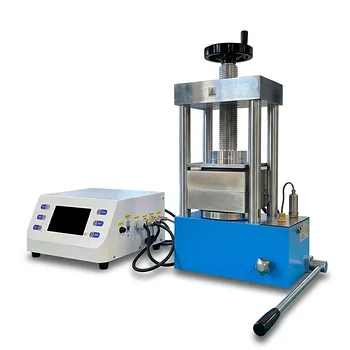
A laboratory plate hot press acts as the critical reaction vessel for the fabrication of fluorosilicone rubber. It creates a synchronized environment of high heat (specifically 140°C) and intense physical pressure. This dual mechanism serves two purposes: it physically forces the material to conform to precise dimensions and chemically triggers the reactions necessary to solidify the rubber.
The hot press functions as both a molding tool and a chemical reactor. By maintaining precise conditions, it activates platinum-catalyzed hydrosilylation, allowing POSS-V to form a robust three-dimensional network that defines the material's final physical performance.
The Mechanics of Physical Molding
Achieving Dimensional Precision
The most immediate function of the hot press is the application of substantial physical pressure.
This pressure ensures that the viscous fluorosilicone rubber flows completely into the mold cavity.
Ensuring Material Integrity
By forcing the material into every section of the mold, the press prevents voids or air pockets.
This results in a specimen with precise dimensions and a dense, uniform structure.
Chemical Activation and Crosslinking
Triggering the Reaction
The press acts as a thermal trigger, maintaining a steady temperature of 140°C.
This specific thermal environment is required to initiate the platinum-catalyzed hydrosilylation reaction.
The Role of POSS-V
Under this controlled heat, POSS-V is activated to serve as a chemical crosslinking center.
It effectively ties together the silicone rubber chains.
Network Formation
The reaction creates a complex three-dimensional network within the material.
This structural evolution is what significantly improves the rubber's final physical properties and durability.
Critical Process Controls
Synchronization is Key
The effectiveness of the hot press relies on the simultaneous application of heat and pressure.
If pressure is applied without sufficient heat, the material will mold but fail to cure chemically.
Temperature Sensitivity
The crosslinking reaction depends on precise temperature maintenance.
Deviations from the target 140°C can result in incomplete crosslinking or poor physical performance of the final product.
Optimizing Your Vulcanization Process
To achieve the best results with fluorosilicone rubber (F-LSR), align your equipment settings with your specific manufacturing goals.
- If your primary focus is Dimensional Accuracy: prioritize high and uniform pressure application to ensure the mold cavity is filled completely without defects.
- If your primary focus is Material Strength: ensure your thermal calibration is precise to fully activate the POSS-V crosslinking centers and maximize the 3D network formation.
Ultimately, the laboratory plate hot press transforms the raw compound into a high-performance material through the precise engineering of heat and pressure.
Summary Table:
| Process Phase | Function of Hot Press | Key Mechanism |
|---|---|---|
| Physical Molding | Dimensional Precision | Uniform pressure forces material into mold cavities, eliminating voids. |
| Chemical Activation | Crosslinking Initiation | Maintains 140°C to trigger platinum-catalyzed hydrosilylation. |
| Structural Formation | Network Development | Activates POSS-V to create a robust 3D molecular network for durability. |
| Process Control | Synchronization | Ensures simultaneous heat and pressure for complete vulcanization. |
Elevate Your Material Research with KINTEK Precision
Achieving the perfect vulcanization of fluorosilicone rubber requires absolute control over thermal and mechanical variables. KINTEK specializes in high-performance laboratory equipment designed for rigorous scientific standards. Our advanced hydraulic presses (pellet, hot, isostatic) and high-temperature furnaces provide the stability and precision needed to activate complex crosslinking reactions like POSS-V hydrosilylation.
From crushing and milling systems to specialized PTFE and ceramic consumables, KINTEK offers a comprehensive ecosystem for rubber, battery, and advanced materials research. Ensure your specimens achieve maximum dimensional accuracy and structural integrity with our industry-leading solutions.
Ready to optimize your molding and curing process? Contact our laboratory specialists today to find the ideal equipment for your F-LSR applications!
References
- Jae Il So, Yingjie Qian. Improvement of Heat Resistance of Fluorosilicone Rubber Employing Vinyl-Functionalized POSS as a Chemical Crosslinking Agent. DOI: 10.3390/polym15051300
This article is also based on technical information from Kintek Solution Knowledge Base .
Related Products
- 30T 40T Split Automatic Heated Hydraulic Press Machine with Heated Plates for Laboratory Hot Press
- Automatic Heated Hydraulic Press Machine with Heated Plates for Laboratory Hot Press 25T 30T 50T
- 24T 30T 60T Heated Hydraulic Press Machine with Heated Plates for Laboratory Hot Press
- Automatic High Temperature Heated Hydraulic Press Machine with Heated Plates for Lab
- Automatic Heated Hydraulic Press Machine with Heated Plates for Laboratory Hot Press
People Also Ask
- What are the advantages of using a laboratory hydraulic press for hot pressing? Achieve Peak Nano-Composite Density
- What are the core advantages of using a laboratory hot press to produce Bi2Se3? Achieve 93% Density & High Conductivity
- Why is a laboratory hydraulic hot press essential for high-density, additive-free Silicon Carbide? Unlock Pure SiC.
- How does a laboratory hydraulic hot press ensure the quality of PHBV/natural fiber composites? Expert Guide
- What is the function of a laboratory hydraulic hot press in the assembly of solid-state photoelectrochemical cells?