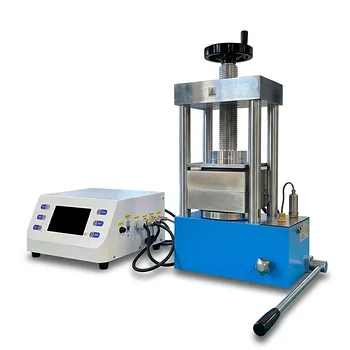
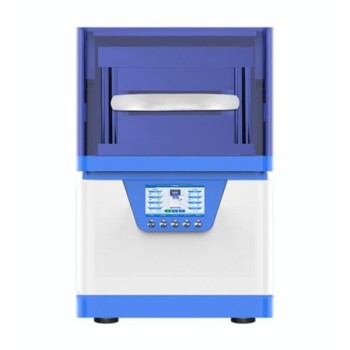
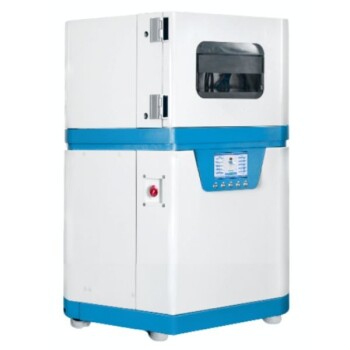
The simultaneous application of high heat and unidirectional pressure is the defining advantage of using a laboratory hydraulic press for this application. For nano-alumina/silicon carbide composites, this method significantly outperforms conventional sintering by reducing the required temperature and processing time, which is essential for preserving the material's nanostructure.
Core Takeaway Hot pressing decouples densification from high thermal loads, allowing you to achieve near-theoretical density without the excessive heat that causes grain coarsening. This process creates a dense, uniform ceramic composite that retains the critical nanometer-scale features required for high-performance applications.
The Physics of Enhanced Densification
Lowering Activation Energy
The primary advantage of the hydraulic press in this context is the reduction of the sintering temperature.
By applying external mechanical pressure, you provide additional driving force for densification. This allows the ceramic powder to sinter effectively at temperatures significantly lower than those required for pressureless sintering.
Shortening the Thermal Cycle
In addition to lowering temperatures, the hydraulic press drastically shortens the insulation (dwell) time.
Prolonged exposure to peak heat is often necessary in standard processes to remove pores. With the assist of hydraulic pressure, particle rearrangement and plastic flow occur much faster, reducing the time the material must remain under thermal stress.
Preserving the "Nano" Microstructure
Inhibiting Grain Growth
The most critical challenge in preparing nano-composites is preventing the grains from growing into the micro-scale during heating.
Because the hydraulic press enables sintering at lower temperatures and for shorter durations, it effectively inhibits grain growth. This "freezes" the nanometric structure in place, ensuring the final composite retains the unique mechanical properties associated with nano-ceramics.
Promoting Interfacial Reactions
The combination of pressure and heat does more than just compact the powder; it actively drives chemical changes.
The process promotes chemical reactions at the interfaces between the alumina and silicon carbide. This results in strong bonding between the matrix and the reinforcement phases, leading to a composite that is not only dense but chemically integrated.
Structural Integrity and Performance
Eliminating Porosity
A laboratory hydraulic press is highly effective at mechanically closing voids and eliminating porosity.
As noted in broader composite applications, removing these voids is critical for ensuring reliable performance data. In the context of ceramics, this results in a transition from a loosely packed powder state to a fully dense, forged-like state with superior toughness.
Uniformity and High Performance
The outcome of these combined factors is a composite material that is dense, uniform, and high-performance.
Unlike conventional methods that may leave residual micropores or agglomerated particles, hot pressing ensures a consistent distribution of the nanometer-scale features throughout the material.
Understanding the Trade-offs
Geometry Limitations
While hot pressing is superior for material properties, it is generally limited to simple shapes (plates, disks, or cylinders).
Because the pressure is unidirectional, creating complex 3D geometries is difficult without subsequent machining. The process is ideal for creating test billets or simple components, but less flexible than pressureless sintering for intricate parts.
Density Gradients
It is important to acknowledge that friction between the powder and the die wall can occasionally create density gradients.
While the resulting material is generally uniform, the unidirectional nature of the force means that the center of the sample may experience slightly different densification dynamics compared to the edges, specifically in thicker samples.
Making the Right Choice for Your Goal
To maximize the utility of a laboratory hydraulic press for your nano-alumina/SiC composites, consider your specific research objectives:
- If your primary focus is keeping grains small: Utilize the press to minimize dwell time and temperature, as this is the only reliable way to prevent grain coarsening in nano-powders.
- If your primary focus is mechanical toughness: Focus on the press's ability to eliminate residual micropores, as achieving near-theoretical density is the single biggest factor in ceramic fracture toughness.
Use hot pressing when the integrity of the nanostructure is more critical than the geometric complexity of the final part.
Summary Table:
| Advantage | Impact on Nano-Alumina/SiC Composites | Benefit to Researcher |
|---|---|---|
| Lower Sintering Temp | Reduces thermal activation energy required | Prevents unwanted grain growth |
| Shortened Dwell Time | Fast particle rearrangement and plastic flow | Preserves nanometric microstructure |
| Mechanical Pressure | Eliminates residual micropores and voids | Near-theoretical density & toughness |
| Interfacial Bonding | Drives chemical reactions at grain boundaries | Enhanced material structural integrity |
| Uniformity | Ensures consistent phase distribution | Reliable, high-performance data |
Elevate Your Material Research with KINTEK Precision
Unlock the full potential of your nano-ceramics by mastering densification and microstructure control. KINTEK specializes in advanced laboratory equipment designed for the most demanding research environments. From high-performance hydraulic presses (pellet, hot, isostatic) and high-temperature furnaces (muffle, vacuum, CVD) to precision crushing and milling systems, we provide the tools you need to achieve near-theoretical density and superior material properties.
Whether you are developing nano-composites, advancing battery research, or testing dental ceramics, our comprehensive portfolio—including high-pressure reactors, cooling solutions, and premium consumables like PTFE and alumina crucibles—is engineered for excellence.
Ready to transform your laboratory workflows? Contact our technical experts today to find the perfect solution for your specific application.
References
- Masaki Narisawa. Silicone Resin Applications for Ceramic Precursors and Composites. DOI: 10.3390/ma3063518
This article is also based on technical information from Kintek Solution Knowledge Base .
Related Products
- 30T 40T Split Automatic Heated Hydraulic Press Machine with Heated Plates for Laboratory Hot Press
- 24T 30T 60T Heated Hydraulic Press Machine with Heated Plates for Laboratory Hot Press
- Automatic Heated Hydraulic Press Machine with Heated Plates for Laboratory Hot Press 25T 30T 50T
- Automatic High Temperature Heated Hydraulic Press Machine with Heated Plates for Lab
- Manual High Temperature Heated Hydraulic Press Machine with Heated Plates for Lab
People Also Ask
- What are the core advantages of using a laboratory hot press to produce Bi2Se3? Achieve 93% Density & High Conductivity
- Why is a laboratory hydraulic hot press essential for high-density, additive-free Silicon Carbide? Unlock Pure SiC.
- How does a laboratory hydraulic hot press ensure the quality of PHBV/natural fiber composites? Expert Guide
- What is the function of a laboratory hydraulic hot press in the assembly of solid-state photoelectrochemical cells?
- How does a laboratory hot press improve alloy performance? Optimize Liquid Phase Sintering for High-Strength Materials