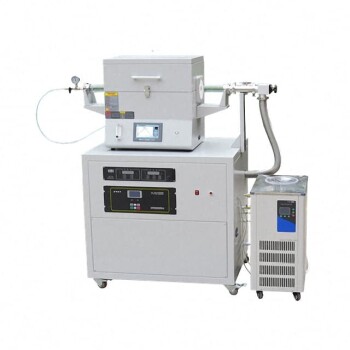
The horizontal Chemical Vapor Deposition (CVD) reactor acts as the central processing unit for the synthesis of carbon nanotubes (CNTs). It creates a high-temperature, atmosphere-controlled micro-reaction environment that converts gas-phase carbon into solid-phase nanomaterials. By precisely regulating the flow rates of nitrogen carrier gas and acetylene carbon source gas, the reactor enables the directional decomposition of carbon and its subsequent nucleation on a catalyst surface.
The horizontal CVD reactor bridges the gap between raw chemical inputs and structured nanomaterials. It provides the strict thermal and atmospheric stability required to dictate the specific physical architecture of multi-walled carbon nanotubes.
Establishing the Micro-Reaction Environment
Precise Atmospheric Control
The primary function of the horizontal reactor is to maintain a specific gas composition. It regulates the introduction of acetylene, which serves as the carbon source, and nitrogen, which acts as the carrier gas.
By controlling these flow rates, the equipment ensures that the carbon source is delivered consistently to the reaction zone. This regulation is critical for shifting the material from a gas phase to a solid phase with high purity.
Thermal Regulation
To trigger the necessary chemical changes, the reactor creates a high-temperature environment. The chamber typically operates between 700 and 900 degrees Celsius.
This specific thermal window is required to effectively decompose hydrocarbon gases. It brings the system to a state where the chemical reactivity is high enough to break down the gas but stable enough to prevent chaotic growth.
The Mechanism of Nanotube Growth
Directional Decomposition
Inside the reactor, the carbon source gas undergoes directional decomposition. This means the breakdown of the gas is not random; it is guided by the flow and thermal gradient of the horizontal setup.
This controlled breakdown is the first step in organizing carbon atoms into the cylindrical lattice structure of a nanotube rather than amorphous soot.
Catalyst Nucleation
The reactor facilitates the interaction between free carbon atoms and metal catalysts, such as iron, nickel, or cobalt. At the critical temperatures maintained by the reactor, carbon becomes soluble within these metal particles.
Once the solubility limit is reached, the carbon precipitates out of the metal. This precipitation is the "nucleation" point where the nanotube begins to grow, anchoring the structure and defining its initial diameter.
Structural Engineering
The reactor's environment allows for the synthesis of complex structures, specifically multi-walled carbon nanotubes.
By tuning the reactor's conditions, operators can influence the macroscopic properties of the nanotubes. This includes controlling the density of the growth (often referred to as forests) and the wall thickness, resulting in materials with high mechanical strength.
Understanding the Critical Dependencies
Sensitivity to Temperature
While the reactor enables high-yield growth, the process is highly sensitive to thermal fluctuations. The environment must remain strictly within the 700-900°C range.
If the temperature drops too low, the hydrocarbon gases will not decompose effectively. If it drifts too high, the solubility dynamics of the catalyst change, potentially altering the nanotube's wall count or introducing defects.
Complexity of Parameter Interaction
The horizontal CVD process is not a "set and forget" operation. It relies on the balance between gas flow rates and temperature.
Changing the ratio of nitrogen to acetylene without adjusting the temperature can disrupt the nucleation process. This interdependence makes the reactor a tool of high precision that requires exact calibration to achieve consistent results.
Making the Right Choice for Your Goal
Depending on your specific requirements for the carbon nanotubes, you must manipulate the reactor's settings differently.
- If your primary focus is Structural Strength: Prioritize the precise ratio of acetylene to carrier gas to ensure the robust formation of multi-walled structures.
- If your primary focus is High Yield: Focus on maintaining the upper limits of the thermal window (near 900°C) to maximize the solubility and precipitation rate of carbon in the catalyst.
- If your primary focus is Purity: Ensure the carrier gas flow is optimized to flush byproducts, preventing the introduction of impurities during the gas-to-solid phase transition.
The horizontal CVD reactor is the definitive tool for converting volatile gas into organized, high-strength matter through rigorous environmental control.
Summary Table:
| Key Feature | Role in CNT Growth | Impact on Output |
|---|---|---|
| Atmospheric Control | Regulates acetylene and nitrogen flow | Ensures high purity and consistent carbon delivery |
| Thermal Regulation | Maintains 700°C - 900°C window | Triggers hydrocarbon decomposition and stable nucleation |
| Directional Decomposition | Guides gas-to-solid phase transition | Prevents amorphous soot and organizes cylindrical lattices |
| Catalyst Interaction | Facilitates carbon solubility and precipitation | Defines nanotube diameter and structural anchoring |
| Multi-walled Synthesis | Tunes macroscopic material properties | Controls wall thickness and mechanical strength |
Elevate Your Nanomaterial Synthesis with KINTEK
Precision is the backbone of successful carbon nanotube growth. At KINTEK, we provide industry-leading horizontal CVD reactors, vacuum systems, and CVD/PECVD solutions designed to give you absolute control over thermal and atmospheric variables. Whether you are focused on maximizing yield, purity, or structural strength, our high-performance laboratory equipment ensures reproducible results for the most demanding research.
Ready to optimize your lab’s capabilities? Contact KINTEK Today to Consult Our Experts
References
- A. S. A. Syed Mohammed Buhari, Yusuf Olanrewaju Busari. Mechanical and Corrosion Protection Characteristics of CNTs/epoxy resin Nanocomposite Coating on Buried API 5L X65 Steel Storage Tank. DOI: 10.21315/jps2023.34.1.8
This article is also based on technical information from Kintek Solution Knowledge Base .
Related Products
- Customer Made Versatile CVD Tube Furnace Chemical Vapor Deposition Chamber System Equipment
- Cylindrical Resonator MPCVD Machine System Reactor for Microwave Plasma Chemical Vapor Deposition and Lab Diamond Growth
- Split Chamber CVD Tube Furnace with Vacuum Station Chemical Vapor Deposition System Equipment Machine
- Microwave Plasma Chemical Vapor Deposition MPCVD Machine System Reactor for Lab and Diamond Growth
- Horizontal High Temperature Graphite Vacuum Graphitization Furnace
People Also Ask
- What is a CVD tube furnace? A Complete Guide to Thin-Film Deposition
- What is the function of a high-temperature CVD tube furnace in 3D graphene foam prep? Master 3D Nanomaterial Growth
- What are the technical advantages of using a CVD tube furnace? Optimize Silicon-Carbon Battery Anodes
- How does a CVD tube furnace inhibit the sintering of silver supports? Boost Membrane Durability and Performance
- What is the function of a tube furnace in CVD SiC synthesis? Achieving Ultra-Pure Silicon Carbide Powders