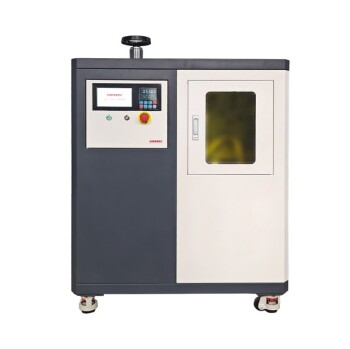
The Hot Isostatic Pressing (HIP) furnace serves as a critical refinement tool for high-performance materials like Antimony-doped Tin Oxide (ATO). By subjecting the material to extreme isotropic gas pressure—often up to 200 MPa—within a high-temperature environment, the furnace effectively collapses internal voids. This process eliminates microporosity and microcracks, transforming the ATO into a denser, more uniform structure that is essential for advanced applications.
While standard sintering creates the basic material form, the HIP process perfects its internal architecture. It drives ATO closer to its theoretical density, simultaneously boosting mechanical strength and optimizing critical electrical and optical properties.
How the HIP Process Works
Applying Isotropic Pressure
Unlike conventional pressing, which applies force from one or two directions, a HIP furnace utilizes isotropic gas pressure. This means the pressure is applied equally from every direction against the material surface.
Eliminating Internal Defects
The combination of heat and pressure (up to 200 MPa) acts to heal the material internally. It forces the material to yield and flow into internal voids, effectively closing microporosity and microcracks that naturally occur during initial processing.
Optimizing Antimony-doped Tin Oxide (ATO)
Reducing Bulk Resistivity
For conductive materials like ATO, internal voids act as barriers to electron flow. By eliminating these voids, the HIP process creates a continuous path for conduction, substantially reducing bulk resistivity.
Improving Optical Transmittance
Pores and cracks within a ceramic material scatter light, reducing its clarity. By densifying the ATO and removing these scattering centers, the HIP furnace optimizes optical transmittance, making the material more effective for transparent conductive applications.
Maximizing Structural Integrity
The elimination of microcracks does more than just densify the material; it removes the stress concentrations where failures typically begin. This results in significantly enhanced structural strength and durability.
Understanding the Operational Trade-offs
Complexity vs. Necessity
The HIP process is an advanced post-processing step, adding time and energy consumption to the manufacturing cycle. It is not merely a "finishing" step but a transformative one involving high pressures and temperatures.
The Requirement for Uniformity
This process is specifically designed for applications where structural uniformity is non-negotiable. If the end-application does not require high optical clarity or maximum conductivity, the significant improvements provided by HIP may exceed the project's requirements.
Evaluating HIP for Your Material Goals
To determine if Hot Isostatic Pressing is the right step for your ATO processing, consider your specific performance metrics:
- If your primary focus is Electrical Performance: The HIP process is essential for achieving the lowest possible bulk resistivity by removing internal voids that impede conductivity.
- If your primary focus is Optical Quality: This method is required to minimize light scattering caused by porosity, thereby maximizing transmittance.
- If your primary focus is Mechanical Durability: Use a HIP furnace to heal microcracks and achieve near-theoretical density for maximum structural strength.
Ultimately, the HIP furnace bridges the gap between a porous, standard ceramic and a fully dense, high-performance component ready for demanding technical applications.
Summary Table:
| Feature | Standard Sintering | Hot Isostatic Pressing (HIP) |
|---|---|---|
| Pressure Application | Uniaxial or Cold Isostatic | Isotropic (360° Gas Pressure) |
| Material Density | Standard Density | Near-Theoretical Density |
| Internal Defects | Contains Microporosity/Cracks | Eliminates Voids & Microcracks |
| Electrical Performance | Higher Resistivity | Lowest Bulk Resistivity |
| Optical Quality | Moderate Transmittance | Maximum Transmittance |
| Structural Strength | Basic | Enhanced Durability |
Elevate Your Material Performance with KINTEK HIP Solutions
Are you struggling with material porosity or inconsistent electrical properties in your advanced ceramics? KINTEK specializes in precision laboratory equipment designed to push the boundaries of material science. Our Hot Isostatic Pressing (HIP) furnaces, along with our comprehensive range of isostatic and hydraulic presses, provide the extreme pressure and temperature control required to achieve near-theoretical density and superior structural integrity.
Whether you are refining Antimony-doped Tin Oxide (ATO), developing high-performance battery materials, or conducting advanced metallurgy, KINTEK offers the technical expertise and high-quality consumables—from specialized crucibles to ceramic tooling—to ensure your research translates into success.
Ready to eliminate defects and maximize conductivity? Contact KINTEK experts today to find the perfect HIP or pressing solution for your lab!
References
- Wen He, Haowei Huang. Advancements in Transparent Conductive Oxides for Photoelectrochemical Applications. DOI: 10.3390/nano14070591
This article is also based on technical information from Kintek Solution Knowledge Base .
Related Products
- 600T Vacuum Induction Hot Press Furnace for Heat Treat and Sintering
- Warm Isostatic Press for Solid State Battery Research
- Laboratory High Pressure Vacuum Tube Furnace
- Controlled Nitrogen Inert Hydrogen Atmosphere Furnace
- Vacuum Heat Treat and Pressure Sintering Furnace for High Temperature Applications
People Also Ask
- What role does an induction vacuum hot pressing furnace play in sintering? Achieve 98% Density in Carbide Blocks
- What advantages does a vacuum hot press furnace provide for LSLBO ceramic electrolytes? Achieve 94% Relative Density
- What role does a Vacuum Hot Press (VHP) furnace play in the densification of austenitic stainless steel 316 composites?
- What role does mechanical pressure play during the vacuum diffusion bonding of tungsten and copper? Keys to Solid Bonding
- What are the advantages of a vacuum hot press furnace for W-50%Cu? Achieve 99.6% Density at Lower Temperatures