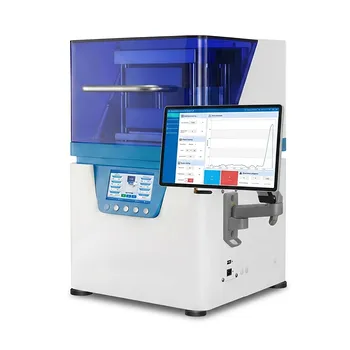
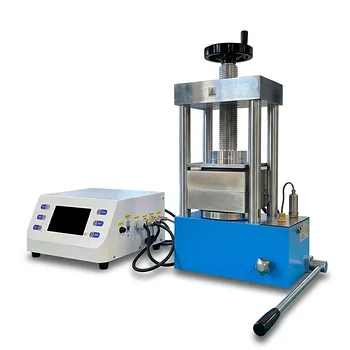
The laboratory hydraulic press serves as the critical instrument for transforming loose lead silicate powder into a structured, high-density "green body" with engineered micro-porosity. By applying precise, controlled force—typically around 5 tons—the press facilitates the mechanical rearrangement of particles into cylindrical pellets. This process is not merely about shaping; it is essential for creating the physical channels required for gas diffusion during subsequent chemical reduction stages.
Core Takeaway: A laboratory hydraulic press provides the precise pressure control necessary to balance mechanical density with a specific level of micro-porosity, ensuring lead silicate pellets are structurally sound yet permeable enough for successful hydrogen reduction.
Achieving Geometric and Mechanical Integrity
Formation of the Green Body
The primary role of the hydraulic press is to consolidate loose powder into a green compact. This physical extrusion process expels air trapped between particles, resulting in a pellet with a predetermined geometric shape and sufficient mechanical strength for handling.
Mechanical Interlocking of Particles
Under high pressure, lead silicate particles undergo mechanical interlocking and increased surface contact. This tight contact is a foundational requirement for preventing cracks or deformations during the intense temperature variations of later thermal processing.
Precision in Dimensions
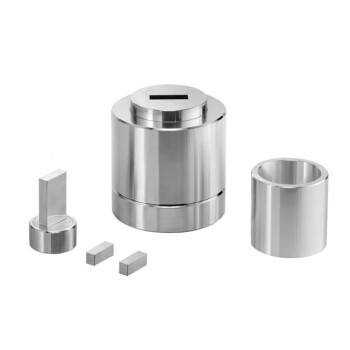
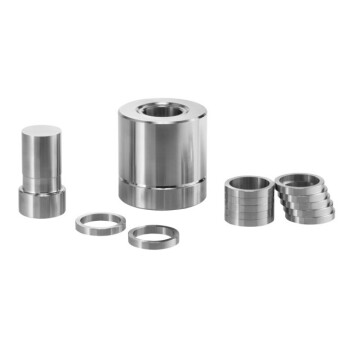
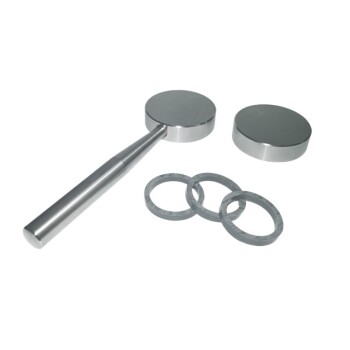
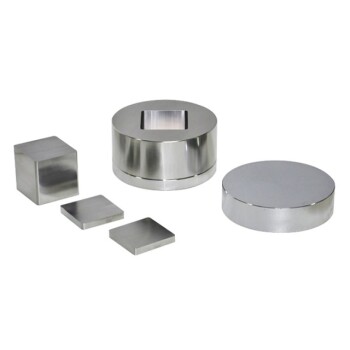
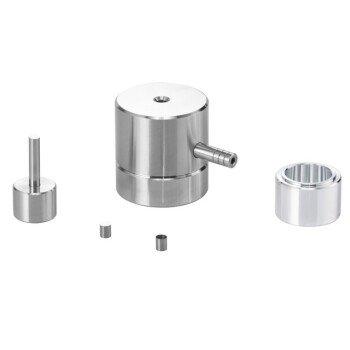
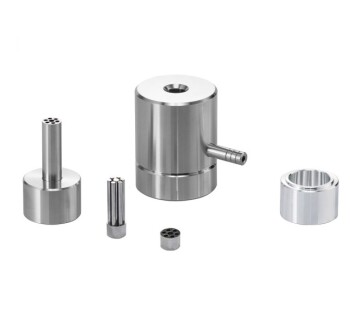
Utilizing precision steel molds, the press ensures that every pellet maintains a fixed diameter and thickness. This consistency is vital for researchers who require repeatable data across multiple experimental trials.
Engineering Micro-porosity for Chemical Reactivity
Creating Diffusion Channels
The hydraulic press does not aim for absolute density; rather, it facilitates a specific micro-porosity. These microscopic pores act as necessary physical channels that allow reducing gases, such as hydrogen, to penetrate the pellet.
Facilitating Hydrogen Reduction
Without the controlled pressure of the hydraulic press, the lead silicate would either be too loose to handle or too dense for gas to enter. The press ensures that hydrogen reduction can occur smoothly throughout the entire volume of the pellet, rather than just on the surface.
Enhancing Reaction Kinetics
By increasing the contact area between particles while maintaining porosity, the press optimizes solid-phase reaction kinetics. This ensures that subsequent heat treatments result in a high-density, uniform final product with consistent structural properties.
Understanding the Trade-offs and Pitfalls
The Pressure-Porosity Paradox
There is a critical trade-off between structural density and gas permeability. If the pressure applied is too low, the pellet will lack mechanical integrity; if it is too high, the micro-pores will collapse, effectively "sealing" the pellet and preventing hydrogen diffusion.
Internal Density Gradients
Inconsistent application of force can lead to density gradients within the pellet. These gradients often cause internal stresses that result in warping or fracturing during the sintering or reduction phases.
Mold Friction and Contamination
High-pressure molding can lead to friction between the lead silicate and the steel mold walls. This can cause surface imperfections or introduce trace contaminants if the mold is not properly lubricated or cleaned between uses.
How to Apply This to Your Project
To achieve the best results with lead silicate powder molding, your approach must be dictated by the intended final application of the material.
- If your primary focus is gas-phase reduction (e.g., hydrogen reduction): Prioritize lower, highly repeatable pressure settings (like the 5-ton standard) to ensure that the internal micro-porosity remains open for gas penetration.
- If your primary focus is material hardness or structural density: Utilize higher tonnage to eliminate as many voids as possible, focusing on maximizing the contact area between particles for solid-phase sintering.
- If your primary focus is experimental repeatability: Implement high-precision steel molds and digital pressure monitoring to eliminate human error and ensure every "green body" has identical dimensions and density.
The laboratory hydraulic press is the bridge between raw chemical powder and a functional, reactive material specimen.
Summary Table:
| Key Role | Technical Function | Impact on Lead Silicate Processing |
|---|---|---|
| Green Body Formation | Consolidates loose powder into a structured shape | Provides the mechanical strength needed for handling and processing. |
| Porosity Engineering | Creates controlled micro-channels for gas diffusion | Ensures hydrogen can penetrate the pellet for complete chemical reduction. |
| Mechanical Interlocking | Increases surface contact and expels trapped air | Prevents cracks, warping, and deformation during high-temperature stages. |
| Dimensional Precision | Utilizes precision steel molds for fixed geometry | Guarantees repeatable data and consistency across experimental trials. |
Elevate Your Material Research with KINTEK Precision
Achieving the perfect balance between mechanical density and gas permeability in lead silicate requires equipment built for precision. KINTEK specializes in high-performance laboratory solutions, offering a comprehensive range of hydraulic pellet presses (manual, electric, and isostatic) and high-temperature furnaces (muffle, tube, and vacuum) tailored for advanced material synthesis.
Whether you are engineering micro-porosity for hydrogen reduction or maximizing structural density for solid-phase sintering, our tools provide the repeatability and control your research demands. Beyond presses, we offer essential consumables like high-precision molds, ceramic crucibles, and PTFE products to ensure a contamination-free workflow.
Ready to optimize your powder molding process? Contact our technical specialists today to find the ideal equipment for your lab and accelerate your breakthrough!
References
- A. Rukini, Tim Van Rompaey. Kinetics and Mechanism of Hydrogen Reduction of Lead-Silicate Slag. DOI: 10.1007/s11663-023-02889-z
This article is also based on technical information from Kintek Solution Knowledge Base .
Related Products
- Ball Press Mold for Lab
- Round Bidirectional Press Mold for Lab
- Fully Automatic Heated Hydraulic Lab Press for Materials Sintering and Sample Preparation
- Automatic Laboratory Hot Press 400x400 mm with Programmable High Temperature and Hydraulic Force Control
- Assemble Square Lab Press Mold for Laboratory Applications
People Also Ask
- What are the advantages of using a laboratory hydraulic press for hot pressing? Achieve Peak Nano-Composite Density
- How to use a press mold? Master the Art of Creating Consistent Ceramic Forms
- What is the press mould method? A Guide to Consistent, Detailed Ceramic Forms
- What is the purpose of specialized pressure devices in sulfide solid-state batteries? Ensure Chemo-Mechanical Stability
- Why are pressure molds with non-conductive resin inner walls required for battery testing? Ensure Data Accuracy