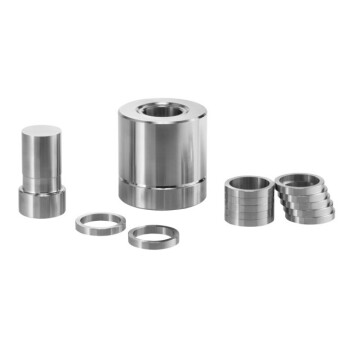
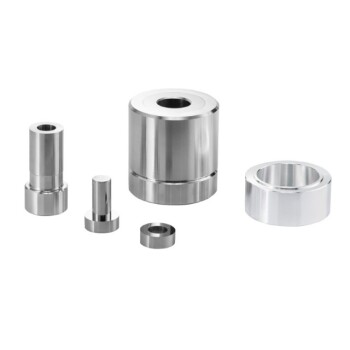
The steel pellet die serves as the critical interface between hydraulic force and the final ceramic form. In the molding of BZY20 ceramics, its primary role is to define precise geometries—specifically 19mm diameter discs or rectangular bars—while maintaining structural integrity under significant uniaxial pressure. By utilizing a high surface finish to minimize friction, the die ensures uniform density and prevents common structural failures in the green body.
Success in ceramic processing is determined before the sintering stage. A precision steel die acts as a defect-mitigation tool, converting raw powder into a homogeneous solid capable of yielding accurate conductivity data.
The Mechanics of High-Pressure Molding
Defining Precise Geometry
The steel pellet die is responsible for the exact physical dimensions of your test samples. Whether you are producing 19mm discs for general characterization or rectangular bars for specific conductivity tests, the die restricts the powder laterally to create a consistent shape. This geometric consistency is essential for the reproducibility of subsequent electrical measurements.
Withstanding Uniaxial Force
During hydraulic forming, the die must endure immense stress without deforming. It acts as a rigid containment vessel that channels uniaxial pressure directly into the BZY20 powder. This rigidity ensures that the force applied by the press translates efficiently into the compaction of the ceramic particles.
The Criticality of Surface Finish
Reducing Wall Friction
The interaction between the powder and the die walls is a defining factor in sample quality. A die with a high surface finish significantly reduces friction at this interface. Lower friction allows the powder to slide smoothly against the walls during compression, rather than dragging or sticking.
Ensuring Uniform Pressure Distribution
When friction is minimized, pressure is transmitted more evenly throughout the powder bed. This leads to uniform density across the entire sample. Without this uniformity, the center of the disc might be denser than the edges (or vice versa), leading to warping or cracking during the firing process.
Common Pitfalls: Defects to Avoid
Preventing Delamination
One of the most severe issues in dry pressing is delamination, where the sample splits into layers. This is often caused by trapped air or uneven stress release upon ejection. A precision die with proper clearance and smooth walls helps prevent these structural inconsistencies.
Avoiding Edge Chipping
Edge strength is a common weakness in green ceramic bodies. The die's design and finish play a vital role in preventing edge chipping during the ejection phase. A smooth release ensures the sample retains its sharp, defined geometry, which is critical for accurate dimensional analysis.
Ensuring Sample Integrity for Testing
To maximize the reliability of your BZY20 conductivity tests, consider the following regarding your tooling:
- If your primary focus is Structural Homogeneity: Ensure the die’s inner walls possess a mirror-like finish to minimize density gradients caused by friction.
- If your primary focus is Geometric Accuracy: Verify that the die assembly creates sharp, defect-free edges to prevent micro-cracks that could propagate during sintering.
Reliable ceramic data begins with the mechanical integrity of the pressing tool.
Summary Table:
| Feature | Function in BZY20 Molding | Impact on Sample Quality |
|---|---|---|
| Geometry Control | Defines 19mm discs/rectangular bars | Ensures reproducible conductivity data |
| Surface Finish | Minimizes wall friction during pressing | Prevents density gradients & internal stress |
| Rigid Containment | Channels uniaxial force into powder | Achievement of high green body density |
| Smooth Ejection | Reduces mechanical drag during release | Prevents delamination and edge chipping |
Elevate Your Ceramic Research with KINTEK Precision Tooling
High-performance materials like BZY20 require more than just force; they require precision. KINTEK specializes in advanced laboratory solutions designed to ensure your samples meet the most rigorous standards. From our high-polish steel pellet dies and hydraulic presses (pellet, hot, isostatic) to our specialized high-temperature furnaces and crushing and milling systems, we provide the end-to-end reliability your research demands.
Whether you are developing solid oxide fuel cells or conducting advanced conductivity tests, KINTEK offers the consumables and equipment—including ceramics, crucibles, and high-pressure reactors—to optimize your workflow.
Ready to eliminate structural defects and achieve superior data accuracy? Contact our laboratory specialists today to find the perfect molding solution for your lab.
Related Products
People Also Ask
- What is the purpose of using a mold for pellet pressing when preparing catalyst test samples? Ensure Data Consistency
- What are the advantages of using the pressed pellet method for XRF sample preparation? Optimize Your XRF Analysis
- What is the pressed powder pellet method? A Guide to Accurate FTIR Sample Preparation
- How does the selection of a pressure mold affect the performance of all-solid-state batteries? Expert Pelletizing Guide
- What are the different types of XRF samples? A Guide to Solid, Powder, and Liquid Prep