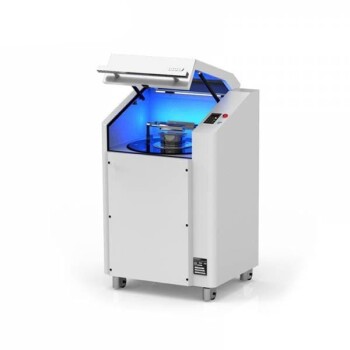
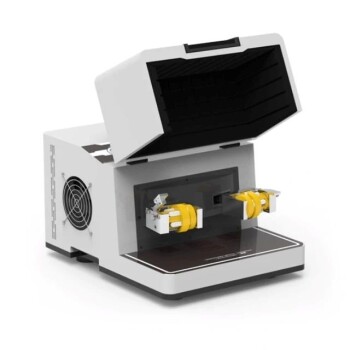
Grinding equipment acts as the critical mechanical activation step in the preparation of Ni-Al2O3-TiO2 composite powders. By utilizing the impact and shear forces of steel balls, the equipment refines the nickel matrix while uniformly dispersing alumina and nano-titania reinforcements over a processing period of approximately one hour.
The ball milling process does more than simply mix ingredients; it physically breaks down nanoparticle agglomerates and increases the powder's surface energy. This mechanical alloying is essential to create the favorable kinetic conditions required for successful solid-state diffusion sintering later in the manufacturing pipeline.
Achieving Microstructural Homogeneity
Breaking Down Agglomerates
The introduction of nano-titania (nano-TiO2) presents a specific challenge: nanoparticles naturally cluster together due to inter-particle forces.
The primary role of the grinding equipment is to disrupt these clusters. The mechanical impact of the steel balls shatters these agglomerates, ensuring the reinforcement phase is not clumped but acts as discrete particles.
Uniform Distribution
To achieve isotropic properties in the final material, the reinforcement phases (Al2O3 and TiO2) must be embedded evenly throughout the nickel (Ni) matrix.
The shear forces generated during the milling process force the ceramic particles into the metallic matrix. This prevents segregation and ensures that every distinct section of the powder mixture contains the correct stoichiometric ratio of components.
Particle Refinement
Beyond mixing, the equipment actively reduces the particle size of the raw materials.
Through continuous collision, the nickel matrix powder is refined. This reduction in grain size is critical for creating a dense microstructure in the final product.
Enhancing Sintering Kinetics
Increasing Surface Energy
The process of ball milling introduces lattice defects and deformations into the powder particles.
This mechanical trauma significantly increases the internal energy and surface activity of the powder. This "activation" lowers the energy barrier required for subsequent reactions.
Facilitating Solid-State Diffusion
The ultimate goal of this powder preparation is to ready the material for pressing and sintering.
By mechanically alloying the powders and increasing their surface energy, the grinding process creates favorable kinetic conditions. This ensures that during sintering, the solid-state diffusion—where atoms move between particles to bond them—occurs more efficiently and at lower activation energies.
Understanding the Trade-offs
The Time Factor
The primary reference notes a processing time of approximately one hour.
This duration is not arbitrary; it represents a balance. Insufficient milling time fails to break all agglomerates, leading to weak spots in the composite. Conversely, excessive milling time can lead to contamination from the grinding media or adverse oxidation of the metallic powders.
Media Contamination
The process relies on the impact of steel balls.
While effective, the friction and impact inevitably cause microscopic wear on the balls themselves. Operators must monitor this to ensure that iron contamination from the steel balls does not negatively alter the chemistry of the Ni-Al2O3-TiO2 composite.
Making the Right Choice for Your Goal
When configuring your grinding or ball milling process for these composites, consider your specific end-goals:
- If your primary focus is Structural Integrity: Prioritize the de-agglomeration of the nano-titania to prevent stress concentrations in the final part.
- If your primary focus is Sintering Density: Focus on the mechanical activation aspect to ensure high surface energy, which drives better densification during heating.
The ball mill is not merely a mixer; it is a reactor that defines the microstructure and potential performance of your composite before heat is ever applied.
Summary Table:
| Process Function | Impact on Composite Powder | Key Benefit |
|---|---|---|
| De-agglomeration | Shatters nano-TiO2 clusters | Prevents stress concentration and weak spots |
| Microstructural Homogeneity | Uniformly disperses Al2O3 into Ni matrix | Ensures isotropic material properties |
| Particle Refinement | Reduces grain size via continuous collision | Creates a dense final microstructure |
| Mechanical Activation | Increases surface energy and lattice defects | Lowers sintering activation energy |
Elevate Your Composite Research with KINTEK Precision
Achieving the perfect Ni-Al2O3-TiO2 composite requires more than just mixing—it demands the superior mechanical activation provided by KINTEK’s high-performance crushing and milling systems. Whether you are refining nickel matrices or dispersing nano-titania, our ball mills are designed to deliver the microstructural homogeneity and particle refinement your project requires.
Beyond milling, KINTEK offers a comprehensive suite of laboratory equipment, including high-temperature furnaces (vacuum, CVD, and atmosphere) for sintering, hydraulic pellet presses, and PTFE or ceramic consumables to ensure contamination-free processing.
Ready to optimize your material properties and sintering efficiency? Contact our experts at KINTEK today to find the ideal equipment solutions for your laboratory's success.
References
- Aya Abdulla. Effects of Nano Titanium Oxide Addition Using Powder Method on Ni-Al2O3 System Structural and Mechanical Properties. DOI: 10.37575/b/sci/2377
This article is also based on technical information from Kintek Solution Knowledge Base .
Related Products
- Laboratory Micro Tissue Grinding Mill Grinder
- Laboratory Ball Mill Jar Mill with Metal Alloy Grinding Jar and Balls
- High Energy Planetary Ball Mill Milling Machine for Laboratory
- High Energy Planetary Ball Mill Milling Machine for Laboratory
- Laboratory Jar Ball Mill with Alumina Zirconia Grinding Jar and Balls
People Also Ask
- What is the function of a laboratory grinding mill? Achieve Precise Sample Preparation for Accurate Results
- What laboratory apparatus is used for grinding? Match the Right Mill to Your Sample Material
- What is the function of a laboratory ball mill in the preparation of AMMCs? Optimize Dispersion & Grain Refinement
- In what way does a laboratory ball mill affect material properties when modifying PHBV/pulp fiber composites?
- What is the function of a laboratory ball mill in the pretreatment of waste tire char (WTC)? Optimize Material Reactivity