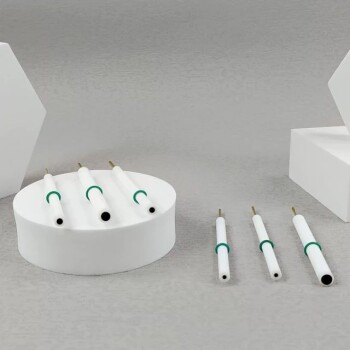
In the experimental characterization of Sc1/3Zr2(PO4)3, platinum electrodes serve a critical role as blocking electrodes. They leverage their chemical inertness to conduct electrons while physically stopping the passage of ions, forcing the mobile species to accumulate at the interface for identification.
Core Takeaway: Platinum electrodes do not merely complete the circuit; they act as a selective barrier. By blocking ion flow, they force migrating species to accumulate and undergo reduction at the cathode, creating tangible metal deposits that provide definitive proof of the charge carrier's identity.
The Mechanism of Ion Verification
To verify the carrier type in a solid electrolyte like Sc1/3Zr2(PO4)3, you must isolate the moving species. Platinum electrodes facilitate this through a specific electrochemical process.
The Selective Barrier
Platinum is electronically conductive but ionically insulating.
In this setup, the electrode allows electrons to flow through the external circuit but strictly prevents ions from passing through the electrode material itself.
Accumulation at the Interface
When a voltage is applied, ions within the Sc1/3Zr2(PO4)3 lattice migrate toward the oppositely charged electrode.
Because the platinum blocks their exit, these ions hit a "wall" at the cathode interface. Unable to leave the material, they begin to accumulate in high concentrations.
The Reduction Reaction
Once accumulation occurs, a chemical transformation takes place.
The accumulated metal ions accept electrons from the platinum electrode. This causes them to undergo a reduction reaction, transforming from charged mobile ions into neutral, solid metal.
Confirming the Carrier Species
The ultimate goal of using platinum is to produce observable physical evidence of the conducting species.
Formation of Metal Deposits
The reduction reaction results in the formation of visible metal deposits on the surface of the platinum cathode.
These deposits are the physical manifestation of the ions that moved through the crystal lattice.
Direct Compositional Analysis
Researchers can then analyze the chemical composition of these deposits.
By identifying the metal present in the deposit, scientists definitively confirm which specific ion acts as the charge carrier within the Sc1/3Zr2(PO4)3 structure.
Why Platinum is Essential (The Trade-offs)
Choosing the wrong electrode material can lead to ambiguous results. Platinum is selected specifically to avoid chemical interference.
The Requirement for Inertness
The primary attribute of platinum in this context is its chemical inertness, particularly at high temperatures.
If a reactive metal were used, the electrode might chemically interact with the Sc1/3Zr2(PO4)3, creating byproducts that confuse the analysis.
Ensuring Pure Results
Platinum ensures that any deposit found at the cathode is solely the result of ion migration and reduction.
This isolates the variable being tested, ensuring the experimental results accurately reflect the intrinsic properties of the material rather than an electrode reaction.
Making the Right Choice for Your Goal
When designing experiments to characterize solid electrolytes, the role of the electrode is defined by the specific data you need to extract.
- If your primary focus is identifying the charge carrier: Rely on platinum's blocking nature to force the accumulation and reduction of the mobile species for ex-situ analysis.
- If your primary focus is high-temperature testing: Prioritize platinum for its ability to remain chemically inert, preventing contamination of your electrolyte interface.
By forcing mobile ions to reveal themselves as solid metal deposits, platinum electrodes convert invisible electrochemical transport into tangible, verifiable evidence.
Summary Table:
| Feature | Function in Sc1/3Zr2(PO4)3 Characterization |
|---|---|
| Electrode Type | Blocking (Electronically conductive, ionically insulating) |
| Chemical Property | High inertness, prevents electrode-electrolyte contamination |
| Mechanism | Forces ion accumulation at the cathode interface |
| Result | Triggers reduction of ions into observable metal deposits |
| Primary Goal | Definitive identification of mobile charge carrier species |
Precision Electrochemical Analysis with KINTEK
Ensure the accuracy of your material characterization with KINTEK’s high-performance laboratory solutions. Whether you are conducting carrier verification in solid electrolytes or complex battery research, our specialized electrolytic cells and electrodes—including high-purity platinum—provide the reliability you need.
KINTEK offers a comprehensive range of equipment to support your research, including:
- High-Temperature Furnaces (Muffle, Tube, Vacuum) for stable electrolyte testing.
- Crushing, Milling, and Sieving systems for precise material preparation.
- High-Pressure Reactors and Autoclaves for advanced chemical synthesis.
- Ceramic and Graphite Consumables for high-temperature durability.
Boost your lab's research capabilities today. Contact KINTEK for customized solutions and expert support tailored to your experimental needs.
Related Products
- Platinum Sheet Electrode for Laboratory and Industrial Applications
- Platinum Sheet Electrode for Battery Lab Applications
- Rotating Platinum Disk Electrode for Electrochemical Applications
- Platinum Auxiliary Electrode for Laboratory Use
- RRDE rotating disk (ring disk) electrode / compatible with PINE, Japanese ALS, Swiss Metrohm glassy carbon platinum
People Also Ask
- What is a common use for a platinum sheet electrode? As a Reliable Counter Electrode in Electrochemical Cells
- What is the most critical guideline for immersing a platinum sheet electrode in an electrolyte? Ensure Accurate Electrochemical Measurements
- What is the purity of the platinum sheet in a platinum sheet electrode? The Key to Reliable Electrochemical Data
- What is the expected lifespan of a platinum sheet electrode? Maximize Your Electrode's Service Life
- What are the available specifications for platinum sheet electrodes? Find the Perfect Fit for Your Electrochemical Needs