Knowledge What substance is used to make lab-grown diamonds? Pure Carbon, Identical to Natural Diamonds
Author avatar

Tech Team · Kintek Solution

Updated 6 days ago

What substance is used to make lab-grown diamonds? Pure Carbon, Identical to Natural Diamonds


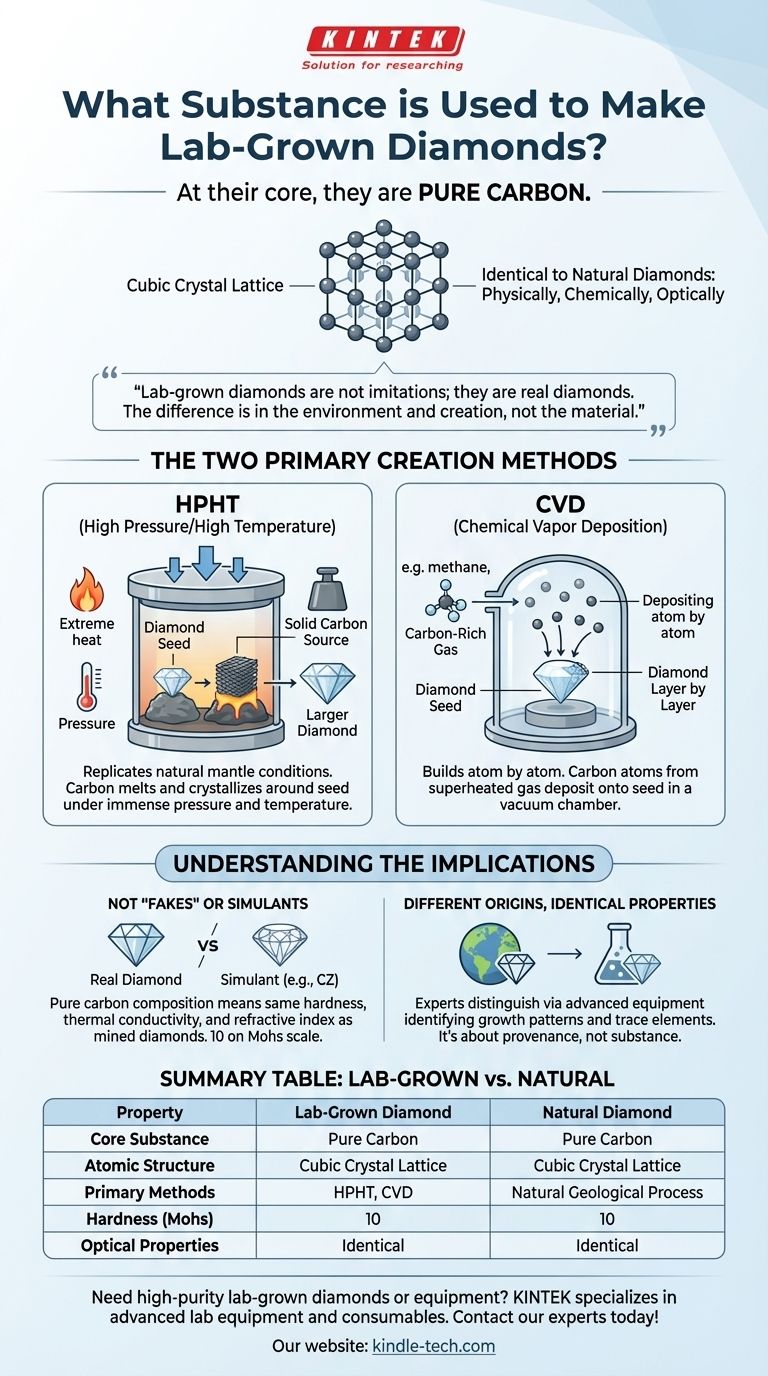
At their core, lab-grown diamonds are made of the exact same substance as natural diamonds: pure carbon. The carbon atoms are arranged in an identical crystal lattice structure, making them physically, chemically, and optically indistinguishable from diamonds formed in the Earth's mantle. The difference lies not in the material, but in the environment and method of their creation.

The essential takeaway is that lab-grown diamonds are not diamond imitations; they are real diamonds. The fundamental building block is carbon, which is transformed into a diamond crystal using one of two highly advanced manufacturing processes.
What substance is used to make lab-grown diamonds? Pure Carbon, Identical to Natural Diamonds

The Core Ingredient: Pure Carbon

A diamond's identity is defined by its atomic composition and structure. Lab-grown diamonds meet this definition perfectly.

An Identical Atomic Structure

Both natural and lab-created diamonds consist of carbon atoms bonded together in a rigid cubic crystal lattice. This specific arrangement is what gives a diamond its exceptional hardness and brilliance.

The Starting Material

The process begins with a source of carbon. In one method, this is often solid carbon like graphite. In another, it is a carbon-rich gas. This carbon is then subjected to specific conditions to encourage it to crystallize into a diamond.

The Two Primary Creation Methods

Labs use two main techniques to create the precise environment needed for diamond formation. Both methods start with a tiny diamond "seed," which acts as a template for the new crystal to grow upon.

High Pressure/High Temperature (HPHT)

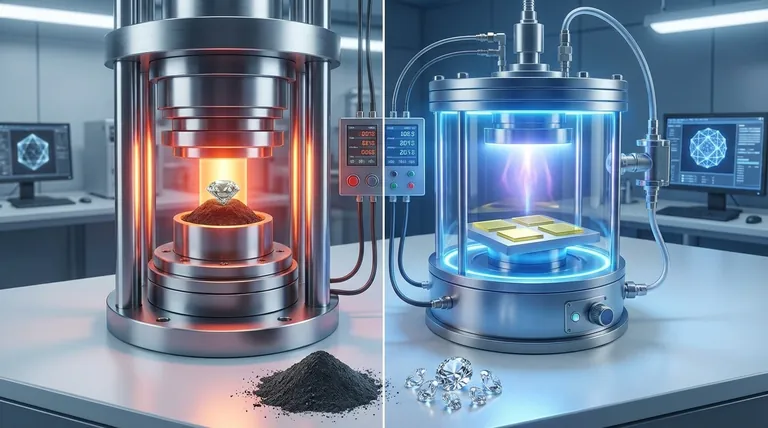
The HPHT method replicates the natural conditions deep within the Earth's mantle. A diamond seed is placed in a cell with solid carbon and subjected to immense pressure and extremely high temperatures.

This extreme environment causes the carbon to melt and crystallize around the seed, forming a new, larger diamond.

Chemical Vapor Deposition (CVD)

The CVD method takes a different approach, building the diamond atom by atom. A diamond seed is placed inside a sealed vacuum chamber filled with a carbon-rich gas, such as methane.

This gas is superheated, causing carbon atoms to break away and "deposit" onto the diamond seed. Over time, these atoms build up, growing the diamond layer by layer.

Understanding the Implications

Because lab-grown diamonds are made of pure carbon, they are not "fakes" or simulants like cubic zirconia. They are simply diamonds with a different origin story.

Real Diamonds, Different Origins

The final product from both HPHT and CVD processes is a real diamond. It possesses the same hardness (10 on the Mohs scale), thermal conductivity, and refractive index as a mined diamond.

Distinguishing Between Them

While visually identical to the naked eye, gemological experts can distinguish between lab-grown and natural diamonds. They use advanced equipment to identify minute differences in growth patterns and the presence of trace elements unique to each formation process.

Why This Matters

The distinction is about provenance, not substance. Choosing a lab-grown diamond is a decision based on factors like budget, environmental considerations, and ethical sourcing, not on the quality or authenticity of the material itself.

Making the Right Choice for Your Goal

Understanding the material composition helps clarify what a lab-grown diamond truly is.

  • If your primary focus is jewelry: A lab-grown diamond is a real diamond in every physical and chemical sense, offering the same beauty and durability as a mined diamond.
  • If your primary focus is authenticity: Understand that "lab-grown" signifies origin, not a difference in material. Both lab and mined diamonds are certified based on the same qualities of cut, color, clarity, and carat weight.
  • If your primary focus is material science: Both HPHT and CVD produce structurally identical diamonds, but the specific growth process may introduce unique properties relevant for industrial or technological applications.

Ultimately, a diamond's identity is defined by its carbon structure, not its origin.

Summary Table:

Property Lab-Grown Diamond Natural Diamond
Core Substance Pure Carbon Pure Carbon
Atomic Structure Cubic Crystal Lattice Cubic Crystal Lattice
Primary Methods HPHT, CVD Natural Geological Process
Hardness (Mohs Scale) 10 10
Optical Properties Identical Identical

Need high-purity lab-grown diamonds or the equipment to create them? KINTEK specializes in advanced lab equipment and consumables for diamond synthesis and analysis. Whether you're in jewelry, research, or industrial manufacturing, our solutions ensure precision and quality. Contact our experts today to find the perfect diamond or equipment for your specific application!

Visual Guide
What substance is used to make lab-grown diamonds? Pure Carbon, Identical to Natural Diamonds Visual Guide

Related Products

People Also Ask

Related Products

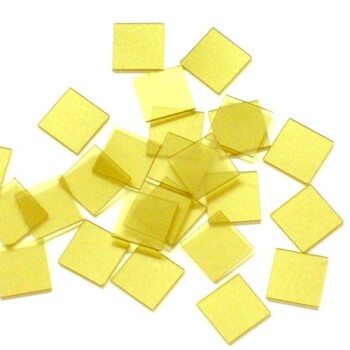
CVD Diamond for Thermal Management Applications

CVD Diamond for Thermal Management Applications

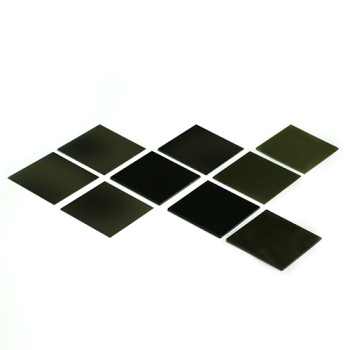
CVD diamond for thermal management: High-quality diamond with thermal conductivity up to 2000 W/mK, ideal for heat spreaders, laser diodes, and GaN on Diamond (GOD) applications.

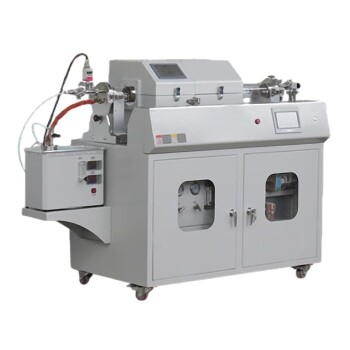
Chemical Vapor Deposition CVD Equipment System Chamber Slide PECVD Tube Furnace with Liquid Gasifier PECVD Machine

Chemical Vapor Deposition CVD Equipment System Chamber Slide PECVD Tube Furnace with Liquid Gasifier PECVD Machine

KT-PE12 Slide PECVD System: Wide power range, programmable temp control, fast heating/cooling with sliding system, MFC mass flow control & vacuum pump.

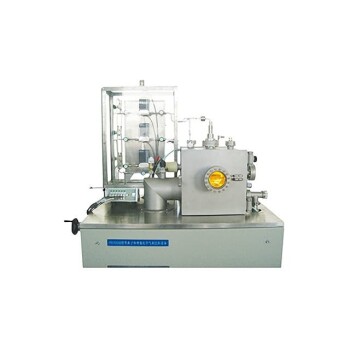
Cylindrical Resonator MPCVD Machine System Reactor for Microwave Plasma Chemical Vapor Deposition and Lab Diamond Growth

Cylindrical Resonator MPCVD Machine System Reactor for Microwave Plasma Chemical Vapor Deposition and Lab Diamond Growth

Learn about Cylindrical Resonator MPCVD Machine, the microwave plasma chemical vapor deposition method used for growing diamond gemstones and films in the jewelry and semi-conductor industries. Discover its cost-effective advantages over traditional HPHT methods.

Custom CVD Diamond Coating for Lab Applications

Custom CVD Diamond Coating for Lab Applications

CVD Diamond Coating: Superior Thermal Conductivity, Crystal Quality, and Adhesion for Cutting Tools, Friction, and Acoustic Applications

Microwave Plasma Chemical Vapor Deposition MPCVD Machine System Reactor for Lab and Diamond Growth

Microwave Plasma Chemical Vapor Deposition MPCVD Machine System Reactor for Lab and Diamond Growth

Get high-quality diamond films with our Bell-jar Resonator MPCVD machine designed for lab and diamond growth. Discover how Microwave Plasma Chemical Vapor Deposition works for growing diamonds using carbon gas and plasma.

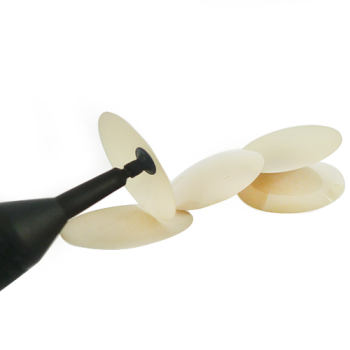
CVD Diamond Domes for Industrial and Scientific Applications

CVD Diamond Domes for Industrial and Scientific Applications

Discover CVD diamond domes, the ultimate solution for high-performance loudspeakers. Made with DC Arc Plasma Jet technology, these domes deliver exceptional sound quality, durability, and power handling.

Inclined Rotary Plasma Enhanced Chemical Vapor Deposition PECVD Equipment Tube Furnace Machine

Inclined Rotary Plasma Enhanced Chemical Vapor Deposition PECVD Equipment Tube Furnace Machine

Upgrade your coating process with PECVD coating equipment. Ideal for LED, power semiconductors, MEMS and more. Deposits high-quality solid films at low temps.

CVD Diamond Cutting Tool Blanks for Precision Machining

CVD Diamond Cutting Tool Blanks for Precision Machining

CVD Diamond Cutting Tools: Superior Wear Resistance, Low Friction, High Thermal Conductivity for Non-Ferrous Materials, Ceramics, Composites Machining

RF PECVD System Radio Frequency Plasma-Enhanced Chemical Vapor Deposition RF PECVD

RF PECVD System Radio Frequency Plasma-Enhanced Chemical Vapor Deposition RF PECVD

RF-PECVD is an acronym for "Radio Frequency Plasma-Enhanced Chemical Vapor Deposition." It deposits DLC (Diamond-like carbon film) on germanium and silicon substrates. It is utilized in the 3-12um infrared wavelength range.

CVD Diamond Optical Windows for Lab Applications

CVD Diamond Optical Windows for Lab Applications

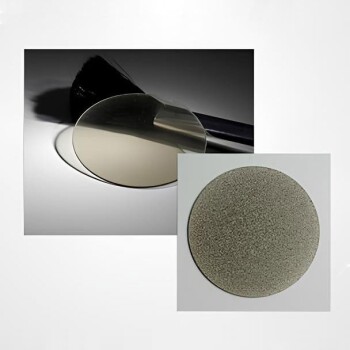
Diamond optical windows: exceptional broad band infrared transparency, excellent thermal conductivity & low scattering in infrared, for high-power IR laser & microwave windows applications.

Non Consumable Vacuum Arc Induction Melting Furnace

Non Consumable Vacuum Arc Induction Melting Furnace

Explore the benefits of Non-Consumable Vacuum Arc Furnace with high melting point electrodes. Small, easy to operate & eco-friendly. Ideal for laboratory research on refractory metals & carbides.

Single Punch Electric Tablet Press Machine Laboratory Powder Tablet Punching TDP Tablet Press

Single Punch Electric Tablet Press Machine Laboratory Powder Tablet Punching TDP Tablet Press

The single-punch electric tablet press is a laboratory-scale tablet press suitable for corporate laboratories in pharmaceutical, chemical, food, metallurgical and other industries.

Cylindrical Lab Electric Heating Press Mold for Laboratory Applications

Cylindrical Lab Electric Heating Press Mold for Laboratory Applications

Efficiently prepare samples with Cylindrical Lab Electric Heating Press Mold. Fast heating, high temp & easy operation. Custom sizes available. Perfect for battery, ceramic & biochemical research.

Assemble Lab Cylindrical Press Mold

Assemble Lab Cylindrical Press Mold

Get reliable and precise molding with Assemble Lab Cylindrical Press Mold. Perfect for ultra-fine powder or delicate samples, widely used in material research and development.

Assemble Square Lab Press Mold for Laboratory Applications

Assemble Square Lab Press Mold for Laboratory Applications

Achieve perfect sample preparation with Assemble Square Lab Press Mold. Quick disassembly eliminates sample deformation. Perfect for battery, cement, ceramics, and more. Customizable sizes available.

Special Shape Press Mold for Lab

Special Shape Press Mold for Lab

Discover high-pressure special shape press molds for diverse applications, from ceramics to automotive parts. Ideal for precise, efficient molding of various shapes and sizes.

High Performance Laboratory Freeze Dryer

High Performance Laboratory Freeze Dryer

Advanced lab freeze dryer for lyophilization, preserving biological & chemical samples efficiently. Ideal for biopharma, food, and research.

Ball Press Mold for Lab

Ball Press Mold for Lab

Explore versatile Hydraulic Hot Press molds for precise compression molding. Ideal for creating various shapes and sizes with uniform stability.

High Performance Laboratory Freeze Dryer for Research and Development

High Performance Laboratory Freeze Dryer for Research and Development

Advanced laboratory freeze dryer for lyophilization, preserving sensitive samples with precision. Ideal for biopharmaceuticals, research & food industries.

Lab Scale Rotary Single Punch Tablet Press Machine TDP Tablet Punching Machine

Lab Scale Rotary Single Punch Tablet Press Machine TDP Tablet Punching Machine

This machine is a single-pressure automatic rotating, continuous tableting machine that compresses granular raw materials into various tablets. It is mainly used for tablet production in the pharmaceutical industry, and is also suitable for chemical, food, electronics and other industrial sectors.


Leave Your Message