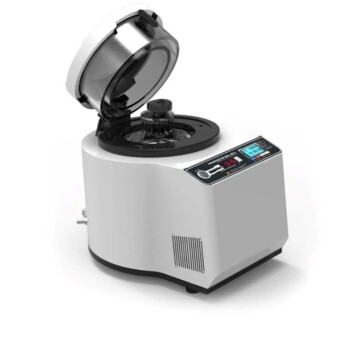
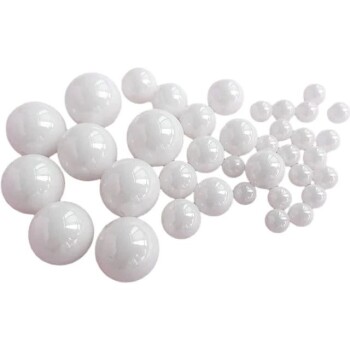
High-density tungsten milling balls are chosen primarily for their exceptional specific gravity, which allows them to generate intense impact forces during the milling process. This high kinetic energy is critical for effectively refining and uniformly dispersing complex raw material mixtures, ensuring the successful synthesis of the LLZTBO solid electrolyte.
Core Insight: The choice of tungsten over lighter alternatives is driven by the physics of momentum; the high density of tungsten ensures that even small (3mm) media deliver sufficient impact energy to facilitate the elemental diffusion required for a pure, homogeneous garnet-phase crystal structure.
The Role of Specific Gravity in Milling
Generating High-Energy Impact
The defining characteristic of tungsten milling media is its high specific gravity. Because tungsten is significantly denser than standard ceramic media, it carries more momentum at a given milling speed.
Maximizing Kinetic Energy
When these balls collide with the raw materials, they transfer a substantial amount of kinetic energy. This "heavy" impact is necessary to break down and refine the precursors—specifically lithium carbonate, lanthanum hydroxide, and zirconium oxide—more effectively than lighter media could.
Facilitating the Solid-State Reaction
Ensuring Elemental Diffusion
The ultimate goal of preparing LLZTBO powder is to create a solid electrolyte with high ionic conductivity. To achieve this, the elements must mix at an atomic level. The intense impact from tungsten balls facilitates this elemental diffusion, setting the stage for the subsequent high-temperature reaction.
Creating a Homogeneous Garnet Phase
By thoroughly refining the mixture, tungsten media ensures the formation of a pure and homogeneous garnet-phase crystal structure during calcination. Inconsistent mixing or insufficient particle reduction can lead to impure phases, which degrade battery performance.
Understanding the Trade-offs
Tungsten vs. Zirconia
While tungsten is selected for its density and impact power, it is important to recognize the industry standard alternative: Zirconia. Zirconia is frequently used because of its extreme hardness and superior wear resistance.
The Contamination Factor
A potential downside of using metallic media like tungsten is the risk of introducing impurities. Zirconia is often preferred in scenarios where maintaining absolute purity is paramount, as it prevents the introduction of metallic contaminants (like iron or chromium) that can cause side reactions or electrochemical degradation.
Balancing Power and Purity
Therefore, the choice to use tungsten implies a specific prioritization: the process requires the aggressive mixing energy provided by tungsten's weight, even if it entails a different wear-rate profile than ceramic zirconia.
Making the Right Choice for Your Goal
To optimize your milling process for solid electrolytes, weigh the following priorities:
- If your primary focus is maximizing reaction kinetics and mixture homogeneity: Utilize tungsten media to leverage its high specific gravity for superior impact force and particle refinement.
- If your primary focus is preventing metallic contamination: Opt for Zirconia media to utilize its hardness and wear resistance, ensuring high purity during extended milling cycles.
Success in LLZTBO synthesis relies on balancing the physical force required to mix the precursors with the chemical purity needed for electrochemical stability.
Summary Table:
| Feature | Tungsten Milling Balls | Zirconia Milling Balls |
|---|---|---|
| Primary Benefit | High Specific Gravity & Impact Force | Extreme Hardness & Wear Resistance |
| Material Goal | Maximizing Reaction Kinetics | Preventing Metallic Contamination |
| Best Used For | Rapid Particle Refinement & Diffusion | Maintaining Ultra-High Chemical Purity |
| Application | Complex LLZTBO Solid Electrolytes | High-Purity Sensitive Lab Research |
Elevate Your Solid-State Battery Research with KINTEK
Precision in LLZTBO synthesis begins with the right milling media. Whether you require the high-energy impact of tungsten carbide or the contamination-free performance of zirconia, KINTEK provides the professional-grade tools needed for breakthrough results.
Our extensive portfolio supports every stage of your battery research, including:
- Crushing & Milling Systems: High-density media and planetary mills.
- High-Temperature Furnaces: Muffle, tube, and vacuum furnaces for perfect calcination.
- Hydraulic Presses: Pellet and isostatic presses for electrolyte shaping.
- Specialized Labware: High-purity ceramics, crucibles, and PTFE consumables.
Ready to optimize your electrolyte homogeneity? Contact our technical experts today to find the perfect milling and thermal solutions for your laboratory.
Related Products
- Laboratory Ball Mill Jar Mill with Metal Alloy Grinding Jar and Balls
- Laboratory Jar Ball Mill with Alumina Zirconia Grinding Jar and Balls
- Laboratory Jar Mill with Agate Grinding Jar and Balls
- Stainless Steel Laboratory Ball Mill for Dry Powder and Liquid with Ceramic Polyurethane Lining
- Laboratory Horizontal Planetary Ball Mill Milling Machine
People Also Ask
- What is the function of a laboratory ball mill in the preparation of AMMCs? Optimize Dispersion & Grain Refinement
- What is the primary function of a laboratory ball mill in the modification of sulfide-based solid electrolytes with LiPO2F2?
- What is the function of a laboratory ball mill in the pretreatment of waste tire char (WTC)? Optimize Material Reactivity
- What is the primary function of a laboratory ball mill in Rice Husk Ash (RHA) modification? Achieve Peak Densification
- How do laboratory ball mills facilitate the mechanochemical synthesis of ZIF-8? Solvent-Free Synthesis Explained