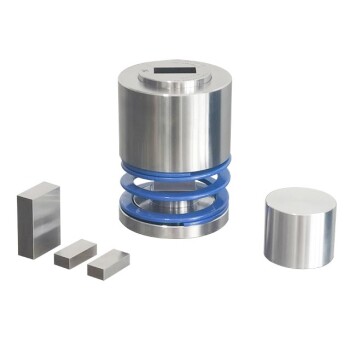
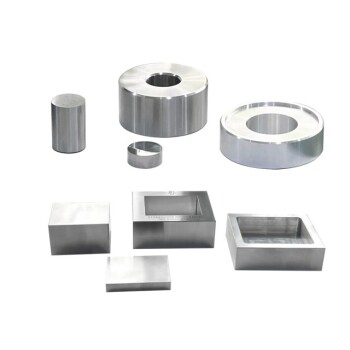
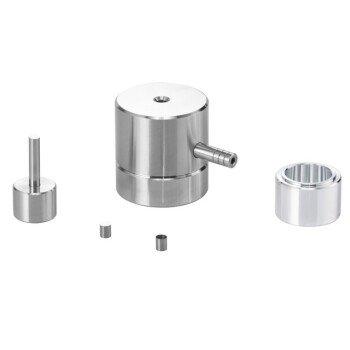
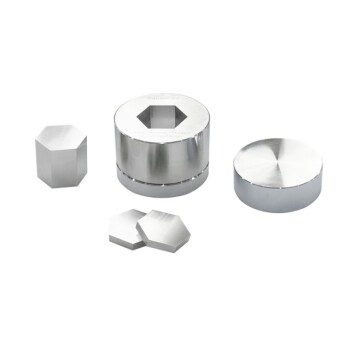
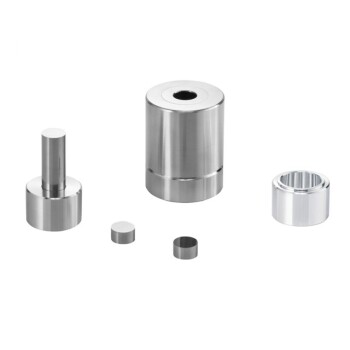
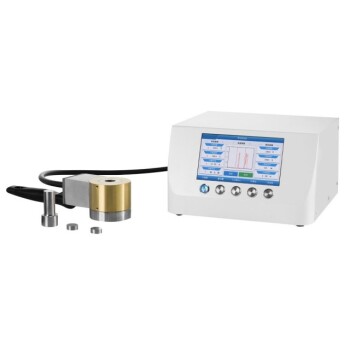
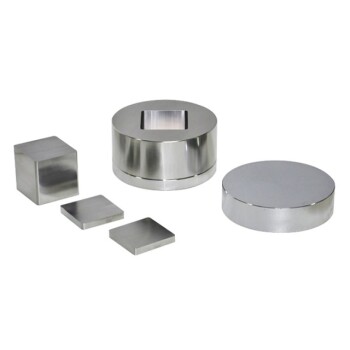
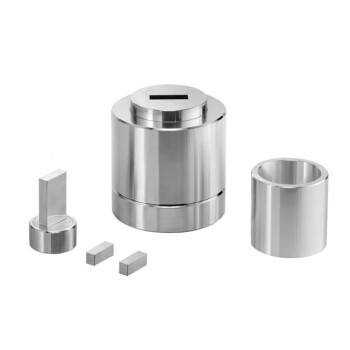
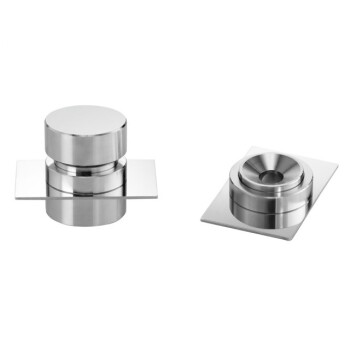
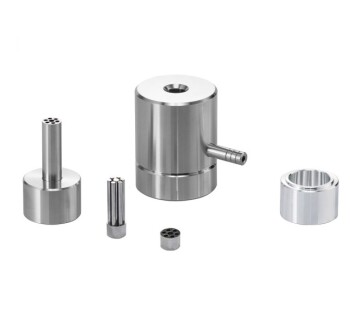
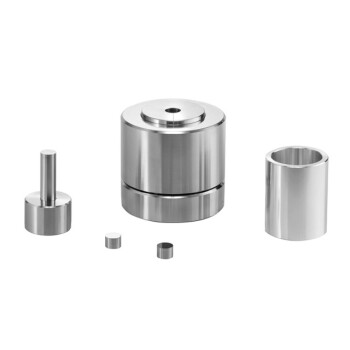
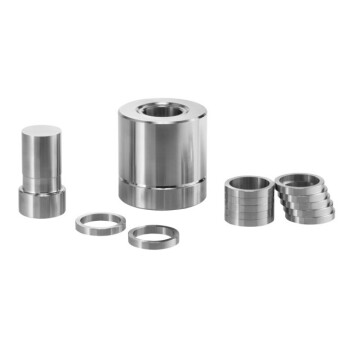
To ensure accurate data, electrical isolation is non-negotiable. Pressure molds with non-conductive resin inner walls, such as polyacetal, are required to prevent electrical current from bypassing the sample during testing. By insulating the side walls, you ensure that the test current travels exclusively through the compressed powder column, preventing short circuits through the mold structure itself.
Core Takeaway: Metal or conductive mold walls create a "path of least resistance" that bypasses the sample, leading to artificially low resistance readings. Non-conductive resin walls force the current into a strictly vertical path through the powder, ensuring the data reflects the true properties of the battery material, not the equipment.
The Physics of Resistivity Testing
The Path of Least Resistance
When measuring the resistivity of composite particles, you apply a direct current (DC) through a compressed powder column. Electricity naturally seeks the path of lowest resistance.
If the mold walls are conductive (e.g., steel), the current will "leak" into the walls rather than struggling through the resistive powder. This results in a measurement that largely reflects the conductivity of the mold, rendering the test useless.
Enforcing Vertical Current Flow
The primary reference highlights that the goal is to measure the powder, not the container.
Non-conductive resins act as a strict barrier. They force the DC current to flow solely in a vertical direction through the sample. This geometric constraint is the only way to ensure the current interacts with the entire height of the compressed column.
Achieving True Volume Resistivity
Validating Geometric Assumptions
Calculating "true volume resistivity" requires precise knowledge of the area and length the current traverses.
The mathematical formulas used for this calculation assume a cylindrical volume of powder where current enters the top and exits the bottom. If current exits through the sides, the effective area changes, and the math fails.
Eliminating Artifacts
All-solid-state battery materials often exhibit complex resistance behaviors that change under pressure.
Using insulating walls removes the variable of side-wall conductivity. This ensures that any change in resistance you observe is caused by the compression levels or the material's intrinsic properties, rather than an equipment artifact.
Understanding the Trade-offs
Mechanical Limitations of Resin
While resin walls are electrically superior for this specific test, they lack the mechanical hardness of hardened steel.
Under the high pressures required to test solid-state battery composites, resin inner walls can deform or wear out over time. This deformation can slightly alter the sample diameter, introducing a different type of error if not monitored.
Thermal and Chemical Considerations
Polyacetal is generally robust, but it is not distinct from thermal constraints.
If your testing involves elevated temperatures to simulate battery operating conditions, you must ensure the test temperature does not approach the softening point of the resin, which would compromise the structural integrity of the mold.
Making the Right Choice for Your Goal
To obtain reliable resistivity data for all-solid-state battery composites, you must prioritize the integrity of the electrical path.
- If your primary focus is absolute data accuracy: Ensure your mold utilizes a high-quality non-conductive liner like polyacetal to completely eliminate leakage currents.
- If your primary focus is high-pressure consistency: Regularly inspect the inner resin walls for physical deformation, as changes in the mold's internal diameter will skew volume calculations.
By forcing current through the sample rather than the tool, insulating molds transform rough estimates into scientifically valid material characterizations.
Summary Table:
| Feature | Non-Conductive Resin (e.g., Polyacetal) | Conductive Metal (e.g., Steel) |
|---|---|---|
| Current Path | Strictly vertical through sample | Bypasses sample through walls |
| Data Accuracy | High; reflects material properties | Low; reflects mold conductivity |
| Short Circuit Risk | Eliminated | High |
| Mechanical Strength | Moderate; subject to wear | High; very durable |
| Best For | Precision resistivity measurements | High-pressure structural molding |
Elevate Your Battery Research with Precision Engineering
Reliable data starts with the right equipment. KINTEK specializes in advanced laboratory solutions designed for the rigorous demands of all-solid-state battery development. From high-precision pellet and hydraulic presses to specialized molds and battery research tools, we ensure your testing environment is optimized for accuracy.
Whether you need high-temperature high-pressure reactors, specialized ceramics and crucibles, or custom-engineered insulation solutions, KINTEK provides the high-performance consumables and hardware required to push the boundaries of energy storage.
Ready to eliminate measurement artifacts and achieve true volume resistivity? Contact KINTEK today for a consultation and find the perfect match for your laboratory’s needs.
Related Products
- Square Bidirectional Pressure Mold for Lab Use
- Anti-Cracking Press Mold for Lab Use
- Ring Press Mold for Lab Applications
- Ball Press Mold for Lab
- Special Heat Press Mold for Lab Use
People Also Ask
- What is the purpose of specialized pressure devices in sulfide solid-state batteries? Ensure Chemo-Mechanical Stability
- What role do high-pressure mold components play in the thermal pressing of nano-crystalline tungsten? Maximize Density
- How to use a press mould? Master the Art of Consistent Ceramic Forms
- Why must Li2S–GeSe2–P2S5 electrolytes be pressurized during EIS testing? Optimizing Solid-State Conductivity Analysis
- What is the significance of high-strength pressure molds? Optimize Bulk Amorphous Alloy Fabrication