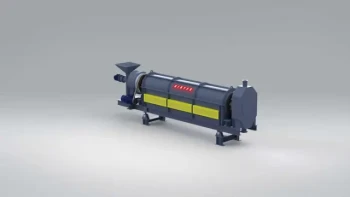
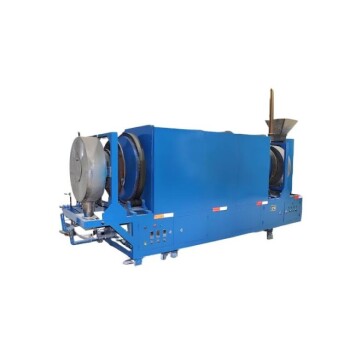
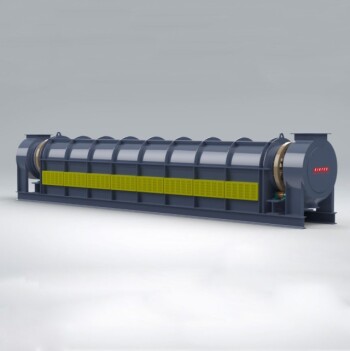
Rotary kiln reactors are widely utilized in large-scale biomass torrefaction because their design fundamentally solves the challenge of heat transfer in bulk solids. By rotating a cylindrical shell to tumble the biomass, these reactors create a dynamic environment that ensures every particle receives uniform heat treatment, preventing the inconsistencies that plague static methods.
By leveraging gravity and rotation to continuously tumble biomass, rotary kilns prevent localized overheating and maintain a stable thermal environment. This mechanical action is essential for achieving the uniform material properties required in high-volume, continuous production.
The Mechanics of Efficient Processing
To understand why rotary kilns are favored, you must look at how they manage the physical movement of the feedstock.
Leveraging Gravity and Rotation
The core mechanism is a rotating cylindrical shell. As the shell turns, gravity causes the biomass feedstock to tumble and cascade through the reactor.
This continuous mechanical motion prevents the material from settling into a static pile, which is critical for processing large volumes.
Enhancing Material Contact
The tumbling action ensures thorough contact between the biomass and the heat source.
Whether the heat comes from direct contact with heating walls or interaction with hot carrier gases, the rotation exposes particle surfaces evenly to the thermal energy.
Facilitating Material Mixing
Effective torrefaction requires homogeneity. The rotary kiln provides inherent material mixing as part of the transport process.
This mixing ensures that no single portion of the biomass is insulated from the heat, leading to efficient energy transfer throughout the entire batch.
Achieving Thermal Uniformity
The primary deep need in large-scale operations is product consistency. Rotary kilns address this through strict thermal control.
Preventing Hot Spots
In static systems, heat can concentrate in specific areas, burning some material while leaving the rest under-processed.
Rotary kilns effectively prevent localized overheating by keeping the material in constant motion, distributing heat energy evenly across the feedstock.
Ensuring Consistent Properties
For industrial applications, the end product must be uniform.
The stable thermal environment created by the kiln ensures that the torrefied biomass exhibits consistent properties, regardless of the batch size or production duration.
Operational Considerations
While the rotary kiln offers significant advantages for scale, it is important to understand the operational dynamics inherent to its design.
Dependence on Mechanical Continuity
The system's efficiency is entirely dependent on the rotation of the shell.
Because the process relies on mechanical motion to achieve uniform material distribution, any interruption in rotation can lead to immediate inconsistencies in heat transfer.
Optimization for Continuous Processes
The design is specifically optimized for continuous production processes rather than small, isolated batches.
The stability of the thermal environment is best maintained when material flows continuously through the system, rather than starting and stopping frequently.
Making the Right Choice for Your Goal
Rotary kilns are a specific tool for a specific scale of problem. Here is how to determine if this technology aligns with your objectives:
- If your primary focus is product homogeneity: The mechanical mixing and tumbling action are essential for preventing hot spots and ensuring every particle has consistent properties.
- If your primary focus is high-throughput production: The design is optimized for continuous processing, allowing for the stable treatment of large volumes of biomass over time.
For large-scale torrefaction tasks, the rotary kiln remains the standard because it effectively mechanizes the critical requirement of uniform heat distribution.
Summary Table:
| Feature | Benefit for Biomass Torrefaction |
|---|---|
| Rotating Shell | Ensures continuous tumbling and prevents material settling |
| Mechanical Mixing | Eliminates hot spots and ensures every particle is treated evenly |
| Heat Transfer | Maximizes surface contact with heating walls or carrier gases |
| Process Flow | Optimized for continuous, high-throughput industrial production |
| Product Quality | Delivers high homogeneity and consistent thermal properties |
Elevate Your Large-Scale Production with KINTEK
Achieving perfect product homogeneity in biomass torrefaction requires precision engineering and reliable thermal control. KINTEK specializes in advanced laboratory and industrial equipment, including high-performance rotary kilns, muffle furnaces, and vacuum systems designed to solve your toughest heat transfer challenges.
Whether you are scaling up biomass research or optimizing continuous industrial processes, our comprehensive portfolio—from crushing and milling systems to high-temperature reactors and cooling solutions—ensures you have the tools to succeed. Our experts are ready to help you select the ideal configuration for your specific material needs.
Ready to achieve superior thermal uniformity? Contact KINTEK today to discuss your project requirements!
References
- Maja Ivanovski, Marjana Simonič. Exploring the Properties of the Torrefaction Process and Its Prospective in Treating Lignocellulosic Material. DOI: 10.3390/en16186521
This article is also based on technical information from Kintek Solution Knowledge Base .
Related Products
- Electric Rotary Kiln Small Rotary Furnace Biomass Pyrolysis Plant
- Electric Rotary Kiln Small Rotary Furnace for Activated Carbon Regeneration
- Electric Rotary Kiln Continuous Working Small Rotary Furnace Heating Pyrolysis Plant
- Electric Rotary Kiln Pyrolysis Furnace Plant Machine Calciner Small Rotary Kiln Rotating Furnace
- Vacuum Sealed Continuous Working Rotary Tube Furnace Rotating Tube Furnace
People Also Ask
- What is the temperature of a rotating kiln? It Depends on Your Material and Process Goal
- What are the principles of a rotary kiln? Master the Mechanics of High-Temperature Processing
- What are the different types of calciners? A Guide to Selecting the Right Thermal Processing Equipment
- How are rotary kilns heated? Direct vs. Indirect Heating Methods Explained
- Is rotary kiln a furnace? Discover the Key Differences for Industrial Processing