Knowledge Why are silicon carbide and silicon oxide polishing consumables required for surface treatment? Ensure Accurate Data
Author avatar

Tech Team · Kintek Solution

Updated 2 days ago

Why are silicon carbide and silicon oxide polishing consumables required for surface treatment? Ensure Accurate Data


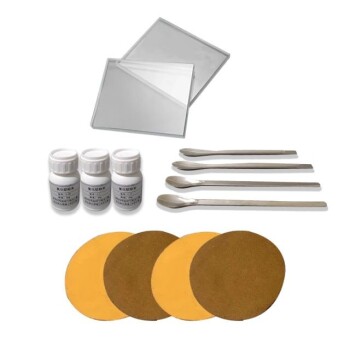
The use of silicon carbide and silicon oxide is critical for eliminating surface defects that distort test data. These consumables are used in a sequential polishing process to strip away damaged material layers and achieve a finish with nanoscale smoothness. Without this treatment, the tribological results would reflect the surface roughness and processing damage rather than the actual properties of the Fe–Cu–Ni–Sn–VN sample.

The core purpose of this rigorous surface treatment is to remove work-hardened layers and morphological interference. This ensures that friction and wear data accurately represent the intrinsic mechanical properties of the composite matrix, rather than artifacts left by previous cutting or grinding.

The Mechanism of Sequential Polishing

The Role of Silicon Carbide (SiC)

SiC acts as the primary abrasive in the initial stages of surface treatment. By using different grades of silicon carbide sequentially, you gradually reduce the surface roughness left by sample preparation. This step is essential for removing the bulk of the deformities and preparing the surface for fine finishing.

The Role of Silicon Oxide (SiO2)

Following the SiC treatment, nano-scale silicon oxide suspensions are used for the final polish. This step is capable of achieving nanoscale smoothness. It refines the surface to a degree where physical irregularities no longer dominate the interaction between the sample and the testing equipment.

Why Surface Condition Impacts Tribology

Removing Work-Hardened Layers

Previous processing steps, such as cutting or coarse grinding, alter the microstructure of the sample's surface. These processes create a work-hardened layer that is mechanically different from the bulk material. If this layer is not removed via polishing, your test results will measure this damaged layer rather than the true Fe–Cu–Ni–Sn–VN composite.

Eliminating Morphological Interference

Surface morphology, or the physical texture of the sample, creates "noise" in tribological testing. Roughness peaks can interlock or abrade differently than a flat surface. Polishing removes this interference of surface morphology, ensuring that the friction coefficients and wear rates recorded are purely a result of the material's intrinsic behavior.

Common Pitfalls to Avoid

Incomplete Layer Removal

A common error is stopping the polishing process before the work-hardened layer is fully removed. Even if the surface looks shiny, microscopic subsurface damage may remain. This leads to misleading data regarding the material's hardness and wear resistance.

Skipping the Nano-Scale Finish

Omitting the final SiO2 suspension stage leaves micro-scratches from the SiC abrasives. In tribological tests, these micro-scratches act as stress concentrators or abrasive channels. This compromises the integrity of the test, preventing an accurate assessment of the intrinsic mechanical properties.

Making the Right Choice for Your Goal

To ensure your tribological testing yields valid, scientific data for Fe–Cu–Ni–Sn–VN samples, follow these guidelines:

  • If your primary focus is obtaining intrinsic material data: Ensure you complete the full sequence of SiC grades followed by SiO2 suspension to fully eliminate work-hardened layers.
  • If your primary focus is minimizing experimental error: Verify that the final surface achieves nanoscale smoothness to remove any morphological interference that could skew friction readings.

Proper surface preparation is not merely cosmetic; it is the fundamental baseline required to validate your material's performance.

Summary Table:

Consumable Type Primary Function Achievement
Silicon Carbide (SiC) Removal of bulk deformities & grinding marks Gradual reduction of surface roughness
Silicon Oxide (SiO2) Final polishing with nano-scale suspensions Nanoscale smoothness & mirror finish
The Process Stripping work-hardened material layers Elimination of morphological interference

Elevate Your Material Analysis with KINTEK Precision

Don't let surface defects compromise your research integrity. KINTEK specializes in high-performance laboratory solutions, providing the high-quality crushing, milling, and polishing consumables essential for achieving the nanoscale smoothness your tribological testing demands.

Whether you are working with complex Fe–Cu–Ni–Sn–VN sintered samples or advanced composites, our comprehensive range of metallographic equipment, hydraulic presses, and specialized abrasives ensures your data reflects the true intrinsic properties of your materials.

Ready to optimize your sample preparation? Contact KINTEK today to discover how our expert tools and consumables can enhance your lab's precision and efficiency.

Related Products

People Also Ask

Related Products

Electrode Polishing Material for Electrochemical Experiments

Electrode Polishing Material for Electrochemical Experiments

Looking for a way to polish your electrodes for electrochemical experiments? Our polishing materials are here to help! Follow our easy instructions for best results.

Silicon Carbide SiC Thermal Heating Elements for Electric Furnace

Silicon Carbide SiC Thermal Heating Elements for Electric Furnace

Experience the advantages of Silicon Carbide (SiC) Heating Element: Long service life, high corrosion and oxidation resistance, fast heating speed, and easy maintenance. Learn more now!

Twin Screw Extruder Plastic Granulation Machine

Twin Screw Extruder Plastic Granulation Machine

Twin screw extruder plastic granulation machine is designed for the mixing and processing experiments of engineering plastics, modified plastics, waste plastics and masterbatches.

Glassy Carbon Sheet RVC for Electrochemical Experiments

Glassy Carbon Sheet RVC for Electrochemical Experiments

Discover our Glassy Carbon Sheet - RVC. Perfect for your experiments, this high-quality material will elevate your research to the next level.

Copper Foam

Copper Foam

Copper foam has good thermal conductivity and can be widely used for heat conduction and heat dissipation of motors/electrical appliances and electronic components.

Custom PTFE Teflon Parts Manufacturer for Hollow Etching Flower Basket ITO FTO Developing Glue Removal

Custom PTFE Teflon Parts Manufacturer for Hollow Etching Flower Basket ITO FTO Developing Glue Removal

PTFE adjustable height flower basket (Teflon flower baskets) are made of high-purity experimental grade PTFE, with excellent chemical stability, corrosion resistance, sealing and high and low temperature resistance.

Laboratory Vortex Mixer Orbital Shaker Multifunctional Rotation Oscillation Mixer

Laboratory Vortex Mixer Orbital Shaker Multifunctional Rotation Oscillation Mixer

The inching mixer is small in size, mixes quickly and thoroughly, and the liquid is in a vortex shape, which can mix all the test solutions attached to the tube wall.

Optical Ultra-Clear Glass Sheet for Laboratory K9 B270 BK7

Optical Ultra-Clear Glass Sheet for Laboratory K9 B270 BK7

Optical glass, while sharing many characteristics with other types of glass, is manufactured using specific chemicals that enhance properties crucial for optics applications.

Zinc Selenide ZnSe Optical Window Glass Substrate Wafer and Lens

Zinc Selenide ZnSe Optical Window Glass Substrate Wafer and Lens

Zinc selenide is formed by synthesizing zinc vapor with H2Se gas, resulting in sheet-like deposits on graphite susceptors.

Custom PTFE Teflon Parts Manufacturer Laboratory High Temperature Mixing Paddle Mixer

Custom PTFE Teflon Parts Manufacturer Laboratory High Temperature Mixing Paddle Mixer

The PTFE mixing paddle mixer is a versatile and robust tool designed for laboratory use, particularly in environments requiring high resistance to chemicals and extreme temperatures. Crafted from high-quality PTFE, this mixer boasts several key features that enhance its functionality and durability.

400-700nm Wavelength Anti Reflective AR Coating Glass

400-700nm Wavelength Anti Reflective AR Coating Glass

AR coatings are applied on optical surfaces to reduce reflection. They can be a single layer or multiple layers that are designed to minimize reflected light through destructive interference.

Precision Machined Yttria Stabilized Zirconia Ceramic Plate for Engineering Advanced Fine Ceramics

Precision Machined Yttria Stabilized Zirconia Ceramic Plate for Engineering Advanced Fine Ceramics

Yttrium-stabilized zirconia has the characteristics of high hardness and high temperature resistance, and has become an important material in the field of refractories and special ceramics.

Custom PTFE Teflon Parts Manufacturer for Culture Dish and Evaporation Dish

Custom PTFE Teflon Parts Manufacturer for Culture Dish and Evaporation Dish

The PTFE culture dish evaporating dish is a versatile laboratory tool known for its chemical resistance and high-temperature stability. PTFE, a fluoropolymer, offers exceptional non-stick properties and durability, making it ideal for various applications in research and industry, including filtration, pyrolysis, and membrane technology.

Laboratory Disc Rotary Mixer for Efficient Sample Mixing and Homogenization

Laboratory Disc Rotary Mixer for Efficient Sample Mixing and Homogenization

Efficient Laboratory Disc Rotary Mixer for Precise Sample Mixing, Versatile for Various Applications, DC Motor and Microcomputer Control, Adjustable Speed and Angle.

Vacuum Hot Press Furnace Machine for Lamination and Heating

Vacuum Hot Press Furnace Machine for Lamination and Heating

Experience clean and precise lamination with Vacuum Lamination Press. Perfect for wafer bonding, thin-film transformations, and LCP lamination. Order now!

Custom PTFE Teflon Parts Manufacturer for PTFE Mesh F4 Sieve

Custom PTFE Teflon Parts Manufacturer for PTFE Mesh F4 Sieve

PTFE mesh sieve is a specialized test sieve designed for particle analysis in various industries, featuring a non-metallic mesh woven from PTFE filament. This synthetic mesh is ideal for applications where metal contamination is a concern . PTFE sieves are crucial for maintaining the integrity of samples in sensitive environments, ensuring accurate and reliable results in particle size distribution analysis.

Custom PTFE Teflon Parts Manufacturer for Acid and Alkali Resistant Chemical Powder Material Scoops

Custom PTFE Teflon Parts Manufacturer for Acid and Alkali Resistant Chemical Powder Material Scoops

Known for its excellent thermal stability, chemical resistance and electrical insulating properties, PTFE is a versatile thermoplastic material.

High Shear Homogenizer for Pharmaceutical and Cosmetic Applications

High Shear Homogenizer for Pharmaceutical and Cosmetic Applications

Enhance lab efficiency with our high-speed Laboratory Emulsifier Homogenizer for precise, stable sample processing. Ideal for pharmaceuticals & cosmetics.

High Performance Laboratory Stirrers for Diverse Applications

High Performance Laboratory Stirrers for Diverse Applications

Precise laboratory overhead stirrers for high-viscosity mixing. Durable, customizable, and ideal for research. Explore models now!


Leave Your Message