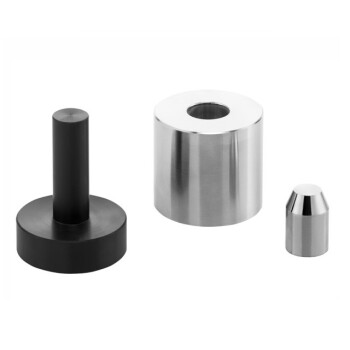
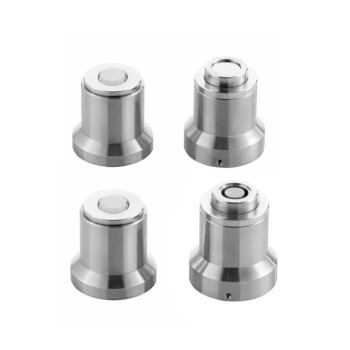
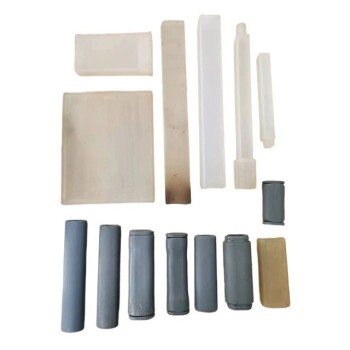
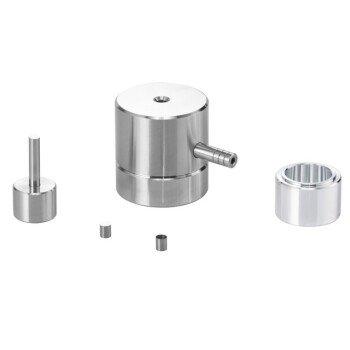
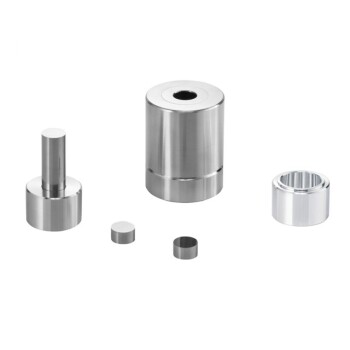
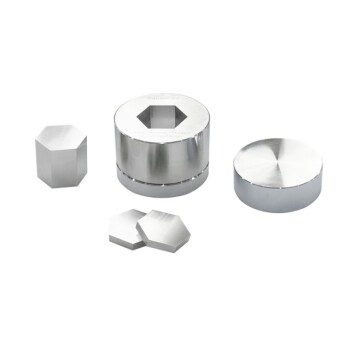
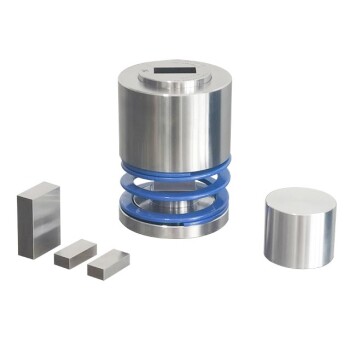
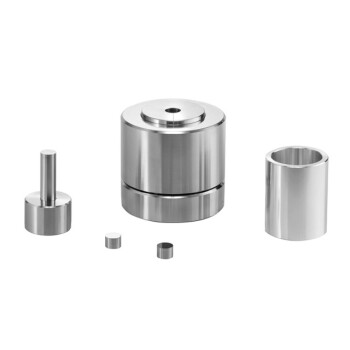
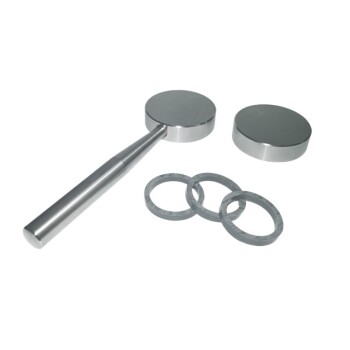
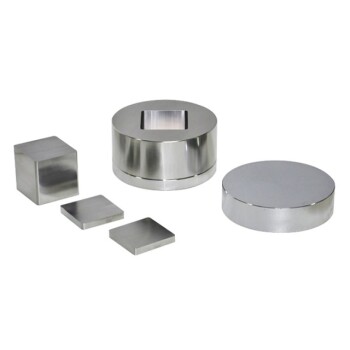
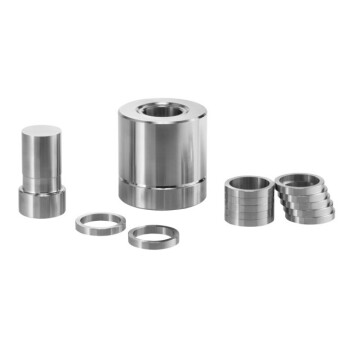
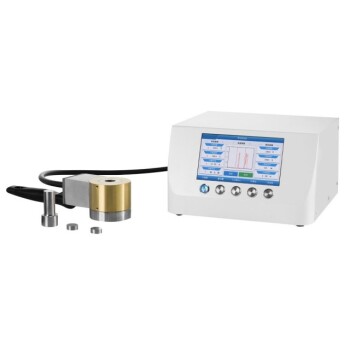
Specialized pressure-retaining test molds are the structural backbone of accurate all-solid-state battery (ASSB) evaluation. Because ASSBs lack liquid electrolytes to fill voids, they rely entirely on mechanical contact for ion transport. These specialized molds apply constant external pressure—often around 8 MPa during cycling—to counteract the significant volume expansion and contraction that electrode materials undergo during charge and discharge cycles.
By maintaining continuous stack pressure, these molds prevent the physical separation of electrode particles from the electrolyte. This ensures that the solid-solid interface remains intact despite the inevitable swelling and shrinking of active materials, preventing crack propagation and preserving the battery's long-term cycle life.
The Mechanics of Solid-State Failure
Counteracting Anisotropic Volume Changes
Unlike traditional batteries, solid-state cells face a severe mechanical challenge: the active materials physically change size during operation. High-nickel cathode materials (such as NCM-811) and sulfur cathodes undergo anisotropic volume expansion and contraction.
Without a mold to constrain this movement, the lattice contraction during charging (delithiation) creates voids. These voids lead to particle isolation, meaning ions can no longer move between the electrode and the electrolyte.
Managing Lithium Metal Dynamics
The challenge is equally critical at the anode. During plating and stripping, lithium metal deposition causes significant volume fluctuation.
Specialized molds compensate for this by applying continuous force (typically 1.5 to 17 MPa) to the stack. This pressure ensures that as lithium is stripped away, the interface does not delaminate, keeping impedance low and stable.
Preventing Crack Propagation
Repeated expansion and contraction without restraint induces stress that leads to cracking. These cracks sever the ionic pathways within the solid electrolyte and electrode composite.
By applying a constant "clamping" force, the test mold mechanically suppresses the formation and propagation of these cracks. This suppression is the primary factor in extending the cycle life of the test cell.
Ensuring Data Accuracy
Eliminating Contact Resistance
The primary goal of electrochemical testing is to measure the material's performance, not the poor quality of the assembly. If the contact between the electrode and electrolyte is loose, interfacial resistance spikes.
Pressure-retaining molds minimize this interfacial impedance by forcing the materials into tight contact. This allows researchers to distinguish between the intrinsic limitations of the chemistry and simple mechanical failure.
Isolating the Current Path
Advanced molds often utilize insulating inner walls made from materials like PEEK (polyether ether ketone). This design feature is critical for measuring Direct Current (DC) resistance and volume resistivity.
The non-conductive liner ensures that the electrical current passes strictly through the compressed powder column vertically. This prevents short-circuiting through the side walls of the mold, which would otherwise skew resistivity data and conceal the true performance of the electrode material.
Understanding the Trade-offs
While necessary, the use of pressurized molds introduces specific variables that must be managed to ensure data validity.
The "Over-Pressure" Artifact
There is a risk of applying pressure that exceeds realistic commercial capabilities. While specific molding steps may require 200–450 MPa to form the pellet, cycling pressures are much lower.
Testing at excessively high pressures (well above 10-20 MPa) may yield excellent lab results that cannot be replicated in a practical battery pack. You must distinguish between the pressure needed to form the cell and the pressure needed to cycle it.
Material Compatibility
The mold material itself must be chemically inert. While PEEK is excellent for insulation, the plunger materials (often metal) must not react with the active components.
Incompatibility can lead to side reactions during Electrochemical Impedance Spectroscopy (EIS) or long-term cycling. These reactions create false signals that can be mistaken for battery degradation.
Making the Right Choice for Your Goal
To select the correct test mold configuration, align the equipment capabilities with your specific research objectives.
- If your primary focus is Long-Term Cycle Life: Prioritize molds with calibrated springs or pneumatic control to maintain constant stack pressure (approx. 8–17 MPa) to accommodate volume breathing.
- If your primary focus is Material Resistivity: Ensure the mold features high-quality insulating liners (like PEEK) to force current vertically and prevent side-wall shorts.
- If your primary focus is High-Nickel or Sulfur Cathodes: Select a mold specifically rated to counteract significant lattice contraction to prevent immediate capacity decay from particle detachment.
Success in solid-state battery testing is not just about the chemistry; it is about mechanically engineering the environment where that chemistry can survive.
Summary Table:
| Feature | Function in ASSB Testing | Impact on Data Accuracy |
|---|---|---|
| Constant Pressure | Counteracts anisotropic volume expansion/contraction | Prevents particle isolation & crack propagation |
| PEEK Insulation | Isolates current path through the material | Prevents side-wall shorts; ensures accurate resistivity |
| Mechanical Clamping | Minimizes solid-solid interfacial resistance | Lowers impedance for true electrochemical measurement |
| Calibrated Springs | Maintains stable stack pressure (8-17 MPa) | Ensures long-term cycle life & repeatable results |
Elevate Your Solid-State Research with KINTEK Precision
Don't let mechanical failure mask your electrochemical breakthroughs. KINTEK specializes in high-performance laboratory equipment, providing the specialized pressure-retaining test molds and hydraulic presses essential for accurate all-solid-state battery (ASSB) evaluation.
Our comprehensive range—from PEEK-lined molds and coin cell tools to high-temperature furnaces and battery research consumables—is engineered to meet the rigorous demands of material science. Whether you are testing high-nickel cathodes or sulfur-based systems, our solutions ensure optimal contact and reliable data.
Ready to optimize your battery testing workflow? Contact KINTEK today to discover how our expertise can drive your research forward.
Related Products
- Button Battery Tablet Press Sealing Mold for Lab Use
- Button Battery Disassembly and Sealing Mold for Lab Use
- Isostatic Molding Pressing Molds for Lab
- Anti-Cracking Press Mold for Lab Use
- Cylindrical Press Mold with Scale for Lab
People Also Ask
- What role do battery test molds or coin cell cases play? Optimize Your All-Solid-State Battery Assembly Today
- What is the function of a tablet press? Transforming Powder into Precise, Uniform Tablets
- What is tablet pressing in pharmaceutical industry? The Core Process for Producing Solid Oral Dosage Forms
- What is the difference between single punch and rotary tablet press? Choose the Right Machine for Your Lab or Production
- What are pill presses called? The Correct Term is Tablet Press for Pharmaceutical Manufacturing