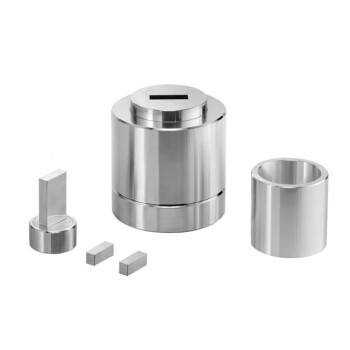
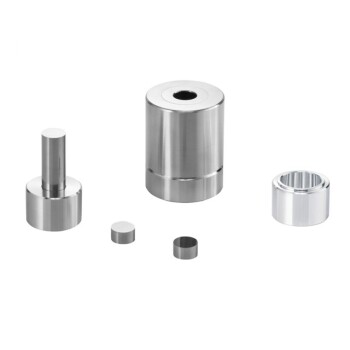
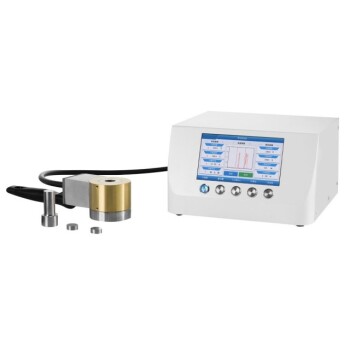
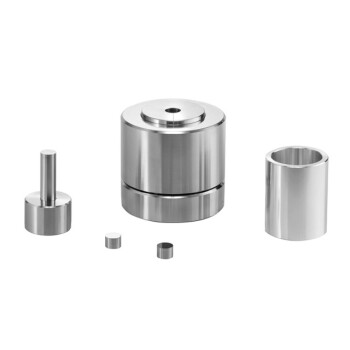
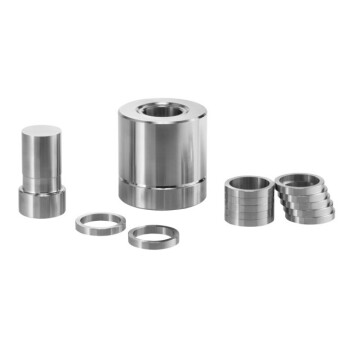
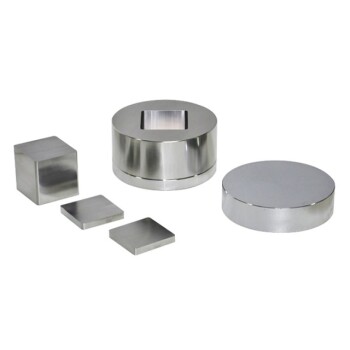
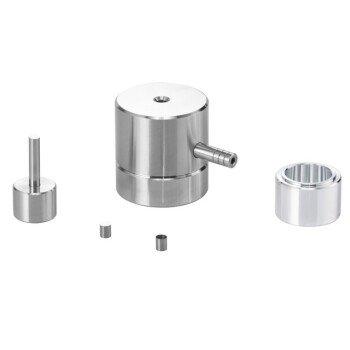
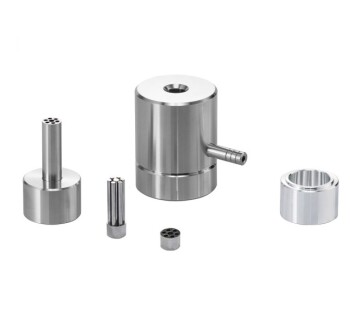
Laboratory hydraulic presses and forming molds serve as the critical densification tools in the synthesis of three-dimensional superlattice nanocatalysts. By applying controlled mechanical force to nanocrystal colloids, these instruments transform loose particles into cohesive "green bodies," establishing the physical architecture required for high-performance applications.
The fundamental value of the hydraulic press lies in its ability to eliminate internal voids within nanocrystal assemblies. This mechanical compression creates the high-density particle arrangement necessary for achieving superior electrical conductivity and structural stability in the final superlattice thin films.
The Mechanics of Nanocrystal Densification
Creating the "Green Body"
The process begins by introducing nanocrystal colloids, such as Lead Telluride (PbTe), into precision forming molds. The hydraulic press then applies force to compress these loose colloids into a solid, pre-sintered form known as a green body.
Precision Geometry Control
The forming mold is responsible for defining the macroscopic shape of the catalyst. By utilizing high-precision molds, researchers ensure the resulting green body meets specific geometric dimensions required for the final application.
Achieving Tight Arrangement
The hydraulic press does more than simply shape the material; it forces the nanocrystals into a tightly packed arrangement. This physical proximity is the precursor to forming a coherent superlattice structure.
Critical Impact on Catalyst Performance
Elimination of Internal Voids
The most significant contribution of the press is the removal of empty space between particles. By squeezing out voids, the process increases the density of the material, which is essential for the material's integrity.
Enhancing Electrical Conductivity
For a superlattice nanocatalyst to function effectively, electrons must move freely through the material. The tight particle arrangement achieved through compression minimizes resistance, directly contributing to high electrical conductivity in the final thin film.
Ensuring Structural Stability
The compression phase is a prerequisite for successful thermal processing. A dense, well-formed green body provides the structural stability needed to withstand subsequent drying and sintering processes without crumbling or deforming.
Understanding the Trade-offs
Balancing Pressure and Integrity
While high pressure is required to eliminate voids, there is a risk of over-compression. Excessive force can crush the delicate nanocrystalline structures or cause laminations in the pellet, potentially degrading the catalyst's intrinsic properties.
Uniformity vs. Scattering Effects
If the pressure is not applied uniformly across the mold, the resulting sample may have uneven thickness or density. As noted in general laboratory practice, such irregularities can cause scattering effects, leading to structural instability and inaccurate characterization results during analysis like XRF or SEM.
Making the Right Choice for Your Goal
To maximize the quality of your superlattice nanocatalysts, align your pressing strategy with your specific requirements:
- If your primary focus is electrical performance: Prioritize void elimination through higher pressure to maximize particle contact and conductivity.
- If your primary focus is structural uniformity: Ensure your forming molds are precision-machined to produce perfectly flat surfaces, preventing density gradients that lead to instability.
Mastering the mechanical compression stage is the foundational step in transforming loose colloidal particles into robust, high-efficiency superlattice materials.
Summary Table:
| Process Stage | Component Role | Key Benefit to Nanocatalyst |
|---|---|---|
| Densification | Hydraulic Press | Eliminates internal voids and increases particle density. |
| Geometric Shaping | Forming Mold | Defines macroscopic shape and ensures structural precision. |
| Particle Alignment | Mechanical Force | Creates the tight arrangement needed for superlattice formation. |
| Performance Tuning | Controlled Pressure | Maximizes electrical conductivity and ensures structural stability. |
Elevate Your Nanotechnology Research with KINTEK Precision
Achieving the perfect 3D superlattice structure requires more than just chemistry—it demands the precision of high-performance mechanical compression. KINTEK specializes in advanced laboratory equipment designed for the most demanding material science applications.
Our comprehensive range of hydraulic presses (pellet, hot, isostatic) and precision forming molds provides the exact force control and geometric accuracy needed to eliminate voids and maximize the electrical conductivity of your nanocatalysts. Whether you are developing thin films or complex catalysts, our solutions—including high-temperature furnaces, crushing systems, and specialized consumables like PTFE and ceramics—ensure consistent, repeatable results.
Ready to optimize your catalyst synthesis? Contact our laboratory specialists today to find the perfect pressing and thermal solution for your research goals.
References
- Nguyễn Đức Cường, Dương Tuấn Quang. Progress through synergistic effects of heterojunction in nanocatalysts ‐ Review. DOI: 10.1002/vjch.202000072
This article is also based on technical information from Kintek Solution Knowledge Base .
Related Products
- Ball Press Mold for Lab
- Assemble Square Lab Press Mold for Laboratory Applications
- Laboratory Hydraulic Press Split Electric Lab Pellet Press
- Carbide Lab Press Mold for Laboratory Applications
- Automatic Laboratory Hydraulic Pellet Press Machine for Lab Use
People Also Ask
- What are the advantages of using a laboratory hydraulic press for hot pressing? Achieve Peak Nano-Composite Density
- How to use a press mold? Master the Art of Creating Consistent Ceramic Forms
- What is the press mould method? A Guide to Consistent, Detailed Ceramic Forms
- What is the purpose of specialized pressure devices in sulfide solid-state batteries? Ensure Chemo-Mechanical Stability
- Why are pressure molds with non-conductive resin inner walls required for battery testing? Ensure Data Accuracy