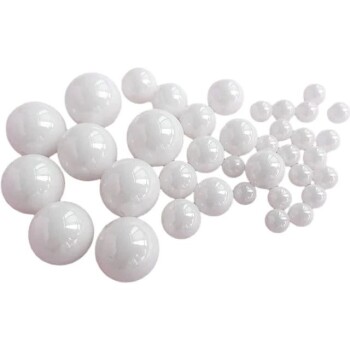
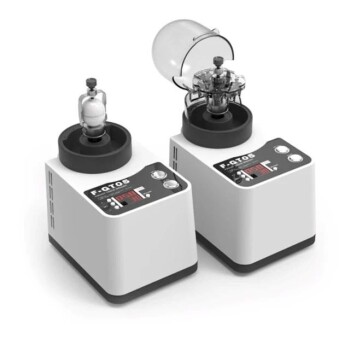
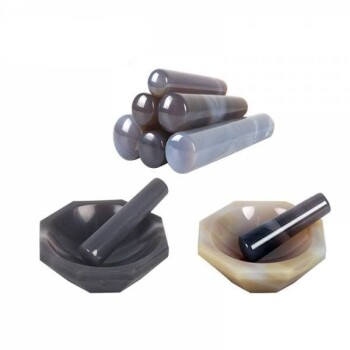
Zirconia grinding balls are the industry standard for this application because they possess the extreme hardness required to physically break down Silicon Carbide (SiC) without degrading themselves. Their superior wear resistance and chemical stability prevent the introduction of foreign contaminants, ensuring the final ceramic retains the high purity necessary for ultra-high temperature performance.
The Core Reality Preparing high-performance ceramics is a battle against contamination. Zirconia media solves the fundamental conflict of milling: it delivers enough impact energy to pulverize extremely hard materials like SiC, yet is durable enough to remain chemically inert, preventing the "media wear" that ruins mechanical properties.
The Physical Mechanics of Milling
Overcoming Extreme Hardness
To create a homogeneous ZrB2-SiC powder, you must effectively crush SiC particles. Silicon Carbide is notoriously hard; if the grinding media is not significantly harder, the media will wear down instead of the powder.
Zirconia balls offer extreme hardness that exceeds that of many target materials. This ensures the kinetic energy of the mill is transferred to crushing the SiC and breaking up soft agglomerates, rather than damaging the grinding media.
Achieving Homogeneity Through Impact
Effective mixing requires more than just motion; it requires high-impact collisions. Zirconia typically has a high density, which translates to greater kinetic energy during the milling process.
This density allows the balls to deliver sufficient impact force to thoroughly mix the ZrB2 and SiC powders. The result is a uniform distribution of particles, which is a prerequisite for consistent material performance after sintering.
Preserving Material Purity
Eliminating Wear Byproducts
The greatest risk in high-energy milling is that the grinding balls will degrade, shedding debris into your powder mixture. With softer media, this introduces significant impurities.
Due to zirconia's superior wear resistance, the volume of media material lost during milling is negligible. This minimizes the introduction of wear byproducts that would otherwise act as defects in the final ceramic microstructure.
Ensuring Chemical Stability
Even if microscopic amounts of wear occur, the chemical nature of the contaminant matters. Zirconia is chemically stable and highly inert.
Unlike steel balls, which introduce metallic impurities that can drastically alter electrical and mechanical properties, zirconia does not react with the powder. This maintains the high purity required for the optimal mechanical performance of Ultra-High Temperature Ceramics (UHTCs).
Understanding the Trade-offs
The Risk of Cross-Contamination
While zirconia minimizes "foreign" contamination (like iron), it is not indestructible. Long-duration high-energy milling can still produce minute amounts of zirconia dust.
However, in the context of Zirconium-based ceramics (like ZrB2), a trace amount of zirconia (ZrO2) is often chemically compatible and far less detrimental than metallic inclusions. The trade-off is accepting a minor, compatible impurity to avoid a major, performance-killing one.
Hardness vs. Brittleness
Zirconia is hard, but it is a ceramic. While it is tougher than glass, it can still fracture under abusive conditions (such as running a planetary mill at excessive speeds with low powder volume).
Operators must balance the milling energy: it must be high enough to crush the SiC, but controlled enough to prevent the zirconia media from chipping and contaminating the batch with large fragments.
Making the Right Choice for Your Goal
When selecting your milling parameters and media for ZrB2-SiC composites, consider your specific end-goals:
- If your primary focus is Mechanical Strength: Prioritize zirconia for its wear resistance to ensure no defects or inclusions weaken the final sintered structure.
- If your primary focus is Microstructural Homogeneity: Leverage the high density of zirconia to ensure sufficient impact energy breaks down all agglomerates for a uniform mix.
Ultimately, zirconia provides the critical balance of force and finesse required to process the hardest ceramic materials without compromising their purity.
Summary Table:
| Property | Benefit for ZrB2-SiC Milling |
|---|---|
| Extreme Hardness | Effectively crushes hard SiC particles without media degradation. |
| High Density | Increases kinetic energy for superior impact and homogeneity. |
| Superior Wear Resistance | Minimizes media byproduct contamination in the final powder. |
| Chemical Stability | Ensures the mixture remains inert and prevents metallic impurities. |
| Compatibility | Trace ZrO2 is chemically compatible with Zirconium-based ceramics. |
Elevate Your Material Research with KINTEK Precision Media
Don't let media wear compromise your high-performance ceramics. KINTEK specializes in providing the laboratory equipment and high-purity consumables essential for advanced materials science. Whether you are preparing ZrB2-SiC powders or developing next-generation UHTCs, our premium zirconia grinding media, crushing and milling systems, and sieving equipment ensure the homogeneity and purity your research demands.
From high-temperature furnaces to specialized ceramics and crucibles, we deliver the tools necessary for precision sintering and processing. Contact us today to optimize your milling process and discover how KINTEK’s comprehensive range of laboratory solutions can drive your innovation forward.
Related Products
- Laboratory Jar Ball Mill with Alumina Zirconia Grinding Jar and Balls
- Precision Machined Zirconia Ceramic Ball for Engineering Advanced Fine Ceramics
- Laboratory Jar Mill with Agate Grinding Jar and Balls
- Laboratory Ball Mill Jar Mill with Metal Alloy Grinding Jar and Balls
- Laboratory Micro Tissue Grinding Mill Grinder
People Also Ask
- What are the primary functions of using a ball mill for BZCY72 powder? Achieve High Purity and Enhanced Sintering
- In what way does a laboratory ball mill affect material properties when modifying PHBV/pulp fiber composites?
- Why is a laboratory ball mill required for ultra-fine fly ash? Unlock Nano-Scale Adsorption Power
- What is the function of a laboratory ball mill in the preparation of AMMCs? Optimize Dispersion & Grain Refinement
- What is the function of a laboratory ball mill in the pretreatment of waste tire char (WTC)? Optimize Material Reactivity