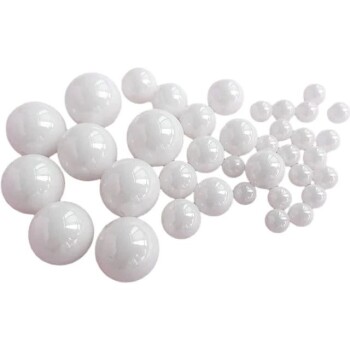
The preference for zirconia grinding jars and balls stems from their unique ability to deliver high mechanical energy without compromising material purity. When mechanically mixing iridium powder with alkaline oxidants, zirconia’s exceptional hardness provides the necessary impact force for effective mixing, while its chemical stability prevents the grinding media itself from wearing down and contaminating the high-value iridium.
The selection of zirconia is driven by the need to balance aggressive mechanical energy with absolute chemical purity. Its high wear resistance ensures that the milling process refines the iridium without introducing contaminants that would degrade the final product's quality.
Maximizing Grinding Efficiency
The Role of Hardness and Strength
Mechanical mixing of dense materials requires significant kinetic energy to be effective. Zirconia is selected specifically for its high strength and extreme hardness. These properties allow the media to withstand the rigorous forces involved in the mixing process without fracturing or deforming.
Delivering Sufficient Impact Energy
To successfully mix iridium powder with oxidants, the grinding media must transfer energy efficiently. Because zirconia is so hard, it does not absorb impact through elastic deformation. Instead, it ensures that the maximum amount of "grinding energy" is directed into the powder mixture, facilitating a thorough mechanical reaction.
Preserving Material Purity
Superior Wear Resistance
A critical challenge in mechanical milling is "media loss," where microscopic particles of the jar or balls abrade into the mixture. Zirconia offers excellent wear resistance, significantly minimizing this degradation. This ensures that the physical volume of the grinding media remains intact even during prolonged processing.
Eliminating Chemical Contamination
High-purity iridium metal raw materials are sensitive to foreign impurities. Zirconia is chemically stable, meaning it does not react with the alkaline oxidants used in the mixture. This inertness prevents the introduction of metallic impurities that would occur with less stable grinding media.
Understanding the Stakes
The Risk of Impurities
In the extraction and processing of precious metals like iridium, purity is the defining metric of value. If softer or chemically reactive media were used, the "loss of grinding media" would introduce foreign elements into the batch.
Reliability Over Time
Zirconia’s resistance to wear is not just about immediate results; it is about consistency. It ensures that the purity of the extracted products remains high batch after batch, as the media resists the physical erosion that typically leads to contamination in other material types.
Making the Right Choice for Your Process
When optimizing mechanical mixing processes for high-value metals, your choice of media defines your output quality.
- If your primary focus is efficient energy transfer: Zirconia provides the high hardness and strength required to generate sufficient impact energy for thorough mixing.
- If your primary focus is zero contamination: The chemical stability and wear resistance of zirconia are critical to minimizing media loss and ensuring the purity of the extracted iridium.
By utilizing zirconia, you protect the integrity of your raw materials while ensuring the mechanical process has the energy required to succeed.
Summary Table:
| Feature | Zirconia (YSZ) Benefit | Impact on Iridium Mixing |
|---|---|---|
| Hardness | Extreme (Mohs 8.5+) | Delivers high kinetic energy for thorough mechanical mixing. |
| Wear Resistance | Superior durability | Minimizes media loss, preventing microscopic debris in the powder. |
| Chemical Stability | Inert to alkaline oxidants | Prevents chemical reactions and introduction of metallic impurities. |
| Strength | High fracture toughness | Withstands rigorous milling forces without fracturing or deforming. |
Elevate Your Material Purity with KINTEK
When processing high-value precious metals like iridium, your choice of milling media is the difference between a premium product and a contaminated batch. KINTEK specializes in high-performance laboratory solutions, offering premium zirconia grinding jars and balls specifically designed for high-energy mechanical mixing and crushing.
Beyond our industry-leading crushing and milling systems, KINTEK provides a comprehensive range of equipment including muffle and vacuum furnaces, high-pressure reactors, and specialized battery research tools. Our goal is to help your lab achieve maximum efficiency without compromising chemical integrity.
Ready to optimize your milling process? Contact KINTEK today to discover how our high-purity consumables and precision equipment can secure your production quality.
References
- Jaeryeong Lee, Youngjin Kim. Chemical Dissolution of Iridium Powder Using Alkali Fusion Followed by High-Temperature Leaching. DOI: 10.2320/matertrans.m2011202
This article is also based on technical information from Kintek Solution Knowledge Base .
Related Products
- Laboratory Jar Ball Mill with Alumina Zirconia Grinding Jar and Balls
- Laboratory Jar Mill with Agate Grinding Jar and Balls
- Laboratory Ball Mill Jar Mill with Metal Alloy Grinding Jar and Balls
- Precision Machined Zirconia Ceramic Ball for Engineering Advanced Fine Ceramics
- Nature Agate Mortar and Pestle for Grinding and Mixing
People Also Ask
- What are the primary functions of using a ball mill for BZCY72 powder? Achieve High Purity and Enhanced Sintering
- In what way does a laboratory ball mill affect material properties when modifying PHBV/pulp fiber composites?
- Why is a laboratory ball mill required for ultra-fine fly ash? Unlock Nano-Scale Adsorption Power
- What is the function of a laboratory ball mill in the preparation of AMMCs? Optimize Dispersion & Grain Refinement
- What is the function of a laboratory ball mill in the pretreatment of waste tire char (WTC)? Optimize Material Reactivity