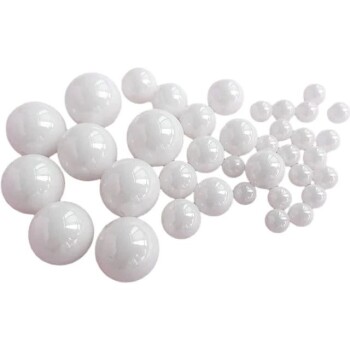
The use of zirconia grinding jars and balls is mandatory for synthesizing sulfide electrolytes like Na3SbS4 and Na3PS4 because of their superior hardness and chemical inertness. These specific properties enable the media to withstand the aggressive mechanical forces of high-energy ball milling without contaminating the sample. Furthermore, zirconia prevents the secondary chemical reactions that commonly occur when highly reactive sulfide precursors come into contact with metallic grinding media.
Core Insight: The success of sulfide electrolyte synthesis hinges on purity. Zirconia is the industry standard because it eliminates the two primary failure modes: physical contamination from media wear and chemical degradation caused by reactive impurities like iron.
Preserving Chemical Purity
Eliminating Contamination Risks
High-energy ball milling is a violent process intended to facilitate mechanochemical reactions. When softer materials are used, the grinding media wears down, shedding debris into the mixture.
Zirconia is exceptionally hard and wear-resistant. It withstands prolonged, high-intensity impacts without introducing significant foreign material into the sample, ensuring the final product remains pure.
Preventing Secondary Reactions
Sulfide precursors are chemically aggressive and sensitive. Using metallic media, such as stainless steel, often leads to unwanted side reactions between the sulfur and the metal.
Zirconia is chemically inert. It does not react with sulfide precursors, ensuring that the chemical reaction is restricted strictly to the intended electrolyte materials (such as Sodium, Antimony, and Phosphorus).
Mechanical Efficiency in Synthesis
Delivering High Kinetic Energy
To synthesize materials like Na3SbS4, the precursors must undergo amorphization or alloying. This requires significant impact energy to break down the crystal structures.
Zirconia offers high density in addition to its hardness. This density provides the necessary kinetic energy during milling impacts to effectively pulverize hard precursors and shorten reaction times.
Maintaining Electrochemical Stability
The ultimate goal of these electrolytes is high performance in a battery cell. Impurities act as defects that impede ion conduction or cause instability.
By preventing the introduction of metallic impurities, zirconia ensures the resulting material maintains high electrochemical stability. This is critical for preventing degradation when the electrolyte is eventually cycled in a battery.
Understanding the Trade-offs: Zirconia vs. Stainless Steel
The "Iron Poisoning" Effect
It is crucial to understand why standard stainless steel jars are rejected for this application. Stainless steel introduces metallic iron impurities due to abrasive wear during milling.
These iron contaminants are detrimental to electrochemical performance. They can trigger side reactions and lower the critical current density of the electrolyte, effectively ruining the synthesis.
The Necessity of Environmental Control
While zirconia itself is inert, the milling environment affects the outcome. Sulfide electrolytes like Na3PS4 are moisture-sensitive and susceptible to hydrolysis (degrading in contact with water).
High-quality zirconia jars are designed to be hermetically sealed. This allows the milling to occur in an inert argon gas environment, preventing oxidation and hydrolysis that would destroy the air-sensitive sulfide compounds.
Making the Right Choice for Your Goal
To ensure the successful synthesis of Na3SbS4 or Na3PS4, apply the following principles:
- If your primary focus is material purity: Exclusively use zirconia media to prevent the introduction of metallic iron, which is fatal to electrochemical performance.
- If your primary focus is process efficiency: Rely on the high density of zirconia balls to provide the kinetic impact energy needed to shorten synthesis time and achieve full amorphization.
Ultimately, zirconia is not merely a preferred alternative but a strict requirement to ensure the chemical integrity and electrochemical viability of air-sensitive sulfide electrolytes.
Summary Table:
| Feature | Zirconia Media | Stainless Steel Media |
|---|---|---|
| Chemical Inertness | High (Non-reactive with sulfides) | Low (Reacts with sulfur/precursors) |
| Wear Resistance | Superior (Prevents media debris) | Moderate (Introduces iron impurities) |
| Impact Energy | High Density (Efficient milling) | High Density |
| Electrochemical Impact | Maintains high ionic conductivity | Causes 'Iron Poisoning' & instability |
| Sample Purity | Maximum purity for electrolytes | Significant metallic contamination |
Elevate Your Battery Research with KINTEK Precision
Achieving the highest electrochemical performance in sulfide electrolytes requires tools that never compromise on purity. KINTEK specializes in premium laboratory equipment, providing high-density, wear-resistant zirconia grinding jars and balls specifically designed for high-energy ball milling of sensitive materials like Na3SbS4 and Na3PS4.
Beyond our industry-leading crushing and milling systems, our comprehensive portfolio includes:
- High-Temperature Furnaces: Muffle, tube, and vacuum systems for advanced material synthesis.
- Battery Research Tools: Specialized consumables, hydraulic presses (pellet, hot, isostatic), and electrolytic cells.
- Advanced Reactors: High-temperature high-pressure reactors and autoclaves for complex chemical processing.
Don't let metallic contamination compromise your innovation. Contact KINTEK today to discover how our high-performance grinding solutions and laboratory consumables can ensure the integrity of your air-sensitive research.
Related Products
- Laboratory Jar Ball Mill with Alumina Zirconia Grinding Jar and Balls
- Precision Machined Zirconia Ceramic Ball for Engineering Advanced Fine Ceramics
- Laboratory Jar Mill with Agate Grinding Jar and Balls
- Laboratory Ball Mill Jar Mill with Metal Alloy Grinding Jar and Balls
- Nature Agate Mortar and Pestle for Grinding and Mixing
People Also Ask
- What are the primary functions of using a ball mill for BZCY72 powder? Achieve High Purity and Enhanced Sintering
- In what way does a laboratory ball mill affect material properties when modifying PHBV/pulp fiber composites?
- Why is a laboratory ball mill required for ultra-fine fly ash? Unlock Nano-Scale Adsorption Power
- What is the function of a laboratory ball mill in the preparation of AMMCs? Optimize Dispersion & Grain Refinement
- What is the function of a laboratory ball mill in the pretreatment of waste tire char (WTC)? Optimize Material Reactivity