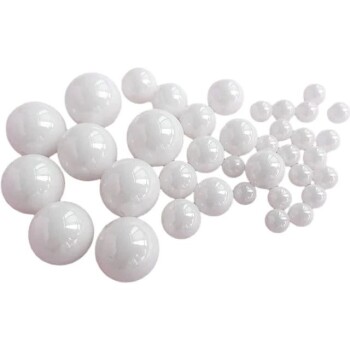
The selection of Zirconia (ZrO2) grinding media is a critical purity safeguard. It is used primarily because it offers a unique combination of extreme hardness and chemical inertness. This allows for the high-energy mechanical alloying required to synthesize fluoride solid electrolytes without introducing metallic impurities that would degrade the material's electrochemical performance.
Core Takeaway: The synthesis of fluoride electrolytes requires high impact energy to drive solid-state reactions. Zirconia is the material of choice because it delivers this energy through high density and hardness while remaining chemically inert, ensuring the final product maintains the high purity necessary for a stable electrochemical window.
The Physical Requirement: Impact and Wear Resistance
Generating Sufficient Impact Energy
Synthesizing solid electrolytes often requires mechanical alloying, a process where powder particles are repeatedly fractured and welded together.
Zirconia is extremely hard and dense. When used as a grinding medium, it provides the substantial impact energy necessary to drive these solid-phase reactions and effectively pulverize hard precursors into a composite.
Superior Wear Resistance
The milling process involves intense collisions that would rapidly degrade softer materials.
Zirconia possesses exceptional wear resistance. This ensures the grinding balls and jar liners retain their structural integrity over long milling durations, preventing the media from breaking down and contaminating the batch with ceramic dust.
The Chemical Requirement: Purity and Stability
Preventing Metallic Contamination
A primary risk in ball milling is the introduction of impurities from the grinding tool itself, often referred to as "cross-contamination."
Using steel jars would introduce iron or other metallic particles into the mixture. In the context of batteries, metallic impurities are catastrophic; they can alter conductivity and cause short circuits. Zirconia eliminates this risk entirely.
Inertness to Fluoride Reactivity
Fluorides can be chemically reactive with certain container materials during high-energy synthesis.
Zirconia is chemically inert. It withstands the reactive nature of fluoride precursors, ensuring that the chemical composition of the electrolyte powder remains unaltered.
Maintaining Electrochemical Stability
The ultimate goal of the synthesis is a material that performs well inside a battery.
By ensuring high purity, zirconia preserves the electrochemical window stability of the electrolyte. Impurities often act as catalysts for unwanted side reactions, so eliminating them is essential for accurate battery testing and long-term performance.
Understanding the Trade-offs
Thermal Management
While Zirconia is excellent for purity, it is a ceramic and acts as a thermal insulator.
Unlike steel, which dissipates heat, zirconia jars can retain heat generated by friction during high-energy milling. Operators must monitor internal temperatures to ensure the heat does not degrade temperature-sensitive precursors.
Brittleness and Handling
Zirconia is extremely hard, but it is also brittle compared to metal.
Care must be taken during handling. Dropping a zirconia ball or jar on a hard surface can cause chipping or fracturing, which is an expensive mistake compared to the durability of stainless steel.
Making the Right Choice for Your Goal
When setting up your synthesis protocol, align your media choice with your performance metrics:
- If your primary focus is Electrochemical Stability: Use high-purity Zirconia to prevent metallic contamination that narrows the electrochemical window.
- If your primary focus is Milling Efficiency: Rely on the high density of Zirconia to impart maximum kinetic energy into the powder for faster reaction rates.
Ultimately, Zirconia is the non-negotiable standard for researchers who cannot afford to compromise the chemical integrity of their solid-state electrolytes.
Summary Table:
| Feature | Zirconia (ZrO2) | Advantage for Fluoride Electrolytes |
|---|---|---|
| Hardness/Density | High | Provides necessary impact energy for mechanical alloying |
| Wear Resistance | Exceptional | Prevents ceramic dust contamination during long milling |
| Chemical Inertness | High | Resists reactivity with fluorides; maintains material purity |
| Contamination Risk | Minimal | Eliminates metallic impurities that cause short circuits |
| Thermal Property | Insulator | Requires monitoring of heat-sensitive precursors |
Elevate Your Battery Research with KINTEK Precision
Don't let metallic contamination compromise your solid-state electrolyte performance. KINTEK specializes in premium laboratory solutions, providing high-density Zirconia grinding jars and balls specifically designed for high-energy milling. Our extensive portfolio also includes crushing and milling systems, high-temperature furnaces, hydraulic presses, and battery research consumables to support every stage of your material synthesis.
Ready to achieve superior electrochemical stability? Contact KINTEK today to discover how our high-purity equipment can optimize your laboratory results!
Related Products
- Laboratory Jar Ball Mill with Alumina Zirconia Grinding Jar and Balls
- Precision Machined Zirconia Ceramic Ball for Engineering Advanced Fine Ceramics
- Laboratory Jar Mill with Agate Grinding Jar and Balls
- Laboratory Ball Mill Jar Mill with Metal Alloy Grinding Jar and Balls
- Nature Agate Mortar and Pestle for Grinding and Mixing
People Also Ask
- What are the primary functions of using a ball mill for BZCY72 powder? Achieve High Purity and Enhanced Sintering
- In what way does a laboratory ball mill affect material properties when modifying PHBV/pulp fiber composites?
- Why is a laboratory ball mill required for ultra-fine fly ash? Unlock Nano-Scale Adsorption Power
- What is the function of a laboratory ball mill in the preparation of AMMCs? Optimize Dispersion & Grain Refinement
- What is the function of a laboratory ball mill in the pretreatment of waste tire char (WTC)? Optimize Material Reactivity