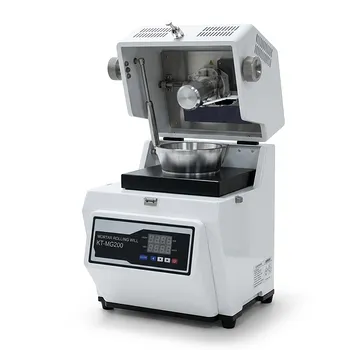
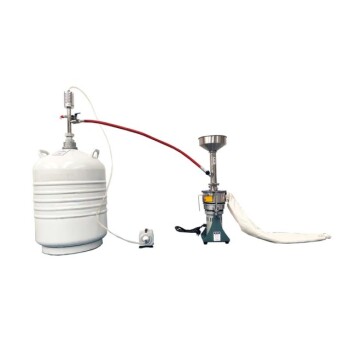
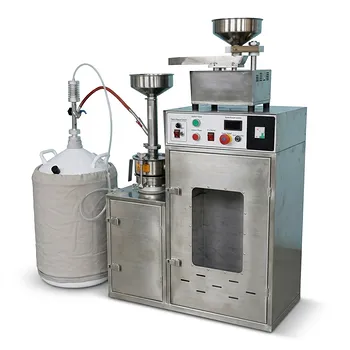
The primary role of grinding equipment in bioleaching is to optimize the physical state of copper concentrate by reducing particle size to a precise range of 45–80 µm. This mechanical reduction is fundamental to the process, as it exponentially increases the specific surface area of the mineral. By maximizing this area, the equipment directly facilitates the chemical and biological interactions required for effective copper extraction.
Core Takeaway Grinding is not merely about size reduction; it is about creating a massive "reaction interface." By exposing more surface area, the equipment ensures bacteria and oxidants have sufficient access to sulfide minerals, which is the direct driver of enhanced leaching rates.
The Mechanics of Surface Area Expansion
Targeting the Critical Size Range
To achieve efficient bio-oxidation, raw copper concentrate must be refined to a specific particle size between 45 and 80 µm.
Grinding equipment achieves this strict specification through multi-stage crushing processes. This ensures that the material is consistently broken down to the optimal dimensions required for downstream processing.
Increasing Specific Surface Area
The reduction in particle size leads to a significant increase in the specific surface area of the mineral.
This physical transformation is the foundation of the leaching process. A larger surface area means a greater percentage of the mineral is exposed to the surrounding environment, rather than being locked inside larger rocks.
Enhancing Biological and Chemical Efficiency
Maximizing Bacterial Adsorption
Bioleaching relies heavily on the activity of acidophilic iron and sulfur-oxidizing bacteria.
These bacteria require physical contact with the mineral to function effectively. The increased surface area provided by grinding creates a high density of adsorption sites, allowing more bacteria to attach to the mineral surface simultaneously.
Facilitating Chemical Oxidation
The leaching process is not solely biological; it also involves non-biological chemical reactions.
Grinding facilitates better contact between chemical oxidants and the sulfide minerals. This enhanced access ensures that chemical oxidation occurs in tandem with biological activity, leading to a comprehensive breakdown of the concentrate.
Critical Process Requirements
The Necessity of Multi-Stage Processing
Achieving the target range of 45–80 µm is rarely accomplished in a single pass.
Operators must rely on multi-stage crushing to refine the concentrate gradually. Failing to utilize a multi-stage approach can result in particle sizes that fall outside the optimal window, thereby reducing the available surface area and stalling the leaching rate.
Making the Right Choice for Your Goal
To maximize the efficiency of your bioleaching circuit, focus on the specific outputs of your grinding stage.
- If your primary focus is Bacterial Efficiency: Ensure your grinding circuit consistently hits the lower end of the size range to maximize the number of available adsorption sites for microorganisms.
- If your primary focus is Reaction Speed: Prioritize the uniformity of the 45–80 µm cut to ensure maximum non-biological contact between chemical oxidants and sulfide minerals.
Precise particle sizing is the single most controllable variable for accelerating the dissolution of copper ions.
Summary Table:
| Key Function | Primary Objective | Impact on Bioleaching |
|---|---|---|
| Particle Size Reduction | Reach 45–80 µm range | Ensures optimal dimensions for bacterial attachment. |
| Surface Area Expansion | Maximize specific surface area | Creates a massive reaction interface for extraction. |
| Bacterial Adsorption | Increase adsorption sites | Enhances activity of iron/sulfur-oxidizing bacteria. |
| Oxidant Accessibility | Improve chemical contact | Facilitates rapid oxidation of sulfide minerals. |
Optimize Your Mineral Processing with KINTEK Precision
Unlock the full potential of your bioleaching circuit with KINTEK’s high-performance crushing and milling systems. Achieving the critical 45–80 µm range is essential for maximizing surface area and bacterial efficiency. Beyond grinding, KINTEK specializes in a comprehensive range of laboratory equipment designed for rigorous research and industrial scaling, including:
- Advanced Crushing & Milling: Precision systems to ensure uniform particle size.
- Sieving & Analysis: Accurate classification for process control.
- High-Temperature Solutions: Muffle, tube, and vacuum furnaces for metallurgical testing.
- Reaction Systems: High-pressure reactors and autoclaves for chemical leaching.
Ready to enhance your copper extraction rates and lab efficiency? Contact our technical experts today to find the perfect equipment solution tailored to your mining and research needs.
References
- Arevik Vardanyan, Narine Vardanyan. Extraction of Copper from Copper Concentrate by Indigenous Association of Iron-Oxidizing Bacteria. DOI: 10.3390/separations11040124
This article is also based on technical information from Kintek Solution Knowledge Base .
Related Products
- Three-dimensional electromagnetic sieving instrument
- Laboratory Grinding Mill Mortar Grinder for Sample Preparation
- Liquid Nitrogen Cryogenic Grinder Mill Cryomill Airflow Ultrafine Pulverizer
- Mini Planetary Ball Mill Machine for Laboratory Milling
- Laboratory Jaw Crusher
People Also Ask
- Why is sieving equipment essential for the classification of processed bio-activated carbon? Optimize Performance
- What are the limitations of sieving? Understanding the Constraints of Particle Size Analysis
- What are advantages and disadvantages of sieving method? A Guide to Reliable & Cost-Effective Particle Sizing
- How is sieving important? The Critical Role of Particle Size Analysis in Quality Control
- What is sieving and how does it work? A Guide to Accurate Particle Size Analysis