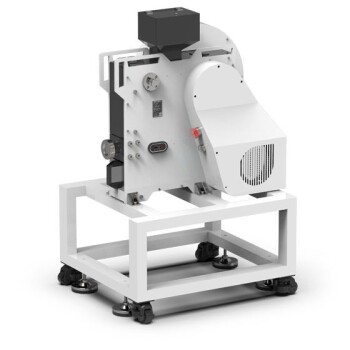
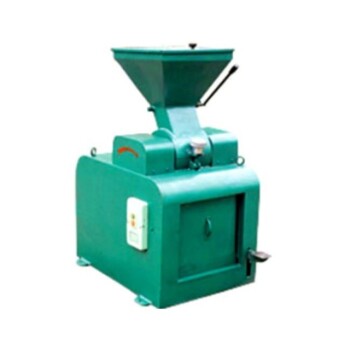
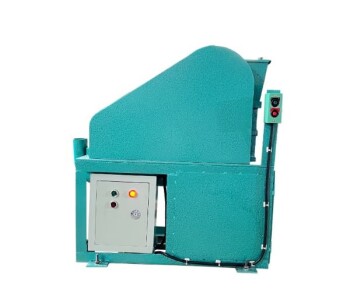
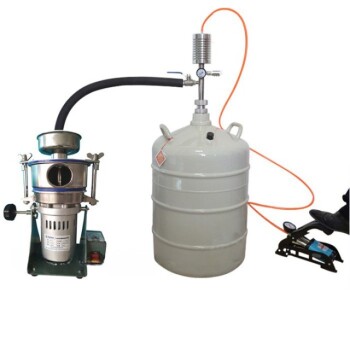
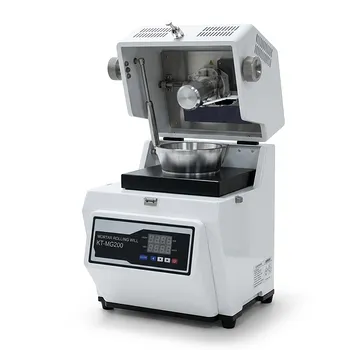
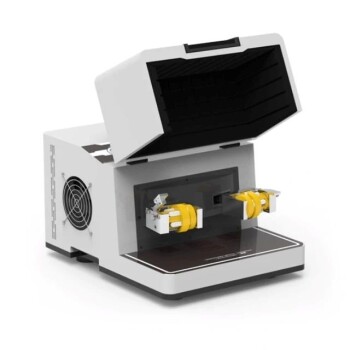
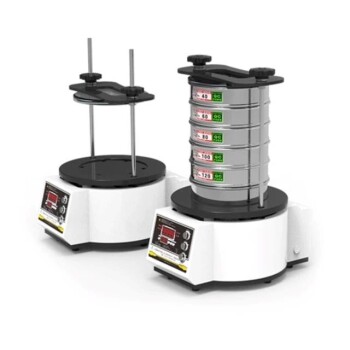
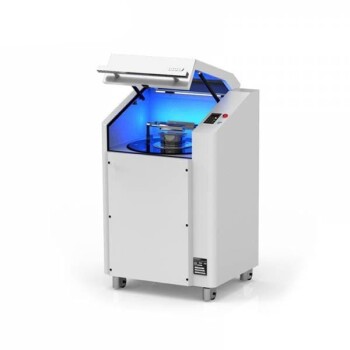
Laboratory crushing and sieving systems act as the foundational standardization mechanism in the pretreatment of biomass raw materials. Specifically, they process organic matter—such as poplar wood and corn stover—into precise particle sizes, typically ranging from 0.43 mm to 1.02 mm. This mechanical reduction is the critical first step that defines the efficiency of all subsequent chemical and physical interactions.
By reducing biomass to a uniform, optimized particle size, these systems significantly increase specific surface area. This physical transformation is the prerequisite for deep, uniform chemical reagent penetration, ensuring that subsequent reactions are both consistent and reproducible.
The Mechanics of Biomass Standardization
Precision Size Reduction
Raw biomass is naturally heterogeneous and bulky. Crushing systems mechanically break down materials into a manageable state.
Sieving systems then filter these fragments to retain only those within a target range, such as 0.43 mm to 1.02 mm. This ensures that every particle entering the reactor has similar physical dimensions.
Maximizing Specific Surface Area
The primary objective of this process is to increase the specific surface area of the raw material.
By fracturing the lignocellulosic structure, the system exposes a greater amount of internal surface area relative to the particle's volume. This exposure is critical for overcoming the natural recalcitrance of biomass.
Enhancing Chemical and Thermal Efficiency
Facilitating Reagent Penetration
In chemical pretreatment, reagents must penetrate deep into the biomass matrix to be effective.
An increased surface area allows chemical reagents to access the lignocellulosic structure more thoroughly. This is essential for processes like acid or alkali treatments, where the goal is to remove hemicellulose and lignin efficiently.
Ensuring Reaction Uniformity
When particle size is inconsistent, reaction rates vary wildly across the batch.
Standardized sieving ensures that all particles react at roughly the same speed. This eliminates "cold spots" or unreacted cores, providing consistent kinetic data and predictable product yields.
Optimizing Heat Transfer
For thermal processes like torrefaction or pyrolysis, uniform particle size governs heat diffusion.
Smaller, uniform particles (e.g., <3mm or <10mm) allow heat to penetrate rapidly and evenly. This prevents thermal gradients that could lead to incomplete reactions or inconsistent char properties.
Understanding the Trade-offs
The Balance of Energy Consumption
While smaller particles generally react faster, achieving extremely fine sizes requires exponentially more energy.
You must balance the improved reaction kinetics against the energy cost of the grinding process. Reducing biomass to microns (e.g., <90 μm) may be necessary for combustion kinetics but is often excessive and inefficient for standard chemical pretreatment.
The Risk of "Fines" and Handling
Aggressive crushing can produce "fines" (dust-like particles) that are smaller than the desired lower limit.
These fines can cause handling issues, clog filters, or create uneven flow in reactors. A robust sieving system must effectively remove both oversized and undersized particles to maintain process integrity.
Making the Right Choice for Your Goal
To select the appropriate crushing and sieving parameters, you must align the physical preparation with your specific downstream process.
- If your primary focus is Chemical Pretreatment: Prioritize a range like 0.43–1.02 mm to maximize reagent penetration without incurring excessive grinding energy costs.
- If your primary focus is Thermal Processing (Torrefaction/Pyrolysis): Target a size range under 10mm or 3mm to ensure rapid, uniform heat transfer across the entire biomass volume.
- If your primary focus is Kinetic Modeling: strict adherence to narrow ranges (e.g., <300 μm) is required to eliminate internal diffusion limitations and capture accurate data.
Ultimately, the precision of your mechanical preparation sets the ceiling for the chemical success of your entire project.
Summary Table:
| Process Objective | Standard Target Range | Primary Benefit |
|---|---|---|
| Chemical Pretreatment | 0.43 mm – 1.02 mm | Maximizes reagent penetration & consistency |
| Thermal Processing | < 3 mm or < 10 mm | Ensures rapid heat transfer & uniform char |
| Kinetic Modeling | < 300 μm | Eliminates internal diffusion limitations |
| Standardization | Filtered by Sieving | Prevents 'fines' and reactor clogging |
Maximize Your Research Precision with KINTEK
Don't let inconsistent particle sizes compromise your experimental data. KINTEK specializes in high-performance laboratory equipment designed for the rigorous demands of biomass research. From precision crushing and milling systems to high-accuracy sieving equipment, we provide the foundational tools necessary to standardize your raw materials and ensure reproducible chemical and thermal results.
Whether you are performing acid pretreatment or advanced pyrolysis, our comprehensive portfolio—including high-temperature furnaces, hydraulic presses, and autoclaves—is engineered to elevate your lab's efficiency.
Ready to optimize your biomass preparation? Contact our technical experts today to find the perfect solution for your specific application!
References
- Andrzej Antczak, W. Cichy. The Influence of Selected Physico-Chemical Pretreatment Methods on Chemical Composition and Enzymatic Hydrolysis Yield of Poplar Wood and Corn Stover. DOI: 10.12841/wood.1644-3985.423.01
This article is also based on technical information from Kintek Solution Knowledge Base .
Related Products
- Laboratory Test Sieves and Sieving Machines
- Laboratory Vibratory Sieve Shaker Machine for Dry and Wet Three-Dimensional Sieving
- Laboratory Jaw Crusher
- Laboratory Sealed Hammer Crusher for Efficient Sample Preparation
- Sealed Jaw Crusher High Efficiency Environmental Protection Safe and Reliable
People Also Ask
- What are laboratory test sieves used for? A Guide to Particle Size Analysis
- How do you calculate the sieve test? Master Particle Size Distribution for Quality Control
- How does a lab test sieve contribute to biomass charcoal powder preparation? Achieve Uniform Particle Size
- What are the specifications for test sieves? A Guide to ASTM & ISO Standards for Accurate Particle Analysis
- What materials are required for sieving? Achieve Accurate Particle Size Analysis