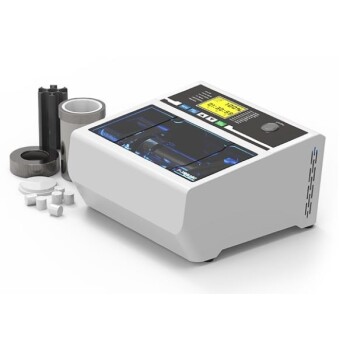
Micro-batch reactors offer a decisive advantage in kinetic studies because they achieve significantly higher heating rates than large autoclave systems. By reaching reaction temperatures rapidly, they allow researchers to observe reactions within precise, short residence times (10 to 20 minutes), ensuring that the data reflects the actual reaction kinetics rather than the artifacts of a slow heating process.
The rapid heating capability of micro-batch reactors effectively eliminates the "thermal lag" that plagues large systems, preventing data distortion and allowing for the accurate identification of optimal yield windows for biomass conversion.
The Critical Role of Heating Rates
Overcoming Thermal Inertia
Large autoclave reactors suffer from significant thermal mass. This results in slow heating rates, meaning a large portion of the experiment occurs while the reactor is still ramping up to temperature.
Achieving Precise Residence Times
Micro-batch reactors are designed to heat instantaneously or very rapidly. This capability allows researchers to define residence times strictly, often within a short window of 10 to 20 minutes.
Isolating Kinetic Data
For a kinetic study to be valid, the reaction conditions must be stable. The rapid heating of micro-reactors ensures that the observed changes in biomass are due to the target temperature, not the transient heating phase.
Preserving Chemical Integrity
Preventing Over-Cracking
Biomass components are sensitive to prolonged heat exposure. The slow heating inherent in large autoclaves often leads to over-cracking, where desirable products decompose into less valuable compounds before the target temperature is even reached.
Minimizing Repolymerization
Extended heating periods favor secondary reactions. Specifically, slow ramp rates can cause intermediate compounds to repolymerize, forming unwanted solid residues (char) rather than liquid biocrude.
Identifying the Yield Window
By minimizing these side reactions, micro-batch reactors allow researchers to pinpoint the optimal yield window. This provides a clear picture of exactly when and how the biomass converts to the desired product.
The High-Pressure Context
While heating rate is the differentiator, the operating environment remains critical for success.
Maintaining Liquid State
To function effectively, these reactors must sustain operating pressures up to 20 MPa. This ensures the solvent remains in a liquid state even at temperatures exceeding its normal boiling point.
Enhancing Cellulose Accessibility
Under these high-pressure conditions, the solvent can effectively penetrate the crystalline regions of cellulose. This physical accessibility is a prerequisite for effective chemical conversion.
Reducing Activation Energy
When combined with catalysts, this high-pressure environment reduces the activation energy required for cellulose deconstruction. This enables the conversion of lignocellulose into soluble sugars in the short timeframes that micro-reactors facilitate.
Common Pitfalls in Reactor Selection
The Danger of Scale Mismatch
Using a large autoclave for kinetic modeling introduces a "blind spot" in your data. The chemistry that occurs during the long heat-up phase cannot be easily separated from the chemistry at the set point.
Misinterpreting Yield Data
Data derived from slow-heating systems often underestimates the true potential of the biomass. The observed yields are frequently lower due to the unavoidable degradation (over-cracking) discussed earlier, leading to incorrect conclusions about reaction efficiency.
Making the Right Choice for Your Goal
To ensure your experimental design matches your objectives, consider the following:
- If your primary focus is determining accurate reaction kinetics: Choose a micro-batch reactor to minimize heating time and isolate specific reaction rates without thermal interference.
- If your primary focus is maximizing product quality and yield: Rely on micro-batch systems to define the precise time and temperature windows that avoid repolymerization and char formation.
Accurate kinetic modeling requires a tool that provides a clear snapshot of the reaction, not a blurred image caused by thermal lag.
Summary Table:
| Feature | Micro-Batch Reactor | Large Autoclave Reactor |
|---|---|---|
| Heating Rate | Ultra-Rapid / Instantaneous | Slow (High Thermal Inertia) |
| Residence Time Control | Highly Precise (10-20 mins) | Blurred by Ramp-up Time |
| Data Accuracy | Isolates Kinetic Reactions | Distorted by Thermal Lag |
| Product Integrity | Prevents Over-cracking/Char | Risk of Secondary Repolymerization |
| Yield Optimization | Identifies Exact Yield Window | Underestimates Biomass Potential |
Elevate Your Kinetic Research with KINTEK
Don't let thermal lag compromise your biomass research. KINTEK provides specialized high-temperature high-pressure reactors and autoclaves, designed to deliver the precision heating and pressure control (up to 20 MPa) required for accurate HTL kinetic studies.
From micro-batch systems to comprehensive crushing, milling, and cooling solutions, our laboratory equipment ensures your materials reach optimal yield windows without degradation. Empower your lab with tools that translate complex chemistry into clear data.
Contact KINTEK Today to Optimize Your Reactor Setup
References
- Ayaz Ali Shah, Daniele Castello. The Role of Catalysts in Biomass Hydrothermal Liquefaction and Biocrude Upgrading. DOI: 10.3390/pr10020207
This article is also based on technical information from Kintek Solution Knowledge Base .
Related Products
- Mini SS High Pressure Autoclave Reactor for Laboratory Use
- Laboratory Micro Horizontal Jar Mill for Precision Sample Preparation in Research and Analysis
- Customizable Laboratory High Temperature High Pressure Reactors for Diverse Scientific Applications
- High Pressure Laboratory Autoclave Reactor for Hydrothermal Synthesis
- Customizable High Pressure Reactors for Advanced Scientific and Industrial Applications
People Also Ask
- Why use high-pressure reactors for molecular sieve synthesis? Unlock Superior Crystallinity and Framework Control
- What is the function of a high-pressure reactor autoclave? Enhancing Cu/N Co-Doped Carbon Catalyst Synthesis
- What are the advantages of using a high-pressure reactor like an autoclave? Maximize Liquefaction Speed & Yield
- Why are high-pressure reactors or autoclaves necessary for the synthesis of new functional materials? Unlock Precision.
- How are high-pressure reactors used to prepare metaphosphate electrocatalysts? Master In-Situ Precursor Growth