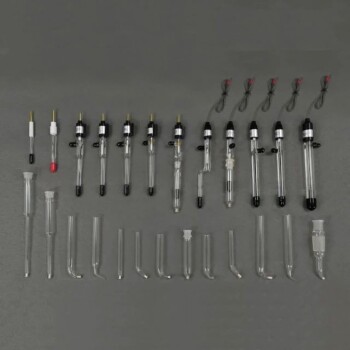
A combination of saturated Ag/AgCl and platinum wire electrodes is required to establish a precise three-electrode system that isolates the working electrode's electrical behavior. This setup ensures that the measured capacitance-voltage curves accurately reflect the semiconductor's properties, such as flat-band potential and carrier density, by providing a stable reference point and an inert path for current.
Core Takeaway: The Ag/AgCl electrode provides a constant, reliable potential baseline, while the platinum wire acts as a chemically inert counter electrode to complete the circuit. Together, they eliminate measurement errors caused by potential drift and electrode polarization.
The Role of the Saturated Ag/AgCl Reference Electrode
Establishing a Stable Potential Baseline
In a Mott-Schottky measurement, the system scans a range of voltages to measure capacitance. The Ag/AgCl electrode provides a highly stable and known electrochemical potential that does not shift during the experiment.
Ensuring Accuracy During Potential Scanning
Without a stable reference, the actual potential applied to the semiconductor would be unknown or floating. This stability ensures that the potential scanning on the working electrode is precise, which is critical for identifying the exact flat-band potential.
Minimizing Potential Drift
Because the Ag/AgCl electrode uses a saturated KCl solution, it maintains a constant chemical environment. This prevents potential drift, guaranteeing that the qualitative and quantitative data collected remains scientifically valid over the duration of the test.
The Function of the Platinum Wire Counter Electrode
Balancing the Charge Transfer Process
The platinum wire serves as the counter electrode (CE), which is responsible for completing the electrical circuit. It balances the charge transfer occurring at the working electrode, allowing the electrochemical analyzer to detect subtle electrical signals.
High Catalytic Activity and Conductivity
Platinum is chosen for its exceptional catalytic activity and high electrical conductivity. These properties allow current to flow through the electrolyte efficiently, facilitating necessary reactions like hydrogen or oxygen evolution without significant resistance.
Preserving System Purity
Because platinum is chemically stable, it does not dissolve or oxidize easily during the measurement. This chemical inertness prevents the introduction of metallic impurities into the electrolyte, which could otherwise interfere with the semiconductor's electrochemical evaluation.
Why the Three-Electrode Configuration is Essential
Eliminating Electrode Polarization
In a two-electrode system, the potential of the counter electrode can change as current flows, leading to "polarization." The three-electrode setup uses the Ag/AgCl electrode to measure potential and the platinum wire to carry current, effectively decoupling these two functions.
Accuracy of Mott-Schottky Plots
Mott-Schottky analysis relies on the relationship between 1/C² and the applied potential. Any error in the potential measurement directly distorts the slope and intercept of the curve, leading to incorrect calculations of carrier concentration and flat-band position.
Understanding the Trade-offs and Pitfalls
Maintenance of the Ag/AgCl Electrode
While Ag/AgCl is stable, the porous frit can become clogged or contaminated over time. If the internal KCl solution is not kept saturated, the reference potential will shift, leading to inconsistent data across different experimental sessions.
Surface Area of the Counter Electrode
The platinum wire must have a sufficient surface area relative to the working electrode. If the counter electrode is too small, it can limit the current flow, creating a bottleneck that introduces artifacts into the capacitance-voltage measurements.
Electrolyte Compatibility
In some non-aqueous or highly acidic/basic environments, standard Ag/AgCl electrodes may leak ions or react. Users must ensure that the electrolyte chemistry does not compromise the reference electrode's junction or lead to the precipitation of silver salts.
How to Apply This to Your Project
Recommendations for Experimental Success
- If your primary focus is high-precision semiconductor physics: Always use a freshly calibrated Ag/AgCl reference electrode to ensure the flat-band potential is accurate to within millivolts.
- If your primary focus is long-term material stability testing: Periodically clean the platinum wire with dilute acid or flame treatment to maintain its catalytic activity and prevent surface fouling.
- If your primary focus is testing in aggressive chemical environments: Consider using a "bridge tube" or Luggin capillary to protect the Ag/AgCl electrode from direct contact with harsh electrolytes.
By utilizing this specific electrode combination, you ensure that your Mott-Schottky measurements are a true reflection of the material's electronic structure rather than an artifact of the testing environment.
Summary Table:
| Electrode Type | Role in System | Key Benefit |
|---|---|---|
| Saturated Ag/AgCl | Reference Electrode (RE) | Provides a stable, constant potential baseline; prevents drift. |
| Platinum Wire | Counter Electrode (CE) | Completes the circuit with high conductivity and chemical inertness. |
| Three-Electrode Setup | System Configuration | Eliminates electrode polarization for accurate 1/C² plots. |
Elevate your electrochemical research with KINTEK’s precision-engineered solutions. We specialize in high-performance electrolytic cells and electrodes, including Ag/AgCl and Platinum options, designed to ensure the integrity of your Mott-Schottky measurements. Beyond electrodes, KINTEK offers a comprehensive range of battery research tools, high-temperature furnaces, and specialized ceramics to support advanced material science. Ensure your laboratory is equipped for accuracy and reliability—contact KINTEK today to find the perfect equipment for your specific application!
References
- Muhammad Abiyyu Kenichi Purbayanto, Agnieszka Jastrzębska. Ambient Processed rGO/Ti<sub>3</sub>CNT<sub><i>x</i></sub> MXene Thin Film with High Oxidation Stability, Photosensitivity, and Self-Cleaning Potential. DOI: 10.1021/acsami.3c07972
This article is also based on technical information from Kintek Solution Knowledge Base .
Related Products
- Electrolytic Electrochemical Cell Gas Diffusion Liquid Flow Reaction Cell
- Reference Electrode Calomel Silver Chloride Mercury Sulfate for Laboratory Use
- Glassy Carbon Electrochemical Electrode
- Graphite Disc Rod and Sheet Electrode Electrochemical Graphite Electrode
- Gold Electrochemical Sheet Electrode Gold Electrode
People Also Ask
- How does the design of an electrochemical electrolytic cell influence the coating uniformity? Optimize Your Catalysts
- What is the correct shutdown and disassembly procedure after an experiment? Ensure Safety and Protect Your Equipment
- Why are electrolytic cells essential in titanium production? Powering Circular Efficiency and Cost Savings
- What is galvanic cell or electrolytic cell? Unlock the Secrets of Electrochemical Power
- What are the three essential components that comprise an electrolytic cell? Key Elements of Chemical Synthesis