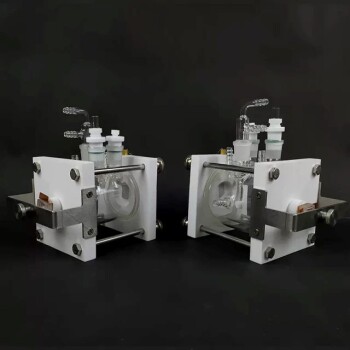
The primary necessity for a double-layer glass electrolytic cell is to manage the extreme thermal energy generated during the Plasma Electrolytic Oxidation (PEO) process. Because PEO involves intense electrical discharge on the metal surface, the electrolyte temperature rises rapidly, requiring an active cooling system to maintain stability and prevent coating defects.
Core Takeaway The double-layer cell functions as a critical heat exchanger, utilizing an external cooling circulation unit to hold the electrolyte at a constant temperature (e.g., 20 °C). This thermal control is the only way to ensure stable film formation, prevent structural cracking, and avoid the chemical degradation of the electrolyte itself.
The Thermal Challenges of PEO
Intense Discharge and Heat Generation
The preparation of cerium-doped magnesium-aluminum oxide coatings utilizes Plasma Electrolytic Oxidation (PEO). Unlike standard anodizing, this process relies on high-voltage breakdown that creates localized plasma on the substrate surface.
This intense discharge releases a significant amount of energy in the form of heat. This heat is immediately transferred to the surrounding liquid environment.
Rapid Electrolyte Temperature Rise
Without intervention, the heat transfer from the micro-discharges causes the bulk temperature of the electrolyte to spike.
Uncontrolled temperature changes alter the conductivity and chemical reactivity of the bath. This makes the coating process unpredictable and difficult to control.
How the Cooling System Stabilizes the Process
The Double-Layer Design
The "double-layer" glass construction creates a jacket around the main electrolytic cell. This allows for the circulation of a cooling medium, typically water, without contaminating the electrolyte.
This design effectively turns the reaction vessel into a heat exchanger. It continuously removes the excess thermal energy generated by the plasma discharge.
Maintaining Equilibrium
An external cooling circulation unit pumps water through the jacket to maintain a precise set point, such as 20 °C.
By clamping the temperature at a fixed value, the system ensures that the thermodynamic conditions remain constant throughout the entire deposition time.
Risks of Inadequate Thermal Control
Unstable Film Formation
If the temperature is allowed to drift, the rate at which the oxide film grows becomes erratic.
Variable temperatures lead to inconsistent coating thicknesses. This undermines the repeatability of the manufacturing process, making it impossible to produce identical batches.
Structural Defects and Cracking
Thermal stress is a major enemy of ceramic-like coatings. If the electrolyte becomes too hot, or fluctuates widely, the coating is prone to cracking as it forms.
Maintaining a cool, stable environment ensures the coating structure remains dense and uniform, preserving the integrity of the cerium-doped magnesium-aluminum oxide layer.
Chemical Degradation
High temperatures can degrade the electrolyte solution itself. This changes the chemical composition of the bath over time.
A degraded electrolyte cannot produce coatings with the correct stoichiometry or doping levels, rendering the solution useless for future runs.
Operational Considerations and Trade-offs
Equipment Fragility
While a double-layer glass cell offers superior visibility and chemical resistance, it introduces mechanical fragility. Glass components are susceptible to breakage during setup or cleaning compared to stainless steel or plastic tanks.
System Complexity
Implementing an external cooling circulation unit adds variables to the setup. Operators must monitor coolant flow rates and chiller performance, adding a layer of complexity to the equipment maintenance schedule.
Making the Right Choice for Your Goal
To successfully prepare cerium-doped magnesium-aluminum oxide coatings, the equipment must match the thermal intensity of the method.
- If your primary focus is Process Repeatability: Prioritize a high-capacity external circulation unit to ensure the temperature variance never exceeds ±1 °C.
- If your primary focus is Coating Integrity: Ensure the cooling jacket flow rate is sufficient to prevent localized hot spots near the cathode, which cause cracking.
Control the temperature, and you control the quality of the PEO coating.
Summary Table:
| Feature | Purpose in PEO Process | Impact on Coating Quality |
|---|---|---|
| Double-Layer Design | Functions as a heat exchanger jacket | Enables precise temperature equilibrium |
| Active Cooling System | Removes energy from plasma discharge | Prevents structural cracking and defects |
| Temperature Stability | Keeps electrolyte at constant ~20°C | Ensures uniform thickness and repeatability |
| Chemical Preservation | Prevents electrolyte overheating | Maintains stoichiometry and doping levels |
Precision in Plasma Electrolytic Oxidation starts with superior thermal management. KINTEK specializes in advanced electrolytic cells, electrodes, and high-performance cooling solutions (including ULT freezers and chillers) tailored for demanding battery research and material coating applications. Whether you are developing cerium-doped oxide coatings or exploring new electrochemical frontiers, our comprehensive range of laboratory equipment—from high-temperature furnaces to precision hydraulic presses—ensures your process remains stable and repeatable. Consult with a KINTEK specialist today to optimize your lab setup and achieve flawless coating integrity.
References
- Stevan Stojadinović, Nenad Radić. MgAl Oxide Coatings Modified with CeO2 Particles Formed by Plasma Electrolytic Oxidation of AZ31 Magnesium Alloy: Photoluminescent and Photocatalytic Properties. DOI: 10.3390/met14030366
This article is also based on technical information from Kintek Solution Knowledge Base .
Related Products
- H-Type Double-Layer Optical Electrolytic Electrochemical Cell with Water Bath
- Double Layer Five-Port Water Bath Electrolytic Electrochemical Cell
- Double-Layer Water Bath Electrolytic Electrochemical Cell
- Multifunctional Electrolytic Electrochemical Cell Water Bath Single Layer Double Layer
- Side Window Optical Electrolytic Electrochemical Cell
People Also Ask
- What is the overall structure of the H-type double-layer optical water bath electrolytic cell? Precision Design for Controlled Experiments
- How is the electrolyte managed in H-type electrolytic cells for specific reactions? Achieve Precise Control and High Purity
- What checks should be performed on the H-type electrolytic cell before use? Ensure Accurate Electrochemical Data
- What is important regarding temperature control for the H-type electrolytic cell? Ensure Precision and Data Integrity
- What is the overall structure of the H-type electrolytic cell? Understanding Dual-Chamber Electrochemical Designs